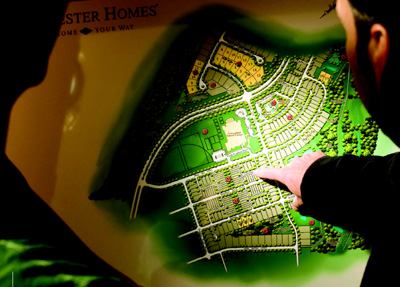
It is an unusually cold Saturday morning in Orlando, Fla. A winter wind kicked up overnight, and dirt is blowing everywhere from cleared home sites at Avalon Park, a neotraditional, mixed-use development several miles southeast of downtown. It is a great day to stay in bed with the newspaper and a hot cup of coffee.
At the Ryland Homes sales center for its newest phase, Northwest Village, the team of three sales consultants—Darci Brammer, Troy Alexander, and Maddy Rosado—and an assistant have arrived early to unlock the models and to check their to-do lists, a computer-generated task list of follow-up phone calls, e-mails, and letters that need to be completed that day.
They’re held accountable for finishing those tasks and staying in touch with customers for a full year beyond closing. Certain form letters are required, but the sales consultants are encouraged to also add their own personal touches along the way with handwritten thank-you notes, colorful postcards, birthday cards, or e-mails about something the customer mentioned, such as a child’s upcoming soccer tournament or dance recital.
Almost as soon as the doors open at 10 a.m., the sales center is packed with prospective buyers interested in the single-family homes and townhouses that are available. It’s so busy that even Leigh Tarullo, Orlando division vice president of sales and marketing, jumps in to help customers until one of the three sales consultants finishes up and can take over.
NO SPEEDING ALLOWED With this much traffic, it would be easy to hand visitors community brochures and floor plans and just point them toward the models. Instead, Brammer, Alexander, and Rosado spend time with each prospective buyer, asking them questions to narrow down the available floor plans that would fit their needs, finding out their time frame for purchase, and gently probing to learn about their qualification for financing.
It’s a big job. Ryland’s offerings in Avalon Park are diverse. Its townhouses range from 1,106 to 1,545 square feet and start in the $230,000 range, while the single-family options go as high as 3,113 square feet and are priced in the mid-$400,000s. As a result, the prospective buyers are equally varied. Mid-morning, Rosado greets a Hispanic couple with a young son (a full third of Ryland’s buyers in Orlando are Hispanic, Tarullo says, and while every sales consultant takes lessons in conversational Spanish, the company tries to have at least one staff member who speaks it fluently). The husband proudly says he is a welder who helped build the nearby high school; his family is renting an apartment, and they are ready to buy their first home. Since it’s a first-time buyer with one child, Rosado asks if they’re interested in a town-home. No, the wife says, the tender dream evident in her voice. “We want a house.”
Rosado then asks if they’ve gotten any information on mortgages. They haven’t. “I can help you with that today,” Rosado says, as she invites them into an office where they can close a door and discuss financing options. They come out smiling, and she escorts them to the models that she thinks are the best fit for what they want and what they can afford.
STEPPING STONES Brammer and Alexander, meanwhile, are busy talking to families at various stages of house-hunting. Brammer chats with a young man who is scouting homes for his parents who live up north in a 6,000-square-foot house and are planning to relocate to Orlando within the next several months. Since he’s not an actual buyer, it might be tempting to cut him short. But, as Tarullo points out, he’s their advance scout, and his treatment will determine which builders he recommends to them.
Alexander, a Texan with an easy smile, comes back from the models with another couple who have settled on a plan they like, but aren’t sure they’re ready to buy. He asks about the time frame of their purchase decision. He explains about the phasing of lot releases and price increases and asks if they’d like to go look at home sites. A moment later, they head out the door together to take a drive.
It’s all part of critical path selling that is standard procedure at Ryland, Tarullo says. “It’s like stepping stones,” she says. “You don’t have to go down the path the same way every time, so long as you touch each stone along the way.”
Learn more about markets featured in this article: Orlando, FL.