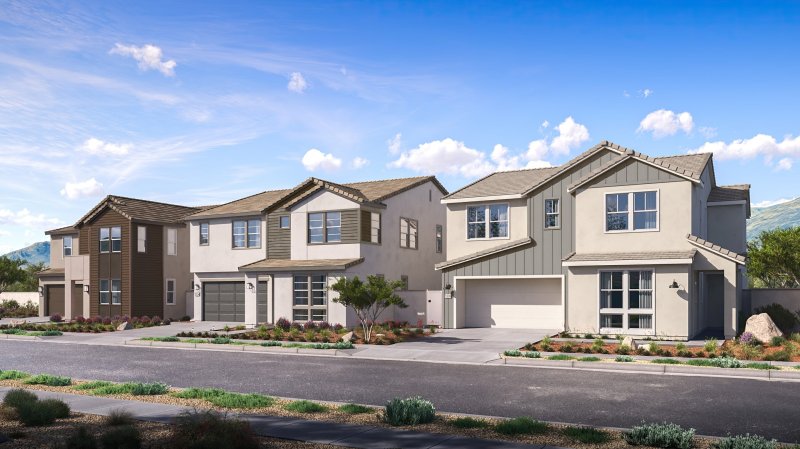
Lennar’s third quarter results underscored how quickly expectations for a housing market rebound have faded in 2026. Rising mortgage rates, persistent inflation, weakening consumer confidence, and geopolitical tension have combined to create an increasingly difficult environment for builders during the year.
For Lennar, the No. 2 company on the 2026 Builder 100 list, the challenging backdrop translated into a 3% decline in deliveries to 20,840, a 9% decline in orders to 20,879, a 6% decline in home sales revenue to $7.7 billion, and a 50% decrease in profit per share to $1.19 compared to results from the third quarter of 2025. .
“This was a quarter of execution within a market that moved against us. Rates went up, inflation ran hotter than hoped, resale supply got heavier, and through all of that we delivered inside our range, brought incentives down, set a cycle time record, and reduced standing inventory, while owning almost none of our land,” CEO Stuart Miller noted during the builder’s earnings call.
Emerging Resale Competition
While Lennar took steps to improve operational metrics, cycle times, inventory turns, and construction costs during the quarter, Miller noted the return of resale inventory is a growing external challenge for the company.
“The resale sector has become a more aggressive competitor for customers, especially at our price range,” Miller said. “Resale supply has continued to rebuild and is now very competitive in price.”
Active listings have climbed to high levels in many markets, with Texas and Florida, Lennar’s two largest states of operation, experiencing particularly elevated levels of resale inventory. Against this backdrop, Lennar has responded with pricing adjustments and incentive offerings to remain competitive with the resale market.
“When a resale seller cuts price, they are competing directly for our customer and we respond, which is a meaningful part of the incentives and pricing dynamics you see in our South Central and Southeast market.”
Volume Over Margin
Rather than pull back in the face of difficult market conditions to protect margins, Miller reiterated Lennar’s commitment to maintaining volume. Lennar’s focus on even-flow production helps maintain sales and construction volumes even when demand weakens.
Miller argued that maintaining volume allows Lennar to continue reducing construction costs while simultaneously working through land positions acquired when market conditions and pricing assumptions were much stronger than they are today.
“We offer the incentives our customers need to achieve the value they can afford and we hold our production pace through the adjustment. That means we are compromising margin in order to maintain volume,” Miller explained. “We understand this is a choice, it is deliberate, and it is not something the market is doing to us. It is a strategic choice that has enabled us to drive construction costs down and to financially transform our business model and our balance sheet.”
Rather than waiting for rates to decline or affordability conditions to improve, Lennar believes maintaining volume allows it to continue reducing costs while generating cash from land purchased when prices and margins were materially different.
Miller pointed to the company’s performance since late 2023 as evidence the strategy is working. During that period, revenue per square foot has declined approximately 13%, but construction costs per square foot have fallen roughly 14%, effectively offsetting much of the impact from lower pricing.
Even-Flow Production
Central to Lennar’s strategy is what management refers to as “even-flow” production, a model designed to keep starts, sales, and deliveries moving at a consistent pace regardless of broader market volatility.
During the third quarter, Lennar generated 20,879 orders, delivered 20,840 homes and started just under 21,000 homes. The company reported both a sales pace and start pace of 4.1 homes per community per month across its 1,713 active communities.
Miller said that balance is critical to maintaining operational efficiency throughout the organization.
“By maintaining volume, we have improved execution across numerous key metrics,” he said.
The builder continued to make progress on several operating measures during the quarter. Construction costs per square foot declined 1% sequentially and were down 6% year over year. Cycle time improved to a record-low 116 days, down from 121 days in the second quarter and 126 days a year ago.
The builder views those metrics as evidence that consistent production creates efficiencies throughout the building process, from labor utilization and purchasing power to cycle time management and inventory control. Rather than reducing starts in response to weaker demand, Lennar believes maintaining a steady production cadence enables the company to lower costs and strengthen its competitive position.
“We are not waiting for the market to rebuild our margin,” Miller said. “One quarter at a time, at a pace we control, we are replacing it with land priced for this market condition.”
Land Challenges
Miller argued the company’s largest margin challenge today is land, particularly land that was identified and underwritten in a very different housing market. Much of Lennar’s current land portfolio was acquired when home prices, margins, and market conditions were considerably different than they are today. As a result, the builder is selling homes into a weaker market while carrying land costs that reflect an earlier environment.
With each home Lennar closes, Miller argued, it effectively retires a homesite acquired under those earlier assumptions and generates cash that can eventually be redeployed into land priced for today’s market. Lennar views that process as a critical reason to maintain sales pace and production volume despite lower margins.
“Every home we close retires a homesite that was priced for a market that no longer exists and frees us up to replace it with a homesite priced for the market that we actually have,” Miller said.
Miller acknowledged the strategy comes at the expense of near-term profitability, but argued slowing sales in an attempt to preserve margin would leave the builder carrying higher-cost land positions for a longer period of time.
“The alternative, holding price and selling fewer homes, leaves us carrying the same expensive land for longer and generating less cash,” Miller said. “We made the decision deliberately. We have been consistent about it every quarter.”
As Lennar works through older land positions, the company continues advancing its yearslong push toward an asset-light, land-light operating model.
In the third quarter, Lennar owned just 2% of its homesites and controlled the remaining 98% through a third party. Chief financial officer Diane Bessette noted that keeping land off-balance sheet helps reduce risk, particularly in a period of uncertain housing conditions.
“Approximately 86% of the homes we delivered this quarter came from land-banked land, which is the model working exactly as designed,” Miller said.
Lennar also remains focused on limiting exposure to completed inventory. To this end, the builder reduced completed, unsold homes to 1.8 homes per community during the third quarter, down from 2.1 homes per community in the second quarter and 3 homes per community in the third quarter of 2025. The builder maintains this approach will leave the company better positioned when affordability improves and housing demand accelerates.
“We are not going to carry standing homes into a soft market, and we are not going to carry land on our balance sheet,” Miller explained.