Few builders can claim the market dominance and longevity of McBride Homes. After nearly 80 years in business and more than 40,000 homes delivered, the company continues to grow while remaining privately owned and locally led.
For CEO Jake Eilermann, that combination of long-term thinking, operational control, and deep community roots has been central to McBride’s success. Below he shares how the No. 76 builder on the 2026 Builder 100 is navigating today’s housing market and preparing for the opportunities ahead.

Courtesy McBride Homes
Jake Eilermann
What do you think has been the key to staying relevant and growing through so many different housing cycles?
The simple answer is keeping customer satisfaction our top priority. Our customer focus is a factor in our decision making for every aspect of the building process, from land acquisition to design. Trending design preferences may be different across housing cycles, but our commitment to quality construction, affordability, and finding A+ locations doesn’t change. Three generations of St. Louis families have now bought a McBride home, and that kind of trust only compounds if you stay disciplined through the down cycles as well as the up ones.
Holding the largest market share of any builder in the St. Louis market, how do you maintain that leadership position in such a competitive environment?
As Missouri’s largest home builder, one of McBride’s greatest strengths is the scale of our operations, long-standing trade and vendor partnerships, and a diversified portfolio of communities that keep us insulated when one submarket slows down. We build homes from the low $200,000s to well over $1 million, which ensures we’re not overexposed if market conditions change, and can adjust our strategy for wherever buyers are showing up. That combination of scale and range is hard for a single-price-point competitor to replicate.
Because McBride isn’t answering to shareholders every quarter, how does that influence the decisions you make and the way you run the business?
We’re not managing our strategy around a quarterly earnings call, so we can hold back on housing starts when the market calls for discipline rather than pushing volume to hit a quota. Take this year for example, we’ve prioritized healthy margins and aligning production with demand rather than pursuing growth at any cost. It also means our land strategy can be more selective, focusing on locations that align with long-term priorities, instead of chasing whatever’s available this quarter.
Described as a locally driven company with decisions made by people who live and work in the market. Why is that local connection so important, especially as more national builders expand into regional markets?
National builders can replicate a floor plan, but they can’t replicate 80 years of knowing which school districts, commute patterns, and submarkets St. Louis buyers actually care about. That knowledge shows up in how we operate—every community we enter gets a tailored approach. Our team works directly with local governments and city councils early in the process to understand what that specific area needs. As more national builders expand into regional markets, that local fluency becomes the differentiator, not the floor plans or the financing.
How does controlling more of the home building process translate into benefits for buyers?
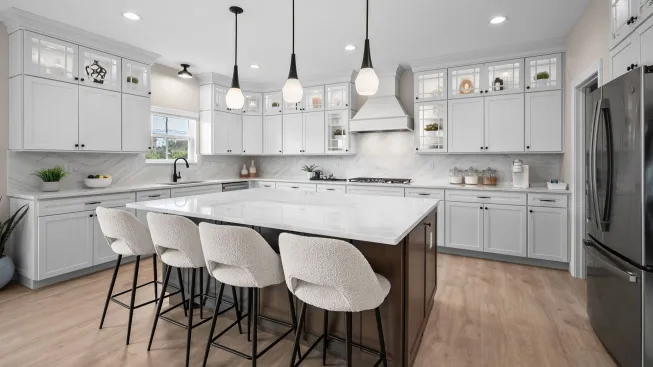
We’ve brought more of the process in-house over time from land development to purchasing and design. All of those decisions benefit the buyer with either lower costs or by guaranteeing more certainty and consistent quality for them. Our Design Studio, a 10,000-square-foot facility, gives buyers a level of personalization control that’s usually reserved for luxury builders. We’ve built it into the process at every price point, not just the top end.
Courtesy McBride Homes
How is McBride balancing rising costs with its mission to provide value across a wide range of home styles and price points?
The June NAHB study found regulatory costs alone now add more than $130,000 to the price of an average new home, roughly a quarter of the purchase price and up sharply over the last five years. We can’t control those costs, so we focus on what we can: discipline in land acquisition, so we’re not chasing every parcel just to keep volume up. That discipline is what lets us keep offering a full range of styles and price points.
Across the St. Louis region, what trends are you seeing in where buyers want to live and the types of neighborhoods they’re seeking out?
The clearest trend is buyers moving further out of the city for value, but without giving up access. Our “Next Exit” strategy is in response to this move, targeting exurban markets with strong job growth and interstate access. We’re also seeing sustained demand for quick move-in homes across our communities. Quick move-in homes make up roughly 40% of our business, signaling that buyers want the certainty of a known price and closing date rather than waiting out a nine-month build.
The company has expanded beyond St. Louis into other Missouri markets. What lessons from your success in St. Louis have been most transferable to those newer markets?
The core lesson travels well: know the submarket before you build. Our Next Exit strategy is built on that idea—rather than dropping a standard product into a new zip code, we study local job growth, interstate access, and land costs, then work with local governments early to shape a development that actually fits the community. That discipline is what allows us to extend the McBride approach into new Missouri markets like Phelps and Crawford County and, this year, Jefferson City and Ste. Genevieve. We’ll apply the same playbook to wherever we grow next.
How has the home buyer experience evolved in recent years, and what are today’s buyers prioritizing most?
Buyers are more informed and more schedule-driven than they used to be. That’s part of why quick move-in homes have grown to roughly 40% of our business. When you have 200-plus homes under construction at any time, buyers get new-construction certainty on a timeline that competes with resale. At the same time, they still want personalization, which is exactly what our Design Studio is built for. We’ve also noticed that buyers are increasingly looking to price in the total cost of ownership, not just the purchase price. Our 10-year structural warranty plan and scheduled warranty visits at one and 11 months matter just as much to them as the floor plan does.
What opportunities are you most excited about for McBride over the next five to 10 years, both in St. Louis and beyond?
Inside St. Louis, we’re excited to continue proving that a builder can serve the full spectrum of buyers, from entry-level and first-time buyers to high-end luxury, without picking a lane. We’re also excited to continue bringing new development to areas that have gone several years without it. Beyond St. Louis, we’re excited to continue scaling our Next Exit strategy responsibly, expanding into new markets while building on the strong foundation we’ve established. We see this as a steady, sustainable path for growth over the next five to 10 years, allowing us to continue growing beyond our current 800-plus homes annually while maintaining the quality and reputation McBride has built over nearly 80 years.