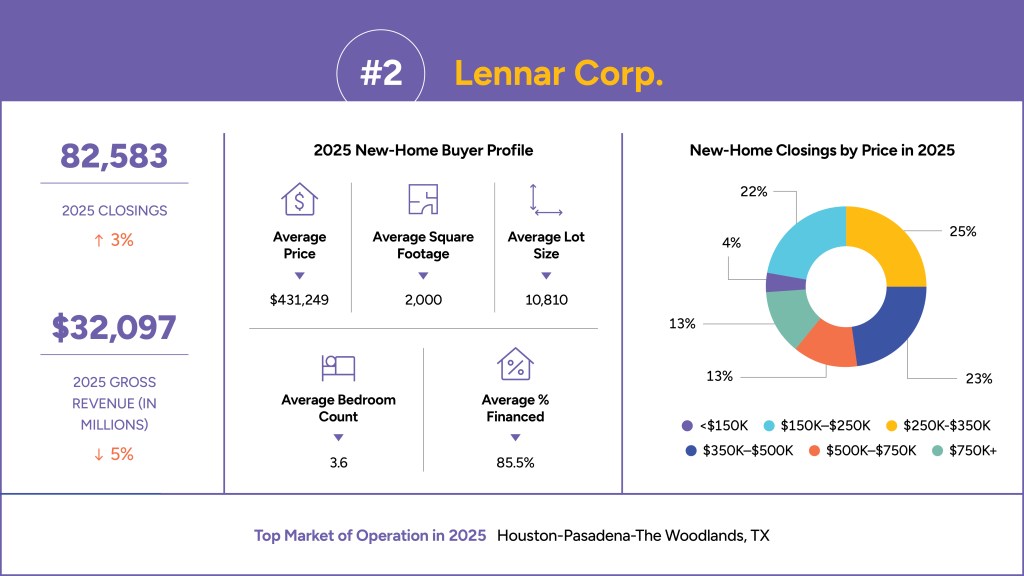
Lennar’s operating model is centered on consistency, capital efficiency, and scale. The builder has placed an emphasis on even flow production, prioritizing steady starts and sales rather than reacting sharply to market swings. Even amid a challenging 2025 housing market, Lennar grew closings by 3% to 82,583.
In 2025, Lennar also continued its pivot toward a land-light model. The builder’s spin-off of Millrose Properties at the end of 2024 was a continuation of Lennar’s volume-based strategy, allowing the builder to hold more land off balance sheet. As recently as the first quarter of 2026, Lennar now holds less than 5% of its land on balance sheet, reducing home building inventory from $20 billion two years ago to $10.5 billion.
Underlying these two strategic pillars is a focus on operational consistency and technology integration to enhance construction processes and the customer experience. Lennar’s vertical construction costs have declined by 10% over the past two years alongside measurable gains from technology initiatives that are improving cycle times.
Lennar is also managing incentives, driving down costs, and preserving its volume. While margins remain pressured due to elevated incentives, CEO Stuart Miller said the company is prepared to pivot when pent-up demand is reactivated. Lennar has a portfolio spanning 30 states and more than 1,700 active communities and is integrating new markets inherited from its 2024 acquisition of Rausch Coleman.
“Our numbers are not yet where we’d like them to be, but the trajectory is just right,” Miller said. “Costs are coming down, volume is holding. Our asset-light platform is functioning extremely well, and technology initiatives are beginning to yield real and measurable results.”