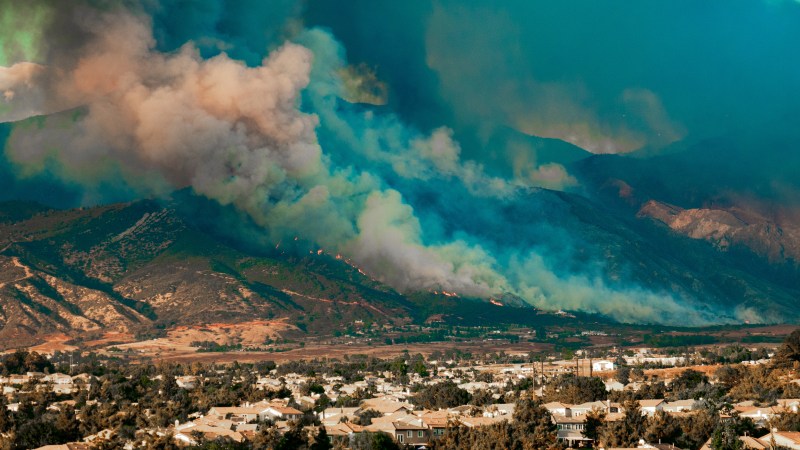
Fire season is once again upon us, arriving after the one-year anniversary of the devastating wildfires that swept through Malibu, Eaton, and Pacific Palisades in California. Those fires killed at least 27 people, destroyed more than 15,000 structures, burned roughly 63 square miles, and caused an estimated $275 billion in economic damage.
As climate conditions continue to intensify wildfire risk, the home building industry is uniquely positioned to design and construct homes and communities that are more resistant to fire. Wildfires are a natural but unavoidable part of life in certain regions across the U.S., and recent events, like the current Sandy Fire in Southern California, have underscored how dry conditions, high winds, and scrub vegetation can combine to create catastrophic outcomes.
Osvaldo Joya, director of pre‑construction at LJP Construction Services, outlines five fundamental principles builders and developers should be considering when working in fire‑prone areas.
What areas of a home’s construction are the most important for resilience?
Roofs: The most effective defensive element for improving a home’s wildfire resiliency starts with the roof. Wildfires generate high winds and wind‑driven embers, and homes that can resist ignition from embers have a higher chance of surviving nearby fires. Metal roofs, as well as slate, clay, or concrete tile roofs, are classified as Class “A” under building and residential codes. Because the roof is the most exposed portion of the structure, a Class “A” roof greatly reduces the risk of ignition and can potentially save the home. Installing ember‑resistant metal vents and screens further increases roof assembly resistance.
Windows: Dual‑pane windows and skylights offer better protection against shattering when exposed to intense heat. While they are not fire‑rated or tempered glass, dual‑pane assemblies perform better than single‑pane windows and can provide valuable time for firefighters to respond before breakage occurs. Once windows fail, embers can easily enter the home and cause catastrophic damage.
Exterior walls: Non‑combustible exterior cladding materials significantly reduce risk. Cement plaster (stucco) and fiber‑cement boards are popular, cost‑effective alternatives to wood siding and are more resistant to ignition from embers and nearby flames.
Chimneys: Chimneys and stovepipes should be covered with an approved spark arrestor.
What are the biggest mistakes home builders make at the individual home level? What are they doing wrong—and what are they getting right?
One common mistake is building perimeter fences out of combustible materials with minimal clearance, especially when shrubs are planted near property lines. Non‑combustible fencing materials, such as concrete, brick, or stone, or the use of heavy timber, are better suited to delay or prevent fire spread between homes. If wood plank fences are used, they should be separated from house walls by a minimum of 5 feet, with the intervening space kept clear of vegetation, particularly shrubs or trees that contain natural oils or resins.
On the positive side, more builders are using non‑combustible cladding materials. Cement plaster and one‑coat stucco systems over insulation boards resist ignition from embers or nearby vegetation fires.
Builders could also do more to incorporate residential fire sprinkler systems. Although expensive, if extreme fire protection is desired, adding a residential fire sprinkler system to a home can significantly improve its chances of surviving a fire. The sprinkler system can also include outside elements that partially activate once fires start adjacent to the property, within the “defensible space” around the house for maximum efficacy.
What are the best practices for fire prevention at the community level, including access, defensible space, and density?
In high‑risk fire areas, especially those with single‑road access, less dense housing patterns are preferable. Increasing the spacing between homes can slow fire spread and make fire‑scaping strategies more effective.
Fire‑scaping involves reducing fire risk through strategic vegetation choices. Builders and communities should avoid plants, shrubs, or trees with natural oils or resins, such as pines and eucalyptus. Instead, select evergreen plants that do not shed large volumes of debris at once or plants with high water content, including succulents, cacti, and aloes. These plants can help create a fire barrier against wind‑driven embers.
A 10‑foot defensible space should be maintained around homes, using low‑growing, fire‑resistant plants and limiting the use of trees or large shrubs near exterior walls. On sloped sites, that defensible distance should be increased, as fire moves more rapidly downhill. Community HOAs should also maintain regular irrigation, trimming schedules, weed removal, and early cleanup of fallen leaves and flowers.
Communities should be designed with wide roads and driveways to allow fire department access, even when cars are parked along streets, and should ideally include two exit routes to prevent blockades in case one roadway is blocked or becomes unsafe.
In addition, an owner‑driven initiative known as the Wildfire Prepared Home designation program is available in many states, with more being added. Owners and developers follow a checklist, submit eligible photos, and undergo third‑party evaluation. Homes may earn either Base‑essential or Plus‑enhanced designations, and entire neighborhoods can also qualify. The program employs many defensive strategies already mentioned.
What are the biggest mistakes developers make at the community level—and what are they doing right?
High‑density development in high‑risk fire zones or communities with single‑road access is a significant mistake. Greater spacing between homes allows for better fire‑scaping and improved defensible space.
Some developers are successfully incorporating fire‑scaping strategies by avoiding high‑resin vegetation and selecting evergreen or high‑moisture plants instead. Maintaining a 10‑foot defensible zone with low‑growing, fire‑resistant plants continues to be an effective community‑level strategy.
Fencing materials also remain an opportunity for improvement. Non‑combustible fencing, or heavy timber, should be specified. When wood fencing is used, maintaining at least 5 feet of separation from building walls and keeping that zone clear of vegetation is critical.
Are there higher costs associated with these fire‑resilient strategies? What challenges remain?
Some strategies do come with added costs, while others do not. Thoughtful fire‑scaping can actually reduce overall expenses. Fire‑resistant roofing can often be achieved with minimal cost increases when incorporated early in planning.
Many fire‑resilient strategies are already included in current building codes. Others—such as widening community roads, improving access, and reducing density—require early coordination among developers, designers, and local officials. While challenging, these efforts are well worth the investment.