Time for Design
A slower pace, streamlined choices, and more education lead to higher options sales at Ryland Homes in Phoenix.
It's 8:30 a.m. on an unusually chilly Friday morning in Phoenix, and Kevin and Tiffany Kucifer are due to arrive shortly at the Ryland Homes' design center to select options and upgrades for their new home. They're buying the Sonora, a two-story, four-bedroom, 2 ½-bath model with a large upstairs bonus room and a first-floor den, in Ryland's Sunset Farms Vista in Tolleson, Ariz. At 2,886 square feet, it's the largest home available in the community. They're also installing a pool.
Designer Wade Van Dine has told them ahead of time to plan on being there for the day—and they'll need every minute of it. They are concerned that they haven't met with their mortgage counselor yet to know how much money they can spend. This is an anomaly in the process, but the Kucifers had been called out of town suddenly with a death in the family and couldn't meet with him before their appointment. Van Dine knows this, and says that they have a sizable budget with their incentive dollars. Their mortgage counselor works in the same office suite and will stop by to see them later in the day.
He recommends that they pick out what they want, and they can make adjustments as needed. He also explains that for each option category, he'll show them standard items and the available upgrades, grouped into price points from low to high. He'll also point out the pros and cons of the choices, including upkeep and impact on resale value. They're comfortable with that, and they're ready to start.
WHOLE NEW BALLGAMEIt's a big change from the crazed days of the real estate boom, when four designers each juggled two appointments a day, gently but firmly pushing buyers through their selections.
“In 2005, it was almost a factory line,” says Ryland sales manager Emilio Garcia. “A market like this is beneficial to buyers. They get a lot more time to make their choices.”
Now, while sales are down, the amount of money that customers are spending on options and upgrades is up, says design center manager Virginia Richards. On average, customers are spending 10 percent more in the design center than they did when the market was booming, she says. In the boom times, many of the buyers were investors who chose standard grade on everything. The buyers now are buying for themselves, and they recognize that they're creating their dream home. They're thoughtful about their choices and willing to spend money to get their heart's desire.
They're much more focused, Richards says, and, thanks to cable networks such as Home and Garden TV, they want more for their homes.
With the relaxed pace, Van Dine and fellow designer Carla Arger each do no more than one appointment per day. (The other two designers have moved to other divisions or departments at Ryland.) They can take their time, get to know their buyers' lifestyles, and help them make decisions that customers will be happy with for years to come.
The Kucifers are new in Phoenix, having moved here from Virginia Beach, Va., the previous summer. She is a registered nurse in a pediatric cardiac care unit; he is in medical equipment sales. They have a 6-year-old daughter and cats. This is the first time they've ever bought a new house.
It's all important information for Van Dine, who has worked at Ryland for five years. The first and most important decision of the day is flooring because it costs the most money of all their options (except for the pool) and is the most permanent. If they'd said they had dogs instead of cats, for example, he would have strongly suggested they rethink their choice of hardwood floors. As it is, he takes time to explain how the floors will wear and how they could be damaged. They spend a long time choosing carpet, with a discussion that includes Kool-Aid cleanup. Van Dine, a dad with three young children, has been there. The couple ultimately chooses the same style of carpet he has in his own house.
“It's like they have a family working with them,” Richards says.
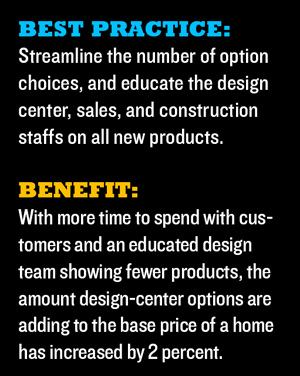
STREAMLINING CHOICESWhile the Kucifers comment on the number of choices they have, they don't realize that Richards and the design team have done a lot of the heavy lifting for them ahead of time. When Richards took over as manager in 2003, one of her first tasks was to streamline the number of options. She asked vendors to identify their top 10 sellers in the market. She asked the designers to pick out Ryland's top 10 sellers as well. Everything else was taken off the shelves. Lighting and plumbing fixtures, once sold individually, were combined into whole-house packages, dramatically cutting the decision-making process.
With the streamlined choices, Ryland now only offers customers options that can go in an inventory home. With the number of cancellations the market has experienced, it's critical that Ryland be prepared to resell any house that's under construction. That means that while the Kucifers have plenty of choices for carpet, tile, and countertops, they're all safely within the neutral color palette that consistently sells in the Phoenix market. And like virtually all of Phoenix's production builders, Ryland doesn't sell paint, Richards says. The interior will be a cottage white that coordinates with any color combination.
From there, it's on to cabinets (they choose spice cherry) and countertops (granite), and then to see John DeArmond with Dennis Sage Home Entertainment, one of the two outside vendors who work in the design center (the other is Joe Ayers with Paddock Pools). When the Kucifers arrive to meet with DeArmond, he already has their floor plan pulled, along with the available options. They understand that pre-construction is the best time to install options such as structured wiring, surround-sound speakers, a security system, and central vacuuming.
By the end of the day, they'll also choose appliances, lighting and plumbing packages, doors and door hardware, cabinet hardware, stair rails, window coverings, their pool package, and their favorite, the kitchen backsplash. Initially, they wanted the same elaborate tile back-splash they'd seen in the model. Van Dine explains that it probably will push them way beyond what they wanted to spend. Together, they design a backsplash that will be very unique, including accents of iridescent mosaic tiles. They are, to put it mildly, thrilled with the results.
ON-GOING EDUCATIONOne of the reasons for the Kucifers' delight is a group of regular exercises that occur in the design center, Richards says. Once a week, the designers all spend a day in a community, talking to the sales consultants and walking the models and all the houses that are under construction. They see what's selling and how selections work out in the field. Richards also watches the designers' sales figures. If a designer's sales are weak in a particular category, she sends that designer out to shop the competition and has them come back and report to the design center team. “If [the designers] don't see the value in a product, they won't sell it,” she says. The staff also participates in a market-wide design center roundtable, which sponsors ongoing education and provides a forum for problem-solving.
Training isn't limited to the design center staff. All new sales consultants spend a day in the design center, walking the same process their buyers will go through. Plus, when a new product is introduced, Richards arranges training for sales consultants, construction superintendents, and warranty staff. Every two weeks, she meets with the purchasing staff to iron out any difficulties, such as finding substitute items for products that have been discontinued.
Collectively, it's a good practice in a soft market because it keeps everyone up to date on what products are available in the market and helps the designers sell the value of the options. It also assures appropriate pricing and helps everyone at Ryland provide customers with consistent information.
A LEISURELY PACEAt least twice during the day, Van Dine asks the Kucifers if they want to break for lunch. It's not unusual for the designer to order in food or send someone out to pick up lattes. The couple opts to keep going, grabbing snacks from the design center's demonstration kitchen, which is well-stocked with fruit, granola bars, yogurt, bagels, and pastries, as well as coffee, soda, juice, and bottled water.
By the end of the day, they say they are feeling a bit of sticker shock about how much money they've spent, but they feel they were well-prepared for the process and are very excited about the choices they made. Van Dine goes over all their selections with them one last time, gets their sign-off on everything, and tells them they'll be getting carpet, wood, and tile samples in the mail within a few weeks. They'll also get a call when it's time to pick out the granite slab for their kitchen countertop.
It's almost 5 p.m. when they're finished.
“The house is going to be great,” Kevin tells Tiffany.
Richards smiles as they leave. She's glad that they're happy with the choices they've made, and with the revenue their purchases will bring the division. Even though the Kucifers had a long day, the decision-making process was simpler because there were fewer selections within each product category. It was more effective because Van Dine's training helped him explain how each selection would work in the house. And if something were to happen to the deal, there's nothing in the house that would make it tough for Ryland to resell. But that's not likely to happen now that the couple has made such an investment in making it their own.
“We do the emotional tie-down,” Richards explains. “They'll talk about that backsplash and the carpet. They'll carry the samples around with them for weeks. It's not a house now. It's a home.”
OPTIMIZE OPTION APPOINTMENTSFollow these tips to help customers have a better design center experience:
SET THE PROPER EXPECTATIONS. Most buyers dramatically underestimate how much time it takes to select options. Tell them what to expect time-wise and what they need to bring, such as their checkbook for deposits.GET TO KNOW THEM. Have buyers complete a lifestyle survey to help guide the selection process.HELP THEM DREAM. Recommend to buyers that they make a wish list and start with what's most important to them. Then, if they go over budget, they'll get the items they really want and the things they have to cut won't seem like a sacrifice.DON'T MAKE THEM FEEL POOR. Everyone has a budget; establish it ahead of time and respect it. Don't offer upgrades that are clearly out of their price range.MAKE IT KID-FREE. Strongly encourage buyers to make arrangements for child care if at all possible. Kids can get tired, bored, and cranky, which results in buyers being distracted and rushing through their decisions.MANAGE THE MUNCHIES. Have an assortment of healthy snacks to keep buyers alert and engaged. Make sure you include diabetic-friendly items, such as cheese and nuts.LET THEM HANG OUT. Offer browsing hours before the big day so they can narrow down choices ahead of time.- Pat Curry