Find your cause. find yourself. These phrases greet those who enter John Laing Homes’ corporate headquarters office in Newport Beach, Calif. They’re the company’s call to service, encouraging employees to get involved in their communities. On this day in mid-October, they’re on a poster advertising an upcoming episode of Extreme Makeover: Home Edition, in which Laing’s Sacramento division and dozens of other company employees built a new home for a woman and her seven disabled children.
An ethos of service courses through John Laing Homes. The company is generous with its financial donations—it poured at least $1 million into the Extreme Makeover project—but those dollars are matched by employees’ time and energy, whether on a project of size and scope large enough for national television or involving small, local charities.
It’s a good thing the company is so well grounded, because it has been flying high with the boost from California’s tremendous boom market. (Nine of the company’s 11 divisions are based in the Golden State; the other two are in Colorado.) In 2004, the company booked more than $1 billion in revenue, up from $600 million just two years earlier.
On the cusp of 2006, John Laing Homes is in transition. Some of its markets are showing signs of cooling. At the same time, the company is positioning itself to take advantage of some of the biggest trends in home building, including urban projects. Executives say they’ll manage the changing dynamics by remaining true to the strong traits that made the company one of America’s Best Builders this year: smart deals, careful management of people and resources, and attention to customers’ needs.
8:30 A.M.: SOUTH COAST DIVISION MEETING
“We want to be the best home building company in America,” declares Larry Webb, John Laing Homes’ CEO. Despite winning this award, he doesn’t think the company’s there yet. “Every division has things to improve. You can always do better,” he asserts.
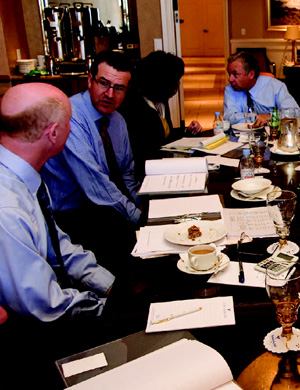
And so sets the table for the 11 meetings Webb will conduct over several weeks in October to discuss each division’s business plan for the next three years. Each division presents its plan over several hours while being peppered with questions from Webb, CFO Wayne Stelmar, and Bill Probert, vice president of sales and marketing.
“We challenge people, and we argue,” Webb admits. “I try to put people on the spot. We ask questions. But we leave better for it.”
Top managers from the company’s South Coast division sit at the conference table today. It’s one of Laing’s largest divisions and builds throughout Orange County, where prices have risen dramatically in recent years. The South Coast division’s attached homes start in the $500,000s; detached prices climb into the low million-dollar range.
Webb spent time over the weekend reviewing the division’s 4-inch-thick business plan binder, and he starts the meeting with his big-picture take on the plan, which he says fits with much of the company. “Your division exemplifies this more than others,” he says. “A very strong 2005, a solid 2006—everyone’s being conservative, rightfully so—and a drop-off in 2007, with good expectations for 2008.” The division’s plan also fits into a growing trend for the company toward higher-density, more complicated projects, he adds.
But first, they must look back. Steve Kable, the division president, describes 2005 as “one of the easier years.” The division surpassed its goal of 397 closings for the year; it will finish 480 homes, for $340 million in revenue.
That tally puts the South Coast on top of the other 10 in terms of revenue. The Sacramento division built more homes, but at lower prices. The competition between divisions is real, Webb says later. But, he adds, “It’s less who makes the most money and more about who earns the highest customer service scores and how well they operate their divisions. They share, but they also want to win.”
A walk around the corporate suite proves how often they win: Awards line bookshelves throughout the office. The newest set of trophies came from Eliant, an independent market research firm that crowns customer satisfaction winners among home builders. Six of John Laing’s divisions placed in Eliant’s top 10 in 2005. What’s more, in J.D. Power’s widely publicized study, the South Coast division tied for the highest customer satisfaction scores in Orange County, and the Denver, Colorado Springs, and Los Angeles divisions all placed within the top three in their markets.
9:55 A.M.: SALES AND MARKETING OUTLOOK
Linda Mamet,
the South Coast’s vice president of sales and marketing, looks ahead to
2006 with “cautious optimism,” she says. The division is nervous about
the effect rising interest rates may have on already dismal
affordability ratios, but the broader outlook remains positive thanks to
strong job growth and housing demand.
Those same concerns cut across most of the company’s divisions. As markets change, CFO Stelmar reminds employees that they’ll need to emphasize the Advantage program, which includes processes and measurement metrics for five key areas: leadership, land, sales, people, and customer care.
The Sales Advantage program sets out the builder–buyer relationship. Its in-house materials talk of “dating,” “popping the question,” and “planning the wedding”—all nicknames for the company’s marketing strategies designed to court and land buyers. In the process, sales team members follow two tracks, concentrating the most effort on top prospects while continuing contact with lesser prospects to generate a backlog of possible buyers.
10:30 A.M.: BUDGET LINE ITEMS
Webb
quizzes managers about their anticipated general and administrative
costs. “I just want to make sure you are worrying about it, that you’re
not taking it for granted,” Webb says. “You could bury anything with the
last few years,” he adds, alluding to the financial cushion the flush
times have provided.
It’s a theme that runs throughout discussions with Webb and many of his employees: Change is coming. That’s why Stelmar earlier stressed the need to rely on the Advantage program, and why he tells the group now, “I would rather see dollars invested in the front end of the business than at the back to fix things that didn’t go right the first time.”
Webb is confident that the systems in place and the strength of his division executives—there’s been no turnover at the president level for four years—will help carry the company through potentially tougher times. He’s also hedging through geographic and product diversification. Laing has added divisions in San Diego and San Francisco, and others designed to target urban and upscale building. The product mix within existing divisions is shifting too. “Two years ago, Orange County (South Coast) did suburban tract building. Now, it’s more infill,” Webb says. “We’re adapting to changing market conditions.”
11:45 A.M.: LAING LUXURY KICKOFF MEETING
Laing
Luxury was born in 2002 as part of that diversification plan. The
division builds houses priced at $1 million and up (that “up” will soon
reach $6 million) between Los Angeles and San Diego. While many of the
company’s competitors also build high-end homes, Laing believes it has a
one-of-a-kind division devoted to delivering luxury product.
Laing Luxury is the sole division to share office space with the corporate staff. Today, while the South Coast division wraps up its meeting a floor below, Laing Luxury managers, market research and design consultants, and an architect have gathered to talk about a potential project of 84 homes in La Quinta, south of Palm Desert.
The land hasn’t been bought yet. This session is designed to brainstorm what might be possible with it. That the group knows its buyers well shines through: They debate whether tennis courts will be needed in the community when so many buyers would already belong to private tennis clubs and agree that private dipping pools would likely hold more appeal than a larger, communal pool.
The company builds in a cushion for start-up divisions. It gave Laing Luxury about three years to get to full speed building between 100 and 150 homes a year, a metric the division will just about hit in 2005 (in mid-October, it estimated 97 closings for the year).
1 P.M.: TUSTIN FIELD VISIT
With
the South Coast planning meeting concluded, Kable and Mamet drive to
check on the final sales phase in their Tustin Field II community in
Orange County.
The 30-acre sites this project and its sister, Tustin Field I, sit on were carved from a decommissioned military base. From the site of barracks rose 178 single-family homes priced close to, and in some cases, more than, $1 million. Tustin Field I—which required only ridding the grounds of a radar station before construction—includes four types of high-density product.
That the division offered some affordable units in Tustin Field I is a point of pride for employees. The lowest-priced affordable units, which are fully integrated into the neighborhoods, sold for $79,000, compared with the market rate of more than $400,000.
3:30 P.M.: VISIT WITH LARRY
Ideas
for the future are never far from Webb’s mind. Though he says the
company is feeling out how large it should grow, he expects that by
2012, John Laing Homes will have 20 divisions in the western United
States and produce between 7,000 and 9,000 homes and earn $4 billion or
$5 billion a year.
“That doesn’t mean it will be a straight line,” Webb cautions. “I do believe that housing is cyclical. There will be good times, and there will be bad times. I would like to see us continue to be leaders in the marketplace, for employees to stay motivated, and to adhere to our vision about caring about customers.”
JOHN LAING HOMESCEO: Larry Webb
Company focus: Eleven divisions in California and Colorado build a full range of attached and detached homes, priced as high as $6 million.
Employees: 1,000
Year founded: 1984
Web site:www.johnlainghomes.com;www.laingluxury.com
Notable: Launched John Laing urban and Bay area divisions; won several high-profile customer satisfaction awards; crossed $1 billion revenue threshold for first time.
AMERICA’S BEST JUDGESThe 2006 America’s Best BUILDER entries were evaluated by a panel of builders, home building consultants, and past winners during the NAHB’s fall meeting in Reno, Nev. They included:
Barbara Anderson-Domingues, vice president of sales and marketing—Arizona division, Vantage/Raylee Homes, Mesa, Ariz.
Mike Benshoof, vice president, SMA Consulting, Colton, Calif.
Steve Friedman, Americas Leader, Homebuilding, Ernst and Young, McLean, Va.
Steve Hays, partner, Home Builder Services Group, RubinBrown, St. Louis
Carl Riden, president, Carl Riden Properties, Buford, Ga.
Tom Sattler, president, Sattler Homes, Greenwood Village, Colo.
Cheryl Schuette, president, Village Homes, Englewood, Colo.
Chuck Shinn, president, Lee Evans Group and Shinn Consulting, Denver
Emma Shinn, vice president, Lee Evans Group and Shinn Consulting, Denver
If you are interested in entering the America’s Best BUILDER competition, please e-mail Loretta Williams at [email protected] or call 202-736-3455. Entry forms are generally available in May and due in mid-July. Winning builders must demonstrate excellence in finance and operations, marketing, construction, customer satisfaction, and community service.
Learn more about markets featured in this article: Denver, CO, Los Angeles, CA, San Francisco, CA, Anderson, IN, Phoenix, AZ.