Homeownership remains significantly more expensive than renting in many U.S. markets. Zonda’s Q1 2026 Apartment Outlook compared Class A effective rents (newer, higher-quality apartment communities) with estimated monthly mortgage payments for a median-priced home purchased in Q1 2026 and found that the gap persists across most metros. While the national spread has narrowed modestly in recent months, differences at the market level tell a far more dramatic story—particularly along the West Coast.
West Coast Metros Constrained by Affordability
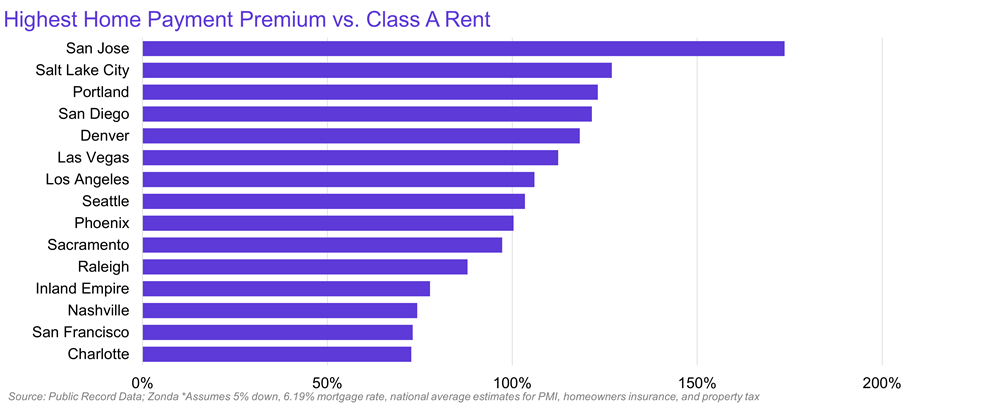
The largest homeownership premiums are concentrated in high-cost coastal markets, where elevated home prices continue to overwhelm modest improvements in mortgage rates. San Jose tops the list, with owning a home costing roughly 174% more than renting a Class A apartment on a monthly basis.
Other West Coast and Mountain West metros follow closely behind. Salt Lake City, Portland, San Diego, and Denver all post homeownership premiums well above 100%, underscoring how quickly home prices have outpaced rents in markets that saw strong in-migration earlier in the cycle.
These elevated ratios help explain why rental demand has remained resilient in high-growth markets despite new supply. For many households, renting newer Class A apartments remains the only viable path to accessing desirable neighborhoods without stretching household budgets beyond comfort.
More Balance Emerges in the Midwest
At the opposite end of the spectrum, several Midwest metros show far less separation between renting and owning. Markets such as Pittsburgh, Cleveland, Chicago, and St. Louis showed the lowest premiums to rent, signaling a more balanced affordability environment. These markets benefit from lower home prices and slower appreciation, keeping ownership within closer reach of renters.
What It Means for Housing Strategy
Zonda’s chief economist Ali Wolf emphasized that the affordability divide is increasingly a local story rather than a national one. “Metros with outsized ownership premiums are likely to see rental demand remain stronger for longer, while markets with narrower gaps may be better positioned for a gradual recovery in entry-level home sales.”
As affordability remains the defining issue of this cycle, understanding where renting and owning intersect, and where they diverge, will be critical for capital allocation, product positioning, and long-term housing strategy.
The insights in this article were taken from more in-depth research reports published in Zonda’s Apartment Outlook.