
As of March, several metros with populations above one million are standing out for elevated unemployment, according to Bureau of Labor Statistics data.
While the national conversation often centers on resilience in the labor market, Zonda’s metro-level analysis highlights where economic stress is most concentrated and where builders may need to recalibrate expectations. For context, the national unemployment rate stood at 4.3% most recently.
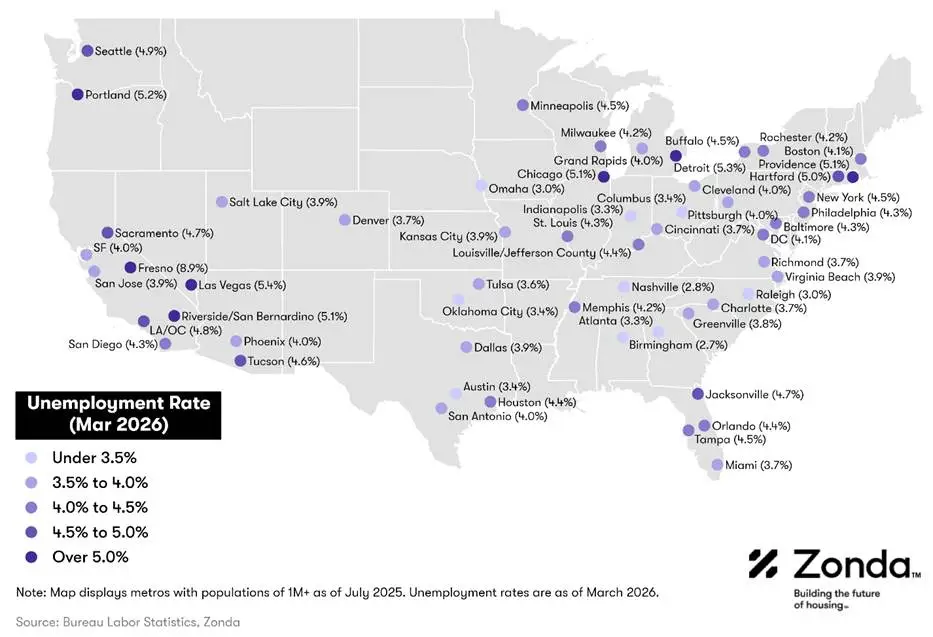
Tech-Oriented Markets Feel the Most Pressure
Several large metros tied closely to technology and corporate services employment show the most meaningful softening when measured against their own pre-pandemic norms. Seattle stands out, with unemployment at 4.9%, which remains relatively modest in absolute terms but sits 1.2 points above its 2015 to 2019 baseline. Portland, Minneapolis, and Denver have followed similar trajectories, each posting unemployment rates roughly one point or more above what these markets historically experienced during stable expansion periods.
Slower hiring, layoffs, and prolonged freezes among major technology firms have disproportionately affected higher-income workers, a group that typically drives demand for move-up and luxury housing. However, it is important to continue to monitor whether renewed investment in artificial intelligence could provide a partial offset.
Southern Growth Markets Remain Anchored by Stability
In contrast, many Southern and Southeast growth markets continue to demonstrate labor market resilience. Birmingham recorded the lowest unemployment rate among large metros at 2.7%, nearly two points below its historical baseline from 2015 to 2019. Nashville followed closely at 2.8%, while Atlanta, Raleigh, and Charlotte also remained well below their historical norms.
These markets benefit from employment bases anchored in healthcare, education, government, and manufacturing, sectors that have shown greater consistency through recent economic cycles.
“Recognizing which markets are under the most pressure allows builders to be more intentional about where they invest, how quickly they move, and what they bring to market as 2026 progresses,” said Ali Wolf, chief economist for Zonda and NewHomeSource.
The insights in this article were taken from more in-depth research reports published in Zonda’s National Outlook.