As tax reform, an improving economy, and continued healing among housing’s data metrics take shape and gain momentum in a profoundly under-housed market, what look to be key opportunity areas for builders to make a difference in their business destiny in the 12 months ahead?
Known unknowns include potential impacts of the tax overhaul on buyer sentiment after new mortgage interest deduction limits are imposed and state and local and property tax deductabilty is eliminated.
Unknown unknowns are just that, but make no mistake, although they’re unknown, it doesn’t mean they’re not material to how 2018 will unfold.
What’s more, an unknown unknown that’s probably the most wicked of all in terms of risk to builders are the matters builders think they know, but really don’t know. For example, a particular deal with framing subcontractors may look solid as a rock today, but once insurance work starts gaining traction in hurricane-afflicted areas of Florida and Texas, and framers start finding out how much more they can make doing those insurance repair projects, that solid-as-a-rock arrangement may quickly go by the boards.
Still, the good news is, contributors to fundamental, growing demand forces–economic growth, job formation, household formation–put many of builders’ supply constraint challenges into the “good-problems-to-have” bucket.
An expected step-function increase–a quarter of a percentage point–in a federal funds benchmark interest rate target range of 1.25% and 1.50% yesterday signaled Federal Reserve confidence in an economy broadly back on its feet.
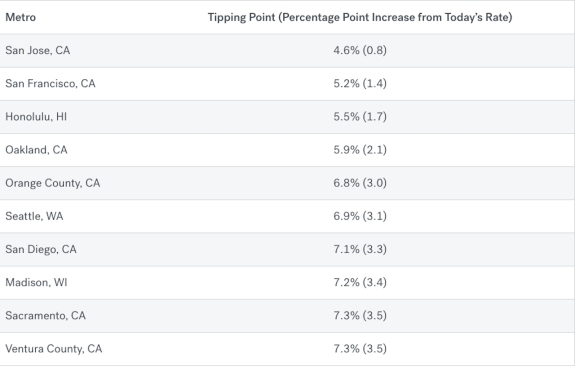
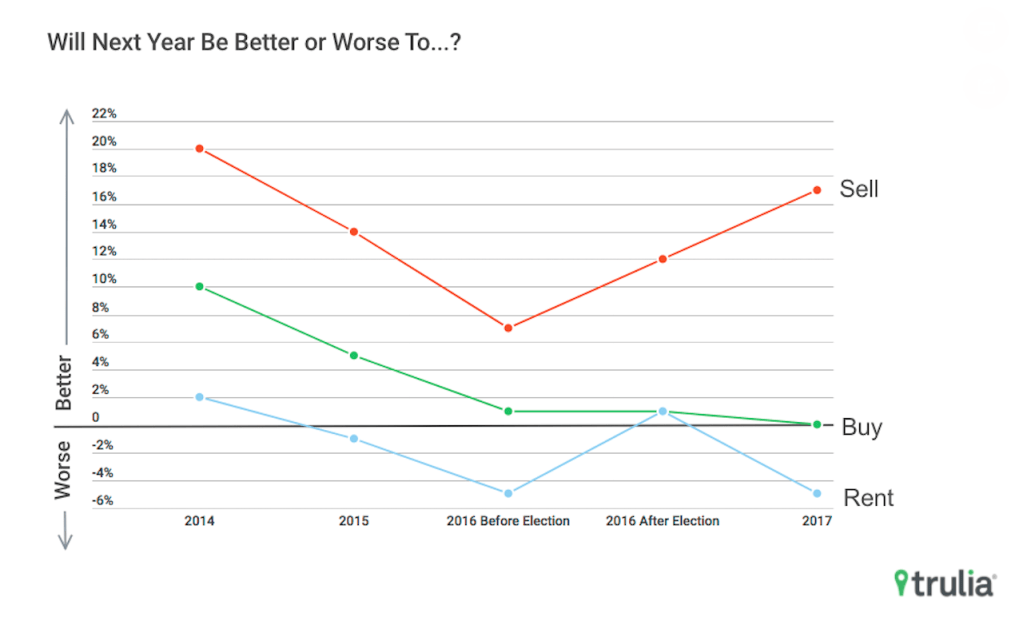
More of the same is likely in 2018, but Fed rate incremental increases in the cost of debt are not likely to be market-rate for-sale housing demand suppressors, especially since the economic benefits of owning a home will outweigh renting a home in most markets.
When it comes to opportunity areas, the biggest for new construction developers, investors, builders, and their partners seems to come down to this statistic, noted here by Trulia chief economist Ralph McLaughlin.
Only 6% of homeowners plan to sell their home in the next 12 months.
The tightening chokehold of resale inventory is truly one of home building and community development’s biggest opportunity area–and good-problem-to-have–but it comes with risks.
In oversimplistic terms, the biggest risk and the biggest opportunity for builders comes down to a number, $85 per square foot.
Where’s that number from? What does it mean? And how does that have anything to do with businesses whose cost and value produced per square foot of sheltered space may vary tremendously from that $85 figure?
The figure derives from the “construction cost breakdown“–ranging from Site Work, to Foundations, to Framing, to Exterior Finishes, to Major Systems, Interior Finishes, to Final Steps, to Other–reported by the National Association of Home Builders 2017 Construction Cost analysis after a deep-dive survey of 4,267 home builders.
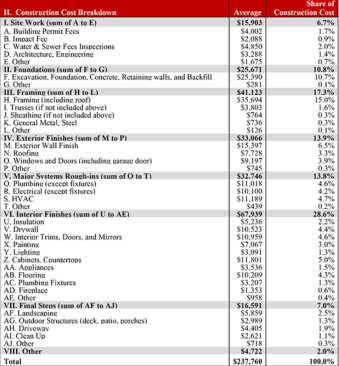
From this sample size–albeit a fraction of the nation’s home builder universe, and at best, a proxy for ranges rather than a precise pro forma cost model–a grand total of construction costs on an average sized lot of 11,186 square feet, for 2,776 square feet of average finished space came to $237,760.
Take the average finished space square footage and divide it into the total construction cost average and you get $85 or so.
Now, $85 is just a number, but whatever that number is, and however a home building business derives it, measures in quantitative terms the opportunity area an investor, builder, developer, etc., who are trying to go to market in an era when only 6 out of 100 people who currently own a home plan to sell it in 2018. Getting a home buyer to buy a new home is asking them to make a big change in his or her life, and to invest in his or her family’s well-being. Builders’ jobs are to lower the barriers–money, convenience, etc.–and at the same time elevate a potential buyers’ sense of inner-demand for that change.
It’s the builders and their partners who develop ways both to lower the cost of that square foot of finished space and to raise the value of of it in the minds of a potential buyer who’ll be looking this time next year and saying they’ve had a successful year.