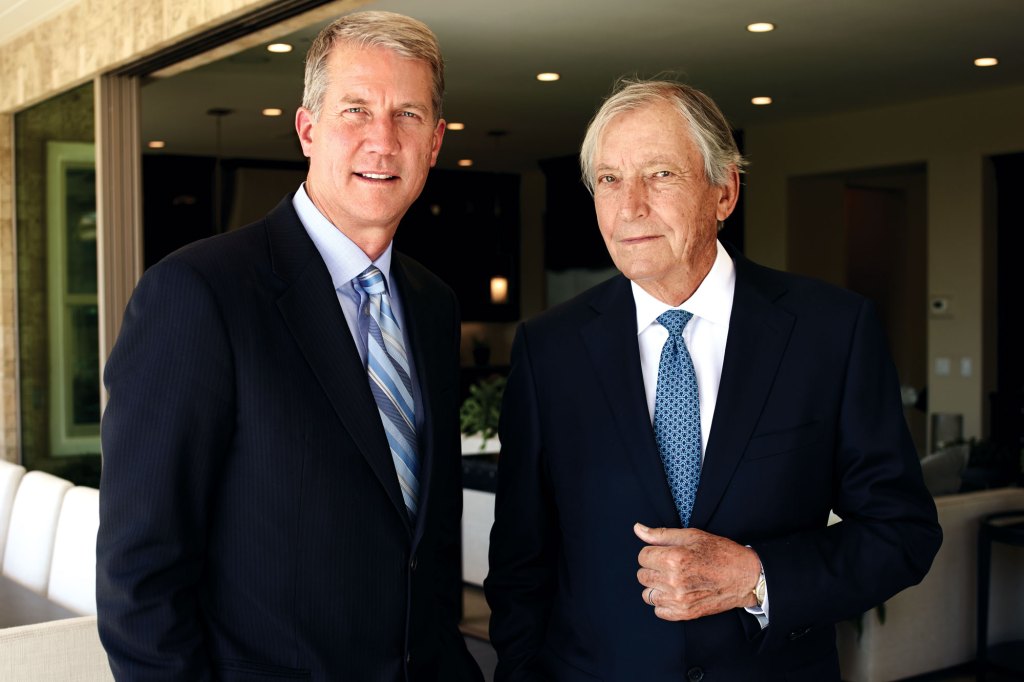
“We never set out in the first place to be a national builder,” explains Foell, who personally put his hand—and eye—to every Standard Pacific land deal from 1965 to 1996, and who serves today as the active chairman of the board of directors. “Our original operating principles, which are at work right up to the present, are ‘build it right the first time,’ and ‘make a profit on every single house we build.’ Under those two principles, we have one, constant value and that’s always to do the right thing for our home buyer, one at a time.”
Those two principles work themselves into the most sophisticated land and finance and construction operations workstreams. They also tend to check the impulse to acquire real estate, run up the balance sheet, and ramp up operations.
“The basics of buying land today are the same as they were in the 1960s,” Foell says. “The question should always be, ‘Is this piece of land good enough to turn into a profit on a short-term basis?’ We’ve tended to be conservative. I never bet the farm.”
The two guiding principles of profitability and good construction, a central value system around integrity, and “doing the right thing” by home buyers run strong in the DNA of Standard Pacific, as they do for any of the companies that enjoy such tenure. Did they evolve out of special executive training, leadership education, or the influence of modern-day management consultants like Boston Consulting, McKinsey & Co., or Bain?
“Frankly, it was just common sense,” says Foell, who’s amused that such truths would need to be learned behavior and ethics rather than ancestrally received knowledge. “It was the way my parents taught me, growing up in Illinois. And besides, when you’re a home builder, you get feedback very quick from your customer. They tell you whether you’ve done the right thing by them.”
In fact, a source of gratification Foell partakes in to this day is to drive through the communities that he’s helped develop. “It’s wonderful to go back into those neighborhoods around Christmas time, and you see the holiday lights, and you feel what’s grown up in those places over the years,” he says. “It’s meaningful.”
Crash Test
The company’s timeline sinews back from the present into a recent near-death experience in fall 2008, across four progressively remote eras of good times, great times, lean times, and nearly ruinous times under just four leaders.
“The basics of buying land today are the same as they were in the 1960s. The question should always be, ‘is this piece of land good enough to turn into a profit on a short-term basis?’ we’ve tended to be conservative. I never bet the farm.” Ron Foell
There’s a saying among progressive home builders: “We never lose. We win, or we learn.” But, in fall 2008, as Wall Street was imploding, that was almost not the case for Standard Pacific. Lehman Brothers was failing, high finance had become a game of low groveling for government handouts and abject despair, and Standard Pacific was on the brink of extinction.
Already, former CEO Steve Scarborough had been replaced by a board selectee, Jeffrey Peterson, and the daily debate centered around two options. One was to stand pat on the company’s assets and try to weather the storm. The second was to massively recapitalize, shrink the balance sheet and operations, and take on a major infusion from hedge fund masters of distressed turnaround deals, New York–based MatlinPatterson.
Here was the pivot point for Foell’s legacy and Stowell’s future. Each drew from his respective reserve of experience, fortitude, and vision, and each flexed every bit of influence he had as the board considered its options. Ultimately, the board chose the path Foell and Stowell recommended, asking MatlinPatterson principal Ken Campbell to join Standard Pacific as operating CEO, for a three-year stint as a turnaround leader.
“It was painful to take our medicine then and ratchet down the size of the company so significantly,” Stowell says. “But Ken’s plan allowed us to rebuild our capital base and we were able to go out and be aggressive buying land beginning in 2010 and 2011, when we were able to get deals that would be unheard of these days. We would not have been able to be where we are today in our own recovery if we hadn’t taken those steps.”
Campbell officially ceded the reins of the company in 2011, and since then, Stowell has rebuilt the corporate culture around a three-legged strategic stool of land, design, and value proposition, which marries the two others into differentiable benefits to home buyers.
It’s pretty much what Foell and Svendsen were doing in the mid-1960s, but with a twist. The analytics, the customer knowledge, the granular competitive submarket insight, the resource availability, and the strengths-weakness-opportunity-and-threat readings are each areas where Stowell demands best-of-breed discipline.
“Today, our focus is performance driven, and we look for five traits that we value most in our people, central to this culture,” Stowell says. “First, a will to win; second, teamwork; third, judgment that balances autonomy and discipline; fourth, creativity and innovation so that we can stay ahead and evolve; and finally, integrity and ownership, which goes back, full circle, to the company Ron and Art founded.”
If Foell has legitimate claim to credit for the solid imprint of sound operating and investment principles—and he does—it is Stowell who’s obsessively layering in correlative truths, practices, and a renewable strategic template that can thrive in an increasingly sophisticated and accelerated business. Stowell pushes the company now toward a fully-loaded builder/developer model, acquiring lots during times of distress, and becoming a net land seller—including to its own divisional network—in times, like now, when good, finished lots are going at a premium.
“What we’ve been working on is to strengthen the performance orientation of the company,” Stowell tells a couple of hundred regional associates in a town hall meeting in Austin this past spring. “I want us to be passionate about becoming great home builders even as we become better, faster, and smarter. We want our homes to be our buyers’ favorite place on earth.”
Common sense, Foell might say. But uncommon achievement.