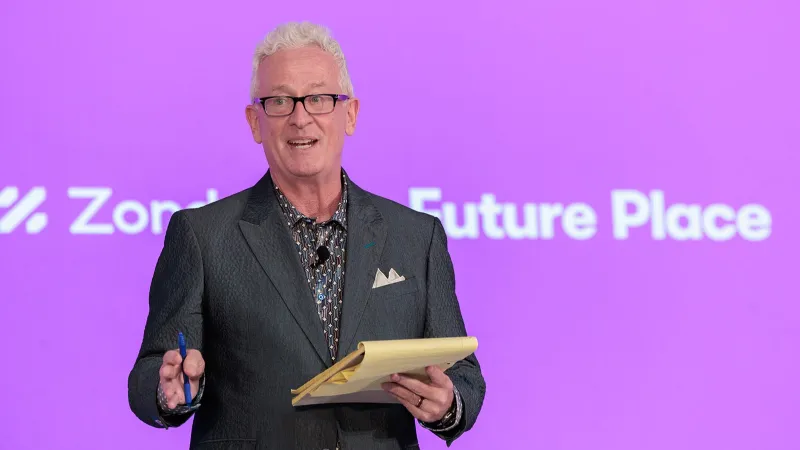
At the end of Future Place’s second day, Zonda chief advisory officer and the event’s emcee Tim Sullivan delivered his often-famous wrap-up.
Touching on all topics, Sullivan shared that builders and developers will need to create products better aligned with changing household structures and that a successful master plan depends on disciplined segmentation.
Below is a glimpse of Sullivan’s notes and all the topics discussed at the Ritz-Carolton Dallas, Las Colinas.
Market Conditions and Housing Demand
- Several Texas markets continue to perform well, supported by relatively strong employment.
- One encouraging sign is that market participants have not quit or withdrawn entirely despite current challenges.
- Builders need to align their products with the buyers who can realistically purchase them.
- The market may not have a universal housing shortage. Some price points face shortages, while an oversupply of higher-priced homes could sit unsold.
Emerging Buyer Segments
- The 55-plus market should not be treated as a single segment.
- Potential distinctions include ages 55 to 70; ages 70 or 75 to 85; older adults who can continue living independently; and older adults who eventually need assisted living or service-enhanced independent living.
- Important buyer groups to watch include:
- Single-person households;
- Adults ages 55, 65, and 75-plus;
- Multigenerational households;
- Hispanic buyers, particularly in Southern markets;
- Culturally diverse buyers affected by immigration patterns.
- Builders should consider how changing household composition affects home sizes, layouts, locations, and services.
- Service-enhanced independent living could become a critical bridge between conventional active-adult housing and assisted living.
Segmentation as an MPC Strategy
- The economics of master-planned communities can be summarized in one word: segmentation.
- Developers should establish clear lanes for participating builders.
- Product, price, buyer profile, and neighborhood character should be differentiated to reduce direct competition among builders.
- Strong segmentation can increase the velocity and diversity of home sales.
- Developers should avoid allowing builders to drift outside their designated product lanes.
Place-Based Development
- A defining question for each community should be: “What could exist only here?”
- Developers should let the land, history, and local culture inform a community’s identity.
- At Two Step Farm, the land helped determine the project’s concept.
- The area’s connection to the birthplace of the Texas flag influenced the community’s identity.
- The dance hall was conceived as a “love letter to Texas.”
- Authentic placemaking should come from a site’s distinctive characteristics rather than a repeatable formula imported from another market.
Technology and the “Silicon Suburbs”
- Technology investments can become major economic catalysts for surrounding communities.
- Large technology investments can create a chain reaction: investment brings jobs; jobs attract people; population growth creates housing demand; and housing demand supports commercial development.
- Developers must also account for residents’ concerns about traffic, pollution, power consumption, energy costs, and infrastructure capacity.
- Additional research is needed before drawing broad conclusions about the relationship between large technology users, expanded capacity, and consumer energy prices.
Generational Fluidity and Workplace Leadership
- Kim Lear encouraged attendees to approach generational differences with empathy and clarity.
- Strong intergenerational leadership depends on mutual expectations.
- Leaders should clearly define expected response times; who owns a task; what constitutes a draft versus a final product; and how proactive team members should be.
- Leaders should also state what employees can expect from them in return, including responsiveness and support.
- Clear mutual commitments can help teams work across generational differences without relying on stereotypes.
Lifespan, Healthspan, and Wellness
- Lifespan and healthspan are related but distinct. Lifespan is how long a person lives while healthspan is how long a person remains healthy. The goal should be to keep lifespan and healthspan closely aligned.
- Master-planned communities need to support healthy aging through:
- Wellness programming;
- Walkability;
- Appropriate housing types;
- Social connection;
- Services that evolve with residents’ needs.
- Service-enhanced independent living will become more important as residents age into their 80s and 90s.
Field Research and Leadership
- David O’Reilly emphasized getting into the field and observing how people use a community.
- Informal conversations can provide valuable market intelligence.
- One example involved asking rideshare drivers:
- Why visitors come to The Woodlands;
- Where passengers are dropped off;
- Whether they are going to work, home, restaurants, or entertainment;
- What visitors ask about when they arrive.
- This type of “me-search” can help leaders understand how the various parts of a place function together.
Activity Creates Excitement
- Visible activity helps establish energy and confidence in a community.
- Early activation is relevant not only to home builders but also to land developers.
- Buyers need to see signs that a community is functioning and gaining momentum.
- Programming, commercial uses, gathering spaces, and early amenities can help turn a development concept into an active place.
Lifestyle and Hospitality
- Some developers are starting to define themselves as entertainment or hospitality companies that also build homes.
- Minto’s William Bullock described breaking a roughly 40,000-square-foot building into four components: food, theater, fitness, and club space.
- Food, beverages, entertainment, and social experiences are important parts of the lifestyle proposition.
- Lifestyle should be treated as an operating strategy, not simply a marketing claim.
Edible Master Plans
- Commercial components do not always have to function as upfront cost centers. Farms and other food-related businesses can potentially operate as self-sustaining enterprises.
- Farmer-operators can own or manage agricultural components and generate revenue from them. This structure may reduce the burden placed on a traditional homeowners association.
- Edible landscapes and working farms can support community identity; resident interaction; commercial activity; and a more sustainable operating model.
Density and Municipal Flexibility
- Utah City was highlighted for allowing unlimited height and unlimited density.
- Flexible municipal policies can give developers greater freedom to respond to market demand.
- Local governments can either expand or constrain the range of possible housing and development solutions.
- Developers should engage municipal leaders in discussions about density, height, infrastructure, and regulatory flexibility.
Build-to-Rent and the Path to Ownership
- Build-to-rent (BTR) operators must effectively re-lease their homes each year when leases turn over. This gives BTR operators direct and recurring insight into renter preferences.
- Communities should welcome renters while recognizing that many may eventually want to transition into homeownership.
- BTR can serve as both a housing option and a potential entry point into a larger master-planned community.
Artificial Intelligence
- The central message was straightforward: AI is already here.
- Builders, developers, planners, and community operators need to consider how AI will affect their work.
Recurring Future Place Themes
Sullivan concluded with 10 themes heard repeatedly throughout the conference:
- Single-person households
- Intergenerational living
- Segmentation
- Execution
- Art
- Community
- Lifestyle
- Niche and hospitality
- Wellness
- Pickleball