
Across the U.S., the share of adults 25-plus with a bachelor’s degree or higher has steadily climbed, reflecting broader national trends in educational attainment. At the metro level, the gains are even more pronounced. Based on Census Bureau data, every market in this dataset posted an increase between 2014 and 2024, underscoring a widespread shift toward a more educated workforce that carries direct implications for housing demand.
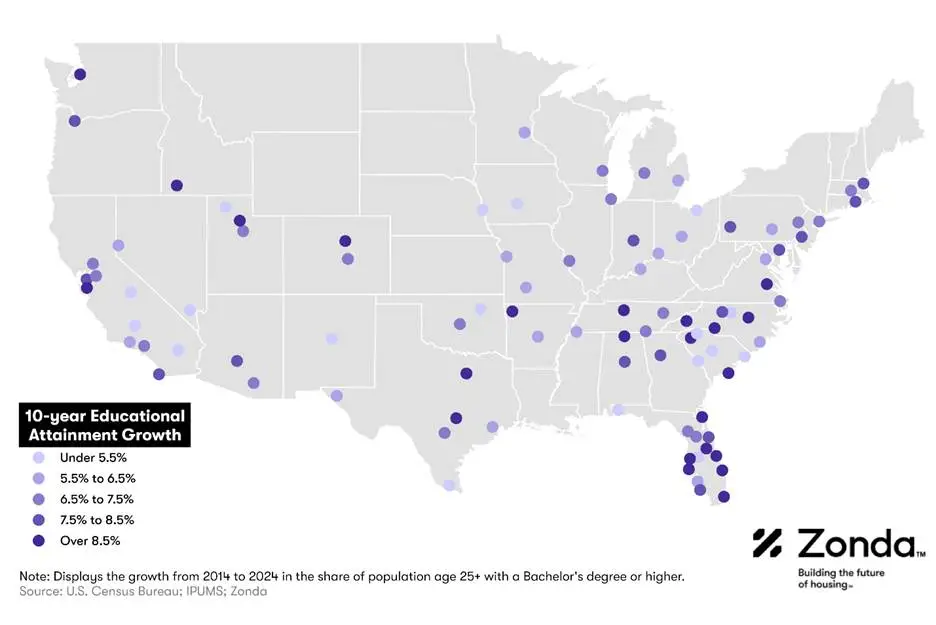
The strongest gains were concentrated in high-growth Sunbelt and Mountain West markets, many of which have been magnets for both population and job growth. Nashville led all markets with an +11.2% increase in bachelor’s attainment over the past decade, followed closely by Asheville (+11.1%), Denver (+10.8%), Austin (+10.8%), and Jacksonville (+10.8%). Markets such as Orlando, Port St. Lucie, Fayetteville, and Greenville also posted robust gains near or above 9.5%.
This clustering is not coincidental. These markets have benefited from strong in-migration, expanding job bases, and increased appeal among younger, highly educated households. As these populations relocate, they bring higher levels of educational attainment with them, further reinforcing local economic growth.
Why Educational Attainment Matters for Housing
For builders and developers, educational attainment serves as a powerful proxy for long-term housing demand. A higher share of college-educated adults is typically associated with stronger income growth, more stable employment profiles, and greater purchasing power. These characteristics are particularly important in today’s affordability-constrained environment, where higher-earning households are better positioned to absorb rising home costs.
Markets like Raleigh (+9.1%), Charleston (+9.2%), Seattle (+9.1%), and Dallas (+8.6%) exemplify this dynamic. These metros combine strong job creation in professional sectors with sustained growth in educational attainment, creating a durable foundation for both for-sale and rental demand. Even in more mature coastal markets such as San Diego (+8.1%), the steady rise in attainment points to continued demand from higher-income households.
Widespread Gains, But Different Speeds
While growth was nearly universal, the pace of change varied notably across markets. Older, industrial, or slower-growth regions tended to see more modest gains. Spartanburg (+2.7%) recorded the smallest increase, followed by Myrtle Beach (+3.4%), McAllen (+3.4%), Fresno (+3.9%), and Bakersfield (+3.9%).
Still, the key takeaway is consistency. Even the slowest-growing markets moved higher, reinforcing that the long-term trajectory of educational attainment remains upward across nearly the entire country. This broad-based trend suggests that, while some markets may lag, the overall quality of the U.S. labor force continues to improve.
Implications for the Next Decade
Looking ahead, rising educational attainment is likely to remain a structural tailwind for housing demand. Markets that continue to attract college-educated households will be better positioned to support new construction, particularly in move-up and higher-end segments.
At the same time, the divergence in growth rates across markets highlights where builders may see the most opportunity. Faster-growing, highly educated metros are likely to sustain stronger demand fundamentals, while slower-growing markets may require more targeted strategies to capture demand.
“While educational attainment has long been an important demographic indicator for the home building industry and remains so today, we are still in the early stages of understanding how AI will reshape the labor market,” said Ali Wolf, chief economist at Zonda and NewHomeSource. “For now, it remains a meaningful metric for our industry, but we will continue to monitor how its relevance evolves over time.”
The insights in this article were taken from more in-depth research reports published in Zonda’s National Outlook.