In an attempt to give home buyers a safe alternative to subprime lenders, Congress this year is considering two bills to modernize the FHA. Representing the largest mortgage insurer in the world, FHA lenders offer qualified buyers a low-interest, fixed-rate mortgage backed by the mortgage insurance premiums the borrowers pay as part of their monthly house payment.

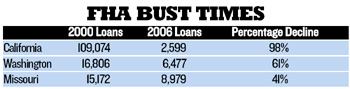
In recent years, the FHA has virtually dropped off the map—in California, FHA loan volume dropped 98 percent between 2000 and 2006—as an option for most home buyers, hampered by loan limits that didn't keep pace with rising real estate prices. In addition, the FHA's down-payment requirements were higher than what was widely available in the market. Whereas private lenders can quickly shift practices and offer new products to meet demand, the FHA literally needs an act of Congress to remain competitive.

NOT SUCH A GOLDEN STATE: The FHA saw reduced activity as a loan insurer during the real estate boom earlier this decade, with California's loan volume declining a whopping 98 percent. SOURCE: FEDERAL HOUSING COMMISSIONER BRIAN D. MONTGOMERY'S TESTIMONY TO THE SENATE COMMITTEE ON APPROPRIATIONS SUBCOMMITTEE ON TRANSPORTATION, HOUSING AND URBAN DEVELOPMENT, AND RELATED AGENCIES, MARCH 15, 2007

In 2006, the House of Representatives overwhelmingly passed the Expanding American Homeownership Act to address the issue, but the Senate failed to pass the bill before the session ended. That bill would have allowed the FHA to insure zero–down-payment loans, increase the loan limits to reach more buyers in high-cost markets, increase the loan term to up to 40 years, allow condominiums to be insured as single-family units, and offer risk-based pricing on mortgage insurance premiums, giving a price break to buyers with better credit.

Part of the reason the 2006 bill didn't pass the Senate was that at that time, the FHA's loan insurance program was on a high-risk list put out by the General Accounting Office (GAO). The GAO cited concerns about a lack of controls on a wide range of issues, including lending, appraisals, and property disposition. In January 2007, the GAO reported that the FHA had made significant progress and removed the agency from the high-risk list.

Since then, two new bills have been introduced in the House this session. H.R. 1752, co-sponsored by Rep. Judy Biggert (R-Ill.) with 16 other Republican representatives, is identical to her bill that passed in the House last year. H.R. 1852 is co-sponsored by Rep. Barney Frank (D-Mass.), chairman of the House Financial Services Committee, and Maxine Waters (D-Calif.), chairwoman of the House Subcommittee on Housing and Community Opportunity. The latter bill includes many elements of the one the House passed in 2006 as well as some fee reductions in closing costs, the requirement of prepurchase counseling for riskier borrowers, and a contribution of FHA surplus funds to an affordable-housing fund.

Federal Housing Commissioner Brian D. Montgomery notes that both House bills “recognize the need to modernize the FHA, which is a good thing. They both allow for some sort of risk-based pricing, which brings the FHA into line with the rest of the industry. ... If we're going to reach hard-working families, we need some flexibility in the premium structure.”

Modernization would provide a powerful tool for builders serving entry-level buyers, says Kim Shelpman, president and CEO of Melbourne, Fla.–based Holiday Builders and a veteran of the mortgage lending industry.

“It will increase the number of buyers we can get into our homes,” she says. “The FHA is a better program for buyers, because they won't ever have an interest-only or piggyback loan. When [buyers] make a payment, they'll build equity in the house.”

Plus, the FHA's stringent underwriting requirements should help builders feel confident that the deal will progress to closing, Shelpman says. “With a loan that comes through on the FHA, I know the buyer is credit-qualified, income-qualified, and I know I have a buyer who can afford the house.”

An Inconvenient Truth

Gore “outed” for big home-energy bills.

As former House Speaker Tip O'Neill was known to say, “All politics is local.” Such has been the case for former Vice President Al Gore, who, in April, got the green light to install 33 photovoltaic panels on the roof of his Nashville, Tenn., home following lengthy city council negotiations that culminated in a zoning change to allow solar.

Unfortunately, the approvals didn't come fast enough to preempt some bad press for the former-veep-turned-environmentalist. Around the time Gore was accepting an Oscar for his groundbreaking documentary on climate change, critics with the libertarian Tennessee Center for Policy Research came forth with the revelation that, according to local utility records, the Gores' 10,000-square-foot mansion gobbled up close to 221,000 kilowatt-hours of electricity in 2006—more than 20 times the 10,656 kilowatt-hours required to power the average American home per annum.

The Gore camp was quick to rebut by pointing out their conscientious, ongoing purchase of carbon offset credits, along with the impending solar renovations to their 70-year-old abode and the installation of high-performance thermostats and windows.

The house might have proved even more energy efficient were it not for a zoning stipulation that a home's solar roof panels lie flat (not angled) for aesthetic purposes—a requirement that will decrease the system's photovoltaic efficiency by about 12 percent. But the larger question remains: How efficient can a 10,000-square-foot residence for two empty-nesters be? -- J. Sullivan

Asbestos Case Win

A court rules that the Air Force must reimburse builders for environmental cleanup.

In a case that has broad implications for base closure redevelopment projects, the U.S. Court of Federal Claims ruled that four Colorado builders are entitled to be reimbursed for asbestos remediation they paid for at the former Lowry Air Force Base in Denver.

Judge Lawrence M. Baskir ruled that when any branch of the military transfers property ownership at a former military base, it must pay for any costs related to contamination caused by past use.

Builders, developers, and Realtors are watching the Lowry case closely because the military plans to close 22 major bases by 2011, and many of the old sites will be used for commercial and residential development.

Contamination was first found on the Lowry site in late 2002. The area in question, known as the Northwest Neighborhood, used to be the site of a military hospital and barracks. According to the original complaint, the builders believe that when the Air Force demolished the hospital and barracks, it buried insulation, steam pipes, and building debris that contained asbestos.

“The Air Force demolished the buildings in the late 1950s and early 1960s when the standards weren't as strict, well before many of the environmental laws were passed,” says Michelle Kales, an attorney from Brownstein, Hyatt, Farber & Schreck, the law firm that represented the builders.

Metropolitan Development, Richmond American Homes, Standard Pacific of Colorado, and Touchstone Homes filed the lawsuit. The group seeks to be reimbursed $9 million for the cleanup.

The exact reimbursement amount will be determined next month at a separate hearing in Washington. While the Air Force is expected to appeal the court's decision, the military can't legally file an appeal until the award is determined. -- S. Zurier