This is the first installment of a three-part series on how the breakdown in lending standards has forestalled the home building industry's economic recovery. The stories will focus on how we got to where we are today, how foreclosures and plummeting property values are affecting a new community in Indiana, and the analysts' best guesses on when the downturn will end.
When 1,300 members of the NAHB made their annual trek to Capitol Hill on June 6, they checked their usual swagger—which came from representing what once was the country's primary growth engine—at the door. That engine was sputtering and could seize up entirely if foreclosures kept mounting. So the builders' laundry list of requests for lawmakers included a plea to allow the Federal Housing Administration (FHA) to help troubled borrowers refinance mortgages, many of which are nonconforming loans with escalating interest rates that have put owners behind the financial eight ball.
Builders aren't just crying wolf, either. The Commerce Department said in March that the number of vacant, privately owned homes had reached its highest peak in the nation's history. And through the first half of this year, there were, conservatively, at least 500,000 mortgage defaults, including notices of foreclosure, auction sales, or bank repossessions, according to various estimates. So the last thing that builders—already in the throes of a downturn that seems to get worse every month—need right now is a new flood of foreclosed homes cascading onto a market where finding willing buyers has become a snipe hunt.
It might be too late to dam that flood, however, at least in the short run.
Housing Predictor.com projected in early June that, based on its analysis of the largest 100 metropolitan real estate markets, more than 2 million homes would be foreclosed in the following 30 months. In June alone, foreclosure filings nationwide jumped to 164,664, nearly 87 percent over the same month a year ago, according to the tracking agency RealtyTrac. That number translates into one filing for every 704 households. “The housing boom was a house of cards,” observes Alexis McGee, president of Foreclosures.com, which reported a 78 percent increase in defaults and foreclosure notices through the first six months of 2007 versus the same period a year ago.
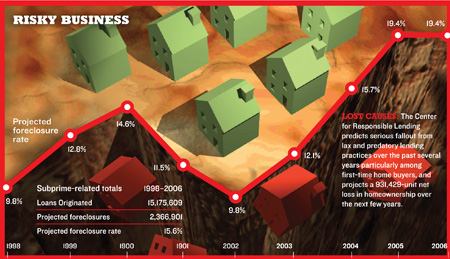
The Center for Responsible Lending, which for years has railed against “the death of common sense and the death of underwriting” in the mortgage lending industry, now warns that 2.4 million homes with subprime mortgages could foreclose by the end of 2008, according to its senior policy counsel Kathleen Keest. “Subprime loans made during 1998–2006 have led or will lead to a net loss of homeownership for almost 1 million families,” the Center reports (see “Risky Business,” below).

LOST CAUSES: The Center for Responsible Lending predicts serious fallout from lax and predatory lending practices over the past several years particularly among first-time home buyers, and projects a 931,429-unit net loss in homeownership over the next few years.
The damage is already spilling into the larger banking sectors: UBS shut down its hedge fund arm in May after it lost $124 million on subprime loans, and Bear Stearns had to pledge $3.2 billion—subsequently reduced to $1.6 billion when lenders accepted other collateral—in late June to facilitate the orderly liquidation of a hedge fund that was collapsing under the weight of bad subprime mortgage investments. To stem this impending foreclosure tidal wave, consumer groups and politicians are calling for everything from foreclosure moratoriums and intensified buyer education programs to massive refinancing assistance for families on the brink of losing their homes (see “Helping Hand,” page 112). The National Association of Realtors (NAR) this spring distributed a brochure to assist distressed homeowners, with a message that was both consoling and disturbing: “You're not alone if you're having trouble paying your mortgage.”
Some industry groups, such as the Mortgage Bankers Association (MBA), continued to insist through early summer that the foreclosure problem wasn't expanding significantly into the prime mortgage sector. And even Housing Predictor.com notes that real estate markets this spring were appreciating in 18 states and stabilizing in 10 others.
But what's no longer in dispute is that sizable numbers of home buyers and investors wound up with mortgages they either couldn't afford or who predicated their ability to repay on the unrealistic expectation that home values would never stop appreciating. This has been especially evident among borrowers with checkered credit histories who were approved for subprime and alt-A loans—often with minimal or no up-front financial commitment required—which now account for one-quarter of all mortgages outstanding.
“We would expect the builders' overall exposure to the subprime mortgage market to be greater than disclosed,” wrote Credit Suisse, which should know because it pumped capital into subprime lenders. The company predicted in March that 565,000 foreclosed homes would come back onto the market for sale within the following six months.
Now that lenders are tightening their credit standards, and the finger pointing about who was to blame for the subprime mess is subsiding, one question still left unanswered is how much of builders' exposure is self-inflicted? In their zeal to sell homes during the recent boom, did builders' salespeople exert undue pressure on loan officers to originate mortgages for buyers who, under less-frenzied circumstances, would be deemed financially unsuitable as homeowners?
Anecdotal evidence—based on interviews with officials of builders' mortgage divisions, former employees, brokers, and home buyers—suggests that, at the very least, builders' preferred lenders loosened their approvals leashes (a few egregiously so), and some may have stepped over ethical lines by funneling buyers into mortgage products because those loans returned higher margins when sold into the secondary market. “We all got lazy and took the easy way out to get buyers into mortgages in 30 days,” admits Dan Klinger, president of Hovnanian Enterprises' K. Hovnanian American Mortgage subsidiary, where subprime and alt-A loans represented 8 percent of its underwriting last year, with another 10 percent of those loans brokered to servicers such as Countrywide Financial and Chase.
Mortgage officials defend these practices (even as some have changed them) by saying they had two choices: either respond to market conditions or lose customers to more aggressive and unscrupulous lenders. “It was chaos; I was coloring my hair every two weeks to keep out the gray,” quips Kim Shelpman, president and CEO of Melbourne, Fla.–based Holiday Builders who ran Holiday's joint-venture partner Shelter Mortgage from 2000 to 2006. In 2005 and 2006, 80 percent of the mortgages Shelter originated were alt-A, which didn't require full documentation of income and debt. “There is no question that some of our competitors engaged in questionable lending,” says Rick Jarrett, sales vice president with San Diego–based McMillin Mortgage, The McMillin Cos.' lending subsidiary. Jarrett expects that tougher standards could drive between 15 percent and 30 percent of potential buyers out of the market.
Like Jarrett, most mortgage officials look back at their companies' lending practices and say they acted with propriety and in the best interests of their customers, who, they are quick to add, often demanded riskier loans that would get them into a bigger, more expensive house. Regardless, the entire housing industry is now paying for the past excesses of lenders and their investors. In June, the impact of tightened credit on home sales dragged down the NAHB/Wells Fargo Market Index, which gauges builders' confidence, to its lowest level since 1991. And few builders want to contemplate the ramifications of between $1.1 trillion and $1.5 trillion in adjustable-rate mortgages resetting this year, especially when so many of those loans are nonprime and held by cash-strapped borrowers.
AN INDUSTRY COMES UNGLUEDThe rising popularity of subprime and alt-A mortgages ran parallel to the unprecedented rise in home prices during the first half of this decade. “The biggest misnomer is that all of this was a surprise,” says Kevin Byers, a certified public accountant with Parkside Associates in Atlanta, whose clients have included developers as well as law firms in mortgage litigation cases. “It actually had been building like a slow-moving storm.” Dr. Robert Manning, author of Credit Card Nation and director of the Center for Consumer Financial Services at Rochester Institute of Technology, points out that the last five years of the housing bubble were the first time in American history that wages declined and home prices doubled. The only way many credit-challenged buyers could qualify for a mortgage was if builders and their lenders offered them exotic products with rock-bottom “teaser” interest rates that required little or no money down.
There were $1.3 trillion in subprime loans outstanding at the end of last year, versus only $200 million in 2001, according to San Francisco–based First American LoanPerformance, which follows mortgage activity. And the pricier the market, the greater the demand was for such loans. Manning told BUILDER in April that two-fifths of the mortgages underwritten in Washington, D.C., over the previous 18 months were interest-only. And housing analyst John Burns says his research finds that more than half of the mortgages K. Hovnanian wrote last year in California's Inland Empire region were approved without down payments.
The standards that mortgage companies once lived by “came unglued” during this period, Angelo Mozilo, Countrywide's chairman and CEO, told Reuters. CPA Byers feels particular contempt for lenders that flaunted “piggyback” loans, where more than one mortgage is underwritten and the buyer is approved at the much lower interest rate. “These have been a joke, and there's been a lot of abuse.” (Credit Suisse estimates that 40 percent of loans last year were piggybacks, compared to 20 percent in 2001.) Tawn Kelley, president and CEO of Orlando, Fla.–based Mortgage Funding Direct, which is Morrison Homes' joint-venture mortgage company and a mortgage originator in Central Florida for Toll Brothers and Meritage Homes, feels the same way about “stated income” loans that don't require income verification. These “liar loans,” as they're known, represented 81 percent of alt-A originations last year, says Credit Suisse. In Kelley's estimation, “they were asking the borrower to commit fraud.”
Any invisible barrier that separated selling homes from originating mortgages evaporated at many companies, notably San Diego–based New Century Financial, once the third-largest subprime mortgage lender (now bankrupt and under several investigations), which has become a symbol for this industry's rise and fall. A portrait of a dysfunctional operation emerges from an article The Washington Post published in May, based on testimony from former employees, which depicts New Century's salespeople wielding baseball bats menacingly at appraisers who dared to disqualify buyers purely on the basis of their incomes versus a home's value. Reuters posted a similar exposé of an industry governed by a “no-rules paradigm,” where Realtors, salespeople, and loan officers encouraged borrowers to lie about their incomes to qualify for mortgages, and where buyers seeking refinance options were subjected unknowingly to bait and switch tactics.
These activities weren't confined to specialty mortgage lenders, either. HUD spokesperson Brian Sullivan recently told USA Today that his agency had been receiving “increasing consumer complaints about builders,” including allegations of kickbacks, illegal referrals, and phantom incentives. Keest observes that predatory lending flourishes because of “misplaced trust” between buyers and sellers. And that's where some builders let down their customers, either by not paying sufficient attention to the approval policies of their lenders, or by being more concerned about the capture rates of their mortgage subsidiaries than with the tools they used to retain—or, as some argue, trap—buyers.
CONTROL THE CUSTOMERSo far, builders and their preferred lenders have escaped most of the blame for the sub-prime crisis from critics who single out brokers and Wall Street investors as the primary culprits. “I think we exercised discipline” during this recent housing boom, says Debra Still, president and CEO of Denver-based Pulte Mortgage, which captured 91 percent of its parent company's buyers in 2006. One-third of those loans were alt-A, but Pulte Mortgage stopped offering products known as 2/28s and 3/27s, with volatile interest rates, a few years ago. “We don't do transactions; our entire culture is about building communities,” says Still. (But in the heat of battle, mistakes were made: North Carolina reduced a $780,000 penalty against Pulte Mortgage—for having 53 unlicensed loan officers—to $60,000 after Pulte agreed to move its operations to Charlotte and create 230 jobs.)
Shelpman of Holiday Builders thinks the housing industry made it far too easy for customers to waltz in and purchase or refinance their homes. Other officials, though, insist that homeowners must bear responsibility for the latest rash of foreclosures. Jimmy Timmons, president of the Miami-based Universal American Mortgage Co. (UAMC) division of Lennar Corp., says that while the credit crunch put pressure on all 200 of his loan officers, the vast majority performed professionally and worked on behalf of customers with various credit challenges. “The availability of exotic mortgages in the market dictated the products our customers were demanding,” Timmons recalls. “Borrowers share a lot of personal accountability in the loan products they selected.”
However, the questionable dealings of Beazer Homes' mortgage subsidiary, Beazer Mortgage—which have sparked investigations by the SEC into possible improper lending practices and fraud, class-action suits filed by law firms representing buyers in North and South Carolina, and the firings of Beazer's general counsel and general accounting officer—brought unwanted attention to the symbiosis between builders and their mortgage units.
Mark Clore, a mortgage broker with Las Vegas–based First Source Financial USA, says that until this year, several of the national production builders with mortgage entities in his market had made it extremely difficult for borrowers to use outside lenders by assessing penalties, imposing “unattainable” approval deadlines, requiring more earnest money, and taking incentives off the table.
“We were told that our job was to control the customer,” says a licensed real estate agent who worked 18 months for D.R. Horton's DHI Mortgage subsidiary in Nevada. Buyers who chose an outside lender would lose incentives (such as reductions in their closing and options costs) and would be required to increase their earnest money to $10,000, from $3,000 if they used DHI. The source—who was fired from DHI in May 2004 over what she claims was a dispute about splitting fees with her manager—adds that Horton tied a portion of its divisional managers' bonuses to DHI's capture rate. (Officials from D.R. Horton and DHI did not respond to calls from BUILDER requesting comment.)
Another source, who worked 2 ½ years as a manager for one of Lennar's UAMC offices in Nevada before she was laid off in October 2006, says the pressure to approve buyers for loans was “overwhelming.” That pressure came directly from Lennar's divisional president, “who told us the relationship between the builder and the mortgage company was ‘master and slave.'” When this source says she got tougher about qualifying buyers, Lennar removed several communities from her loan office's territory. When asked why Lennar would sanction its mortgage subsidiary to approve loans for buyers it knew would not be able to pay them, this source replies, “Lennar wasn't thinking long term; it's a publicly traded company that's judged on how many homes it closes.”
CONSULTATION LACKINGIt goes without saying that a certain number of buyers and investors—maybe even the majority—knew exactly what they were doing when they chose riskier mortgages. Ryland Mortgage's president, Dan Schreiner, contends that most buyers who demanded alt-A loans—which accounted for just under a quarter of Ryland's originations last year—chose not to fully document their incomes “because it was more convenient, not because they couldn't.”
But by placing the onus on buyers, as a group, for selecting mortgages that could potentially put them behind the eight ball, builders and their mortgage partners conveniently forget that many customers are clueless about these loans and are intimidated by the origination and closing processes. A recent survey that Bankrate.com commissioned found that more than one-third of homeowners polled didn't know what kind of mortgage they had. By ignoring this, builders and mortgage lenders absolve themselves of any responsibility to educate customers about their choices.
“In the 24 months prior to the market downturn last October, customers would come in and say ‘I want an option ARM' without even knowing what it was, but wanting it because the guy in the next cubicle at work got one for 1.25 percent,” says Kelley of Mortgage Funding Direct. “The prospect is only interested in what is known to him, and it's up to us to explain what that is. The problem, though, was that lenders became order takers.” Manning says buyers who, during the housing bubble, had been told constantly that their house was an investment, “were ill-educated to make decisions” about financing that purchase.
Malcolm and Donna Washington probably fell into this category. Last year, they purchased a $473,000 home from D.R. Horton in Stockton, Calif., and put their trust in their loan officer at DHI, who, Malcolm recalls, “said if we did everything they asked us to do, they'd help us out.”
The couple had a decent 680 credit score, and Malcolm earned $66,000 as a facilities worker for the Santa Clara Transit System in 2006, although one-third of that was overtime pay. They didn't want to make a down payment, so DHI steered them into an 80/20 loan with the interest rate for the first mortgage at 4.8 percent and the second mortgage at 13 percent. Malcolm couldn't recall the name of the loan officer, nor what the interest rate for the first mortgage would be when it reset in five years.
A failure to communicate lost Lennar at least one sale in Florida, where a couple with an $84,000 combined income signed a contract in September 2006 to purchase a $360,000 house in that builder's Southern Fields community in Clermont. The couple had trouble selling their house, so they couldn't qualify for a 30-year, fixed-rate mortgage because their debt-to-income ratio would be too high and they didn't have the 10 percent down payment. UAMC told them the best they could get was a 100 percent–financed 80/20 ARM with the first mortgage at 8 percent and the second at 12.5 percent with a 10-year balloon payment. “Lennar wanted a sale then and now and was trying to force us into a mortgage we couldn't afford,” the woman in this couple claims. Even after UAMC offered to buy down the interest rates, the couple canceled their contract in March 2007 and relinquished their $18,000 deposit.
One month later they sold their house for $225,000 and purchased a five-bedroom inventoried home from Banyan Homes for $70,000 under the $360,000 list price. They also got a 6.75 percent fixed-rate mortgage from their bank. If they ever decide to buy another house, it will be through a Realtor and with a lawyer combing over the contract's language.
SOLUTIONS DEBATEDThe fallout from the subprime collapse has been dramatic as lenders' pipeline to Wall Street capital dried up, and more than 80 companies that specialized in underwriting riskier mortgages are wobbling badly or are out of business. Lenders still standing are reining in credit: A recent Federal Reserve survey found that, in the first quarter of 2007, 23 of 53 domestic banks polled were applying stricter lending criteria. “I get three e-mails a day from lenders that are tightening their guidelines,” says Kelley.
At least through early summer, this credit squeeze hasn't impacted the housing industry too severely yet. Pulte Mortgage and UAMC have been able to move nearly all of their borrowers with loans that have gone away into prime mortgages. “We're seeing a real flight to quality,” says Still. Shelpman and Klinger both say they welcome the return to “pre-frenzy” lending practices, which in Holiday's case means income documentation for most loans or an approval letter from an outside lender before Holiday will start the house.
There is industry-wide concern about the extent that mortgage resets will drive more homes into foreclosure. But consensus has yet to coalesce around any one solution to ameliorate this crisis. Lenders generally oppose a federal bailout of distressed homeowners, and they are wary of strengthening the positions of Fannie Mae, Freddie Mac, or FHA. These lenders are also likely to resist anything that smacks of “suitability,” which would force them to match borrowers' incomes and loans far more closely than they do now.
Manning also opposes a government bailout, but he hears the predictable strains of do-nothingism in comments from banks and other lenders. “They are holding the American public hostage by saying ‘things used to be good, and they'll be good again if you just leave us alone.' That's not going to happen this time.”
In next month's issue, BUILDER will continue this story by looking at how easily obtained mortgages led to a wave of foreclosures in one Indiana community.
Shock to the System
Statistics and projections foretell a dicey next few years for the housing and lending industries.
68.8 PERCENT: The homeownership rate in the U.S. at the end of '06 versus 65.4 percent in '96.—U.S. Census Bureau
$1.3 TRILLION: The amount invested in subprime mortgages in 2006, representing between 13 percent and 14 percent of mortgages outstanding, versus $200 million in 2001.—First American LoanPerformance
$1.1 TRILLION TO $1.5 TRILLION: Total adjustable-rate mortgages whose interest rates could reset this year. Between $500 billion and $800 billion won't be refinanced to lower rates.—Mortgage Bankers Association
20 PERCENT TO 30 PERCENT: What an interest-rate reset can add to a homeowner's monthly mortgage payment if not refinanced.—First American LoanPerformance
$75 BILLION: What investors in bonds backed by mortgages stand to lose as a result of loan defaults and lender failures.—Bloomberg News
1 IN 21: The number of homes in Detroit that foreclosed in 2006, 4.5 times the national average. Michigan's attorney general says the state's foreclosure rate rose 55 percent in 2006 and is expected to increase at a higher rate this year.—National Law Review
16,000: The number of mortgage-related jobs lost nationally in 2006, 12,000 of which were in California alone.—MortgageDaily.com
887,000 UNITS: The projected number of new-home sales in 2007, from 1.123 million in 2006, with 236,000 units of that reduction attributable to tightening lending standards.—Credit Suisse
Helping Hand
Everyone seems to be looking for ways to keep foreclosures from spiraling out of control.
Federal Reserve Board chairman Ben Bernanke told a conference audience on May 17 that he did not expect problems in the subprime mortgage market to significantly spill into the rest of the economy. You'd never know that from the blizzard of measures proposed or initiated this spring by government officials, consumer groups, and mortgage bankers, all attempting to defuse what threatens to be a foreclosure time bomb.
Two days before Bernanke spoke, a coalition of more than 100 legal, housing, and consumer advocacy organizations sent letters to six major mortgage lenders asking them to suspend foreclosures on home loans in California for the following six months. Members of Congress had already called for a national foreclosure moratorium, and Senate Democrats proposed bills aimed at preventing foreclosures through assistance that would allow owners to refinance their loans. States with high foreclosure rates—including Ohio and California—also were devising ways to funnel funds to help cash-strapped homeowners at risk of defaulting.
Fannie Mae and Freddie Mac, the country's two largest mortgage holders, are reaching out to distressed homeowners with multibillion-dollar programs that would make available loans with terms that are easier for homeowners to pay over longer time periods. And several giant banks have carved out “workout” divisions to help homeowners restructure their loans to avoid foreclosure. Two of those banks—Citigroup and Bank of America—formed Neighborhood Assistance Corp. of America, through which they've pledged up to $1 billion to offer below–market rate loans.
Some solutions include educational components. By the end of this year, Wells Fargo Financial expects 45,000 nonprime home buyers to be enrolled in the “Steps for Success” consumer education program it started in October 2006, which the bank expanded to alt-A mortgage holders in March 2007. The program is designed to help mortgage customers better manage their credit and to make people “more aware about borrowing,” says Stephanie Christie, senior vice president of Wells Fargo's Home Credit Solutions division in Carlsbad, Calif.
The bilingual program provides annual credit reports, toll-free access to credit specialists, financial literacy instruction tools, and automated mortgage payment and banking services. Christie describes “Steps” as a “lifeline” for people who are seeking objective advice about managing their credit. She also thinks it might help builders sell homes and cultivate repeat business down the road.