THE CLUBHOUSE WAS FESTOONED with yellow “caution” tape, and wooden sawhorses doubled as tables. Everyone who entered was issued a hard hat. When they weren't sipping soup or eating quiche, the 150 invited Realtors played with model Tonka trucks. Vrooom-vrooom. Who knew real estate agents had this much sense of fun?
Sibet Freides does, and her “Lunch Under the Beams” last November at a new single-family development in a former industrial zone of Atlanta confirmed it. “If you're an agent showing, you're not going to think of this area,” says Freides, president of Idea Associates, an Atlanta marketing firm.
Not only did the event Freides calls a “pre-grand opening” get agents to the site, by the time lunch was over, two Realtors had gone to fetch clients and were writing contracts on the homes.

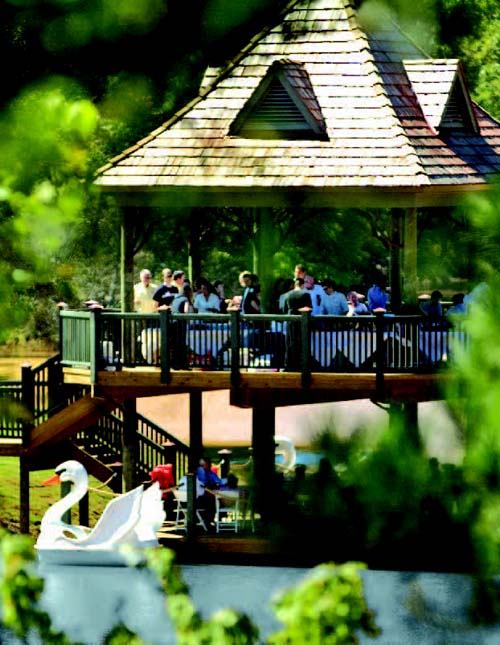
SWAN LAKE: "Soft programming" allows prospective buyers to sample the lifestyle of a community for an afternoon. This party on a bandstand and boat dock near Atlanta is one such example.
At $9,000, the lunch was far from the classic “Grand Opening Blowout,” but it suited the marketing needs of the development, with home prices from $250,000 to $350,000. “In the '80s and '90s, we spent tons of money on events,” Freides says. “At one event, we had fireworks and the Drifters performing for 1,000 people.”
But not anymore. Across the country, builders, developers, and their marketing professionals are fine-tuning the events that surround the opening of condominiums, age-restricted communities, and single-family neighborhoods. Generational shifts—not to mention the high demand for new housing—mean that builders shouldn't necessarily rely on fireworks and pigs-in-a-blanket to sell a project.
“The biggest change has been from an event to a process,” says Richard Gollis, principal of Concord Group, a real estate marketing firm in Newport Beach, Calif.
If the key to the value of a home is location, location, location, the key to selling a lot of them is momentum, momentum, momentum. That's the goal of the process, Gollis and others say, to create just the right amount of interest to sell out a community, and at the preferred price point. “A lot depends on how much noise the developer wants to make and how much he wants to spend,” says Janis Ehlers, president of Ehlers Group, an active adult marketing specialist in Ft. Lauderdale, Fla.
“Sometimes, you want a whisper campaign,” Gollis says. Signage is followed by teaser ads in newspaper real estate sections, and maybe direct marketing materials sent to an already existing database—each step designed to build interest and contribute to a lead list. “You start to build a connection and a relationship,” he says. “You're building an experience around the process of moving in—instead of an event. In a whisper campaign, an open house is not as necessary. A lead list is the culmination.”

LITTLE ITALY: To thank residents of its luxury developments, WCI has thrown parties featuring (clockwise from top left) a tumbler, a fire eater, masked greeters, and a "living fountain.”
Richard Nulman, CEO of Pace Advertising in New York, says the database, or “VIP list,” is more vital to sales success than any one event. “Increasingly, in a strong market, presale is more important than ever before.”
Lift OffPresale is especially important in high-end communities and condominiums. In those cases, the groundbreaking becomes a significant marketing milestone. “Developers use their groundbreaking to solidify contracts on hand or to kickoff their sale,” Ehlers says.
For the groundbreaking at an active adult luxury condo in Coconut Grove, Fla., last summer, Ehlers arranged a cultural event for 125 invited guests. The condo was an infill project, and the sales office was small. But the Coconut Grove Playhouse was within walking distance. “We had the groundbreaking on the site, then went for a performance at the playhouse, followed by a party.”
The opening resulted in one new sale and several excellent prospects, Ehlers says. In addition, the condo “has forged a partnership with the playhouse, [which now] provides theater tickets to prospects and future residents.”
WCI Communities achieved positive results at its Westshore Yacht Club community in Tampa, Fla. “We had been teasing the market for six months and hadn't started construction,” says Mike Curtin, WCI's senior vice president. The company threw a “launch party,” its 600 guests drawn from attendees of three earlier information sessions. At the party, WCI held a priority drawing for the 507 homes that will eventually be released at Westshore.
Sometimes a launch requires a marketing approach that will make buyers respond “like there is a run on the bank,” Nulman says. He calls that response “pandemonium.”

PANDEMONIUM: Some developments run an old-fashioned carnival, such as the one shown here, to attract buyers and establish a sense of community.
“The most pandemonium we ever had was during a live radio remote broadcast promoting the grand opening of condos in Florida,” he says.
The announcer was a popular drive-time personality. The parking lot was overflowing, the sales office was full, and there was a line of prospective buyers going out the door. “People driving in the area heard the broadcast and drove over to the sales center. Others were on their cell phones asking for directions to the sales center.” Pandemonium.
That day, nearly two-thirds of the community—more than 160 homes—were sold, Nulman says.
Step-By-StepWCI's model opening events are more like a traditional grand opening, Curtin says. In addition to walk-ins, over a two-to-three-day period, the builder will hold separate private functions for area Realtors and for those who have already committed to purchasing a home.
At this stage, says Ginger Frailey, senior vice president for The Macauley Cos. in Atlanta, “the best way to get the biggest number of people is in the number of models you have.”
There is one more step in the process, developers and consultants say. At the Sanctuary at Falsecape, an oceanfront condo in Virginia Beach, Va., Scott Ayers erected a tent near the dunes and feted 350 invited guests one Saturday afternoon. “The people who were invited had already bought into the community,” says Ayers, president of Leading Edge Realty in Virginia Beach. Although sales were closed, “it was still part of the marketing plan.”
In a similar way, WCI will hold a closing party once a project is complete. That's when the builder will break out the fireworks. At LaScala, a luxury residential tower in Bonita Springs, Fla., named after the opera house in Milan, Italy, WCI threw a party with an operatic theme. Guests were met by masked greeters in Venetian costumes. The centerpiece of the two-story grand salon was a “living fountain”—a woman on a pedestal, transformed by makeup into a statue who, when she came to life, sprayed water from her fingers and hair.
The point, says Curtin, “is to let the people know that we appreciate their business.”
As important as these consumer events are, builders are careful not to overlook Realtors. As Freides' “Lunch Under the Beams”demonstrated, a good Realtor lunch can translate into immediate results.
But if Realtors shouldn't be forgotten, neither should their time be taken for granted. Realtors have walked away from Freides' events with grab bags containing cash prizes, their bodies relaxed after a massage, and clutching one of those coveted Tonka trucks.

HOT TOWN: The "Town-Warming Festival" at Verrado, developed near Phoenix by DMB Associates, attracted 36,000 people over two weeks and resulted in 160 sales.
“Realtors are invited to two of these [types of] events a week,” says Dave Miles, president of Milesbrand marketing in Denver. “If you're going to do it, make it the biggest event in the market.”
Create An ExperienceThe temperature in Phoenix last Dec. 3 and 4 was in the 60s. On Main Street in nearby Verrado, a new community developed by DMB Associates, the weatherman was promising “snowfall every 15 minutes between 5 and 9 p.m.,” thanks to a snow machine chugging away on a third-floor roof.
“No, it's not going to stick,” Tracy Simmons, field marketing manager for DMB Associates-Verrado, said a couple weeks before the event. Even so, along with performances by the Phoenix Boys Choir, strolling carolers, a holiday storyteller, an art walk, and other events, the faux snowfall at the Hometown Holidays event was meant to reinforce to the 40 to 50 families that have already moved in that they are part of something more than a suburb.
“Much of our marketing is experiential,” Simmons says. “Verrado is not just about purchasing a home, it's about being part of a community.” When built out, Verrado will have 14,000 homes and a population of up to 30,000.
Simmons had a lead list of 5,000 names in October 2003, culled from phone calls and the community Web site. By January 2004, with much of the infrastructure in place—including Main Street, the golf course and clubhouse, and 21 models—Verrado held a “town-warming festival.” It drew 36,000 people over two weeks.
The result was 160 sales. “The numbers were limited significantly by the inventory release of our builders,” Simmons says. “We actually organized a process by which each builder drew names from the hundreds of prospective buyers to schedule sales appointments.”
The town-warming festival cost $500,000 to stage, Simmons says. It, and the more recent Hometown Holidays, capitalizes on a common thread that Concord Group's Gollis sees between Generation-X home buyers and the very different cadre of boomer buyers. “The common theme is community,” he says.
Even though the nesting urge is strong these days, the marketing must be remarkable. “People are doing a lot of shopping on the Internet,” Freides says. “If they don't see what they like on the Internet, snow cones aren't going to bring them out.”
Prospective buyers have wandered into her models and found actors portraying a family arguing around the dinner table. One holiday season, Nulman tied a 15-foot-wide ribbon around a high-rise he was marketing in Toronto. “It looked like a Christmas present.”
It's Worth ItStill, the continuing high demand for new homes means that builders don't necessarily need to break a sweat when they market their products. “If you're building single-family homes for middle America, you don't need to do anything—not in this market,” says Ayers of Leading Edge Realty.
Nulman agrees. “For single-family housing in a competitive market, you don't have to spend a lot of money or get super creative. But if you want to sell them for more money, the little extra bit of creative promotion can add tangible value.”
And every event is an opportunity for a builder to take stock of the project. “Follow up with an independent survey, with people who attended who did not purchase, to find out what they thought of the community, says Miles. “You can also set a benchmark and measure the awareness level in the market over time through phone surveys and awareness surveys.”
While the big blowout party may be increasingly rare, events still come with a five-and six-figure price tag. Ehlers says it isn't unusual to spend between $50,000 and $100,000 on a party. The highest Nulman spends is $150,000 to $200,000—and that is for multimillion-dollar projects.
So, what can you get for that kind of money? “For $150,000, you can get celebrities to show up,” Nulman says. “You can have fancy food and drink, elaborate temporary landscaping. For a luxury high-rise, we once rented Cartier's for the evening and had the party there. If Donald Trump has taught us anything, it's that promotion—if done with flair—can add value to any real estate offering.”
There's another lesson that developers, builders, and their marketing people have learned: There is no single successful formula to build the momentum that will sell a community. And the formula doesn't even have to include a single event.
“We have a builder who says, ‘I don't want people eating my food and drinking my alcohol and messing up my models,'” Ehlers says. “And he's very successful.”
David Holzel is a freelance writer based in Montgomery Village, Md.
What's Your RQ?If being remarkable is the key ingredient of a successful event, how can you make sure your Remarkability Quotient is as high as possible? Here are six tips to follow:
Target your audience. “We never throw a major blowout event,” says WCI's Mike Curtin. “We're pretty conscious about whom we invite. We don't want to feed 10,000 people.”Continue to capitalize on the event. Use photos or video on your Web site, in direct mail, in newsletters, and in press releases, says Janis Ehlers of the Ehlers Group. Send a DVD to everyone who was invited.Don't forget to say “thank you.” “We want people to know that once they have the house, we're not going to forget them,” says Curtin. Steve Shoemaker, director of marketing for Ideal Homes in Oklahoma City, Okla., invites local dignitaries to opening events. “They enjoy being brought into the process. They usually don't get to see the fruits of what they approve.”Residents are your best sales-people. “We're spending money on events, which we hope people will share with their friends,” says Tracy Simmons of DMB Associates-Verrado.Realtors like to be entertained, too. At a Realtor event in a Chicago condominium, Idea Associates' Sibet Freides arranged for the agents to find in the hot tub a bubble-clad hunk pouring champagne for his delighted guests, who were reduced to schoolgirlish giggles.Creativity can backfire. Before starting construction, a Washington state builder wanted to put on a free summer concert on his pasture. Ehlers says she talked him out of it, convincing him that people would react “like he was building over Woodstock.”