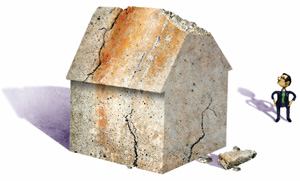
Florida home builders who use concrete—essentially all of them—could be facing a major crisis in the coming months if an appeals court does not overturn a district order shutting down three Miami limestone quarries and ordering an investigation into seven more South Florida mining operations.
A variety of industry groups and various business interests say the July U.S. District Court ruling threatens nearly half of the limestone and one-fourth of the cement used in Florida for road construction as well as residential, commercial, and industrial construction projects.
Kerri Barsh, an attorney representing two of the mining companies affected by the judge’s decision, White Rock Quarries South and APAC Florida, says the “decision threatens one of Florida’s most important industries” and “threatens planned and future road and highway projects.” In addition, she says it could dramatically increase construction costs. In fact, the Tallahassee, Fla.–based Floridians for Better Transportation says the decision could “make construction materials very expensive and hard to get.”
In July, the U.S. District Court for the Southern District of Florida ruled that several mining permits for the Lake Belt area in South Florida had been improperly issued. The court said that mining operations from the facilities may be contaminating local drinking water. Evidentiary hearings showed that benzene, a known carcinogen, was detected in water being pumped from the Biscayne Aquifer, which is the primary source of drinking water for the Miami-Dade County area.
“It is unclear whether landowners in surrounding areas are at an increased risk of potential exposure to benzene, cryptosporidium, giardia, or other contaminants as a result of the mining, which has occurred pursuant to these improperly issued permits,” court documents say.
Barry Rutenberg, president of Barry Rutenberg Homes, a custom home builder in Gainesville, Fla., says in recent years there have been a number of rulings that have affected the mining industry. “The ownership of aggregates is becoming more restrictive.” Though Rutenberg is unfamiliar with the total amount of aggregates coming from these plants, he says, the potential loss could be a problem.
One of Rutenberg’s typical custom homes, for example, uses 100 to 200 yards of concrete. Builders also use tons of aggregates road base and in concrete for land development applications such as drain pipes. “There are a lot of uses for [the aggregates],” Rutenberg says.
At the very least, home builders could be facing significantly higher prices if traditional economic trends hold up. “I think anytime you have fewer companies in the market there is always the possibility there will be higher prices,” Rutenberg says.
The Florida Department of Transportation seems to think so. In an amicus brief the department filed with the district court, state transportation officials predict that a loss of just 5 percent of Lake Belt production would result in a loss of 24,627 jobs and $2.5 billion in lost economic output statewide.
This recent ruling calls for the stoppage in roughly 35 percent of the Lake Belt mining acres. Using those figures, a 35 percent reduction will cost Florida’s economy nearly $17 billion and cost 168,000 Floridians their jobs, the industry groups, led by Floridians for Better Transportation, say.
The court’s ruling affects most of the 12 mining permits issued for the South Florida area. The Court remanded the permitting process to the U.S. Army Corps of Engineers for further review and consideration. Many of the quarries have filed appeals, and Barsh says the appeals court will hear oral arguments on Nov. 28.
Learn more about markets featured in this article: Miami, FL, Deltona, FL, Miami, FL, Tampa, FL.