There's a curse of obscure origin that goes: “May you live in interesting times.” Someone must have slipped that message into Sam Rashkin's fortune cookie, because Mr. Rashkin has been having two very interesting years.

Rashkin oversees the EPA's Energy Star for Homes program. In 2005, his team set out to revamp the specification that houses must meet to earn the Energy Star label. On top of tougher window and equipment standards, the spec now includes a strict, mandatory “thermal bypass checklist.”

“It's been a hellacious year,” says Rashkin. “I don't think I've ever traveled as much in my life as in the last 15 months. When you're a voluntary program and for years you've been explaining how you work, and now you go to the industry to say the rules are changing—and you have to justify why they're changing—you have to accept an amazing challenge.”

Credit: Dot for Dot

PLUGGING THE HOLES

So what's a thermal bypass? Energy Star's online guide says the term describes “building details where movement of heat around or through insulation frequently occurs due to missing air barriers or gaps between the air barrier and insulation.” Simply insulating isn't enough, because insulation products, including fiberglass and cellulose, work only by trapping dead air. Exposed to moving air, they may scarcely perform at all.

Bruce Harley of Conservation Services Group in Massachusetts says, “Generally every trade does its job well, but often no one is paying attention to the gaps between them. This is stuff that just disappears once the house is rocked. The energy losses, the moisture problems—all that action happens in places you can't see. That's what the checklist is about.”

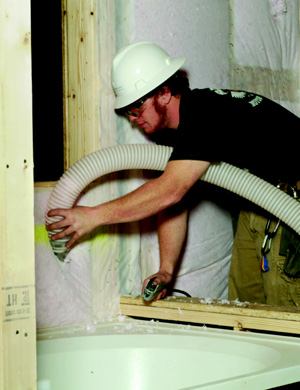
TRICKY SPOTS: Neglected, a few troublesome framing junctures can sabotage a home's airtightness and effective R-value. But careful detailing at spots such as cabinet soffits (top), bathtubs (middle), and floor perimeters (bottom) can help turn a basic home into a top performer.

TRICKY SPOTS: Neglected, a few troublesome framing junctures can sabotage a home's airtightness and effective R-value. But careful detailing at spots such as cabinet soffits (top), bathtubs (middle), and floor perimeters (bottom) can help turn a basic home into a top performer.

Credit: Harry Whitver

Take living space built into an attic. Bill Rectanus, who worked for five years as manager of building systems technology for New Town Homes in Denver, says, “Traditionally, people built an attic knee-wall with drywall, insulation, and then attic air space. And you didn't put anything on the outside of that insulation, because it was in the attic, away from the elements.” But the back of the insulation faces attic air that is frigid in winter and roasting in summer—“and your insulation won't perform as it should with no protection on the back side.”

“We have hundreds of thermal images showing that these assemblies were not working,” Rashkin says. “R-19 attic knee-wall insulation, according to the infrared cameras, was performing like R-1.”

HIDDEN ASSET: Invisible once the house is finished, fireplace and chimney chases are notorious for poor detailing. Here, New Town Homes crews have fully insulated and air-sealed the wall before framing out for this direct-vent unit, leaving just the code-required gap between the vent thimble and the insulation.

HIDDEN ASSET: Invisible once the house is finished, fireplace and chimney chases are notorious for poor detailing. Here, New Town Homes crews have fully insulated and air-sealed the wall before framing out for this direct-vent unit, leaving just the code-required gap between the vent thimble and the insulation.

Credit: Dot for Dot

“It's a huge comfort issue,” says Rectanus. “In summer, a hot wall can make a room feel like it's at 80 degrees Fahrenheit even if the thermostat says it's 72 degrees Fahrenheit.” With air conditioners struggling to handle the unbalanced loads, thermal bypasses can be a formula for customer dissatisfaction.

Missing or exposed insulation behind bath or shower units is another example, says Rectanus. “There are some amazing thermal photo: courtesy dot for dot imaging pictures out there of very, very cold bathtubs. Where in the house do you least want to be cold? The bathtub.”

And big bypasses can torpedo the performance of an otherwise efficient house. Says Harley, “When you mention energy leaks, people think about cracks around windows that you can stick a dollar bill through. But we're talking about holes in the building enclosure that you can stick your head through, or even climb through.” In training sessions, Harley cites an example he observed in New Jersey: the chimney chase for a zero-clearance fireplace, set behind a wide stone hearth. “The chase was 12 feet wide and 2 feet deep, for a 20-inch metal vent—and it was wide open to a vented attic,” says Harley. “I could have fallen in that hole.” The home's cutting-edge ground-source heat pump system couldn't keep people warm: “It ran on electric resistance all winter long.”

Conversely, eliminating bypasses can help ensure performance. At New Town Homes, says Rectanus, advanced framing, good windows, efficient HVAC, and attention to bypasses have yielded better-than-Energy-Star results: New Town's single-family houses get HERS ratings in the high 60s or low 70s. (In the Colorado climate, 85 or lower qualifies a home for the Energy Star label, where 100 is a base-case code-compliant house and zero represents a zero-energy home.)

Credit: Dot for Dot

DETAILS THAT COUNT

Knee-walls and chases are just two of 23 potential bypasses that the checklist calls out.

But in principle, the solution is always the same. Every house needs a continuous air barrier of air-blocking material, as well as a thermal barrier of insulating material. And to avoid bypasses, all the insulation must be in direct contact with an air barrier on all sides. Rashkin talks in terms of “six-sided” assemblies—just like any ordinary stud cavity, every insulated assembly has to enclose the insulation on all sides: left, right, top, bottom, front, and back. The only exception is an attic floor, where the topside of the insulation is left exposed—and even there, insulation has to be protected from wind washing at the eaves.

The bypasses are easiest to address in simple designs, notes Rashkin. “In the Northeast and Mid-Atlantic, where you still see a lot of conventional colonial homes without crazy pop-outs or nutty ceiling configurations, it's not as complicated. Out West, you see a lot of open layouts, open web floor framing, high ceilings with lots of dropped architectural features—those increase the complexity and difficulty of doing the checklist.”

WARM EDGES: Where eave vents create indrafts of hot or cold air, attic insulation needs special protection. Here, New Town Homes framers have installed a waxed cardboard baffle between the trusses to deflect inrushing ventilation air away from the loose-fill fiberglass, while still allowing the attic to breathe.

WARM EDGES: Where eave vents create indrafts of hot or cold air, attic insulation needs special protection. Here, New Town Homes framers have installed a waxed cardboard baffle between the trusses to deflect inrushing ventilation air away from the loose-fill fiberglass, while still allowing the attic to breathe.

Credit: Dot for Dot

Rectanus argues for an “integrated design” process, where everyone involved in solving the problem has a chance to contribute early input. “You don't get the design all done, then hand it to your framer and your HVAC guy. You invite everybody to the table and say, ‘Here's what we're thinking.' So your framer, your HVAC contractor, your building science consultant, get the chance to say, ‘OK, if you really want to do this, you have to consider all these details.' I've seen designs with bathrooms over cantilevers, with plumbing next to unconditioned space. To a building scientist, that makes no sense.”

But site management is also critical to success. Often, insulation or backing material has to be installed after framing but before some other step, such as placing bathtubs. Rashkin says, “The kind of simple coordination you do as a builder is, you leave some batts of insulation and some thin board sheathing material on site for the framer, and the framer knows it's his responsibility to install that material where the tub will go.”

For complex ceilings, says Rashkin, it helps if you identify a flat plane somewhere in the framing configuration, and install backing that defines the house's air barrier along that simple shape. “Let all the undulating surfaces and drops and arches happen below that, and just keep your house simple,” he explains.

BOXING OUT: Where walls separate conditioned space from a hot or cold attic, solid backing for the insulated wall is an important, but often neglected, factor in the insulation's performance. In the next slide, a builder has backed a high wall with sheets of ThermoPly; at right, OSB serves the same purpose.

BOXING OUT: Where walls separate conditioned space from a hot or cold attic, solid backing for the insulated wall is an important, but often neglected, factor in the insulation's performance. In the next slide, a builder has backed a high wall with sheets of ThermoPly; at right, OSB serves the same purpose.

Credit: Advanced Energy Corp.

MAKING IT WORK

Simple in theory. But in practice? “Our trick is that we have a working foreman/superintendent,” says Paul Yandow, co-owner of award-winning Burlington, Vt., builders Yandow Dousevicz Construction Corp. “He actually does the foam, the backers, all the checklist stuff himself. And he knows how to do it right, not just cover it up. But even then, it's a job to make sure other trades don't come along and undo something we've done just because they don't understand the reason for it.”

Some cases cry out for new materials. For living spaces over garages—an especially tough detail—Rashkin recommends spray-foaming the underside of the upper room's subfloor. “That gives you both an air barrier and insulation; you don't need to worry about blocking the edges.” Rashkin says he's been accused of being a foam rep. But he argues, “Foam is just a natural for the band joists, the garage ceilings, cantilevers—so many tricky spots where it's hard to get it right with other materials. So I ask builders to at least consider it.”

For many builders, the new checklist can be a significant challenge. Rick Maranhis is vice president for construction at The Green Co., an Energy Star Partner builder based in Newton, Mass. As the Jan. 1, 2007, phase-in date for the new Energy Star spec approached, The Green Co. took envelope airtightness for granted and focused mainly on duct sealing.

“Our mechanical contractor has done a great job, and we now have consistently low duct leakage ratings,” says Maranhis. “But then our first home out of the gate in January failed on the thermal bypass checklist.” Now, his company is struggling to work effective details into the company's evenflow production schedule and its panelized building system. “As of Jan. 1, the thermal bypass checklist has really caused problems,” says Maranhis.

COSTS AND BENEFITS

And however a builder handles it, there's no escaping reality: The management problem, the added labor time, and especially the need for new insulation materials add up to new costs for builders. “Don't get me wrong; it's easy to figure out how to do it,” says Maranhis. “But right now, in today's market in the housing industry—it's like ‘Let's Make a Deal' out there. People come through saying, ‘What are you going to give me? The builder down the street is willing to do this, this, and this.'” Justifying any new cost is tough—“I already have enough pressures on price,” adds Maranhis.

Credit: Advanced Energy Corp.

No builder is immune to cost pressures, Rectanus acknowledges. “National companies start looking at these details and think, ‘Nobody else is doing this. Why should I do it?' But hopefully they'll look and say, ‘Wait a minute. This reduces my risk and liability. This increases my buyer's comfort and satisfaction.' There are positive dollar signs associated with both of those things that are just harder to quantify.”

Up-front costs hit the bottom line immediately. “But it takes two or three years of compiling data and tracking it before you say, ‘Wow, I didn't spend near as much on warranty for that house as I was spending in the past. I'm seeing positive returns on this extra $2,500 I put into this house.' And it's a hard way to think,” says Rectanus. “But I think the builders who are going to succeed the best in the future are the ones who stay aware of the long-term benefits and not just the up-front costs.”

HAVE POWERPOINT,WILL TRAVEL

Revising the Energy Star standard wasn't easy—and selling the idea to builders, says Sam Rashkin, has not been easy either. Rashkin has been a one-man road show touring the country to explain why the standard has changed, what the new rules require, and how builders can implement the measures that will allow them to meet new, and significantly tougher, tests for Energy Star compliance.

So why are the rules changing? According to Rashkin, the EPA really had no choice: “We had to protect the brand.”

When the program started in the mid-1990s, an Energy Star label on a house meant that the house was 15 percent more energy efficient than a home built to the 1993 Model Energy Code (MEC). In the decade that followed, says Rashkin, the program helped to spark just the market transformation its creators had hoped for. In many markets, even mainstream builders adopted energy-efficient improvements like low-E windows, tight ductwork, and efficient furnaces.

But as officials continued to toughen the Model Energy Code and its successor, the International Energy Conservation Code (IECC), Energy Star fell behind the curve. As the 1993 MEC, Energy Star's original baseline, became obsolete, Energy Star lost its edge: In jurisdictions with more recent energy codes in force, any code-compliant house could qualify for Energy Star. “The changes we stimulated were good,” says Rashkin, “but we were no longer protecting our brand message and our brand promise—which was that we were substantially more efficient than standard products in the market.”

With the new spec, says Rashkin, an Energy Star label once again means that the labeled house stands a good head taller than its competition in terms of energy savings. The evidence is more than anecdotal, he says: In a detailed survey of 7,000 homes in the Phoenix market, Raleigh, N.C.–based consultant Advanced Energy Corp. found a clear positive result from using the upgraded thermal bypass details. “They had 3,000 baseline homes, built with standard practice for Phoenix,” says Rashkin. “There were 3,000 Energy Star homes, built to our old spec. Then there were 1,000 homes in a guaranteed-performance program for a local utility that used thermal bypass details like the ones our new spec requires.” The ordinary Energy Star homes produced savings of 36 percent compared with typical Phoenix new homes, says Rashkin, but the 1,000 homes built to the tougher checklist saved double that.

It's a one-shot chance to beat the competition, argues Rashkin. “You can't go back and add those thermal bypass details after you close that home—not without taking it down to the studs as a gut-rehab.” Competing against existing homes, or even new homes that don't use the checklist, says Rashkin, “you just made 90 percent of your competition obsolete. They don't compete with you, and any infrared camera comparison would show that.”

THINGS GET TOUGH ALL OVER

Energy Star's standard revision was forced on the program by advances in the rest of the industry, says Sam Rashkin. But the makeover came at an awkward moment—because the same period brought other big changes. States were starting to adopt the tougher, new 2003/2004 IECC. Then, Resnet, the national organization of Home Energy Rating Service (HERS) raters, decided to modify its rating scale. In fact, Resnet turned its standard upside down: In place of the old scale running from 80 to 100, with a code-compliant house scoring 80 and a theoretical zero-energy house scoring 100, the new Resnet index sets the code-compliant house at 100 and a zero-energy house at zero. (On the new scale, a lower score means a better house.)

KEEP IT SIMPLE: Here, framers have nailed OSB sheathing to the bottom edge of roof trusses before building down a stepped tray-ceiling soffit. The OSB provides an air barrier between the conditioned room and the attic and gives attic insulation a flat place to rest.

KEEP IT SIMPLE: Here, framers have nailed OSB sheathing to the bottom edge of roof trusses before building down a stepped tray-ceiling soffit. The OSB provides an air barrier between the conditioned room and the attic and gives attic insulation a flat place to rest.

Credit: Advanced Energy Corp.

Bruce Harley chairs Resnet's technical committee. Harley sees an advantage to the new index's wide scale and its emphasis on the ideal zero-energy maximum. “We wanted people to see the difference between [an incremental improvement and a real breakthrough],” he says. “If you've got a base case at 80, Energy Star at 86, and zero energy at 100, it's hard to differentiate. Now, the base case is 100, Energy Star is 80 or 85 (depending on your climate), and you've got a long scale ahead of you on the path to a zero-energy home.”

But some energy raters warned of confusion. Vermont rater Patrick Haller, for example, commented that “[this] could set us back several years in educating builders about threshold scores.” Changing the HERS system while Energy Star was also changing could be a management nightmare in the field, worried Haller, especially for states with limited resources and many small builders to reach: “We expect to lose participation.”

But Haller now says things haven't gone so badly. “Our worst expectations have not been realized,” he told BUILDER in March. “In our area, builders are testing the newer system and clearly want to succeed.” Bathtub and shower areas are proving a pesky detail: “General contractors seem to find it difficult to identify the sub responsible for putting in the air barrier. The difficulty is in the sequencing of work.” Scheduling inspections has also been an issue—“the builders are giving very little time from request of inspection to putting up Sheetrock,” Haller says, “but we're pleasantly surprised by how flexible the builders are.”