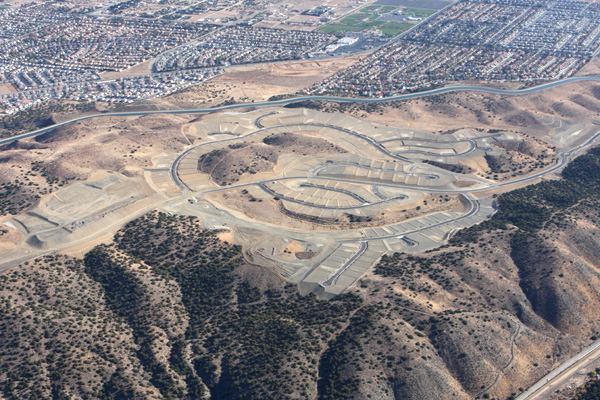
Credit: Courtesy J.P. Eliopulos Enterprises
Everything started to fall apart for Andrew Eliopulos on Christmas Eve of 2007. The president of
J.P. Eliopulos Enterprises in Lancaster, Calif., had been in a holding pattern with
IndyMac Bank on his construction loan, which had come up for renewal six months earlier.
But even with the depressed housing market, Eliopulos thought he was in good shape. He had about $27 million outstanding on the loan for the development and construction of Joshua Ranch, almost 900 acres in northern Los Angeles County. He had plenty of equity, though. In the spring of that year, as the loan was coming up for renewal, the bank got an $82 million appraisal on the property.
After meeting with his bankers in July to renew the note, he got a call that the bank thought the appraisal was stale. They wanted a new one. As the new appraisal was being conducted, IndyMac extended the loan for Joshua Ranch 30 days at a time, Eliopulos says. At the time, he looked into finding new financing, but his IndyMac lenders pressed him to hang in there. "They were saying, 'Don't worry, we'll get through this. We've got a good appraiser,'" Eliopulos says.
Throughout the fall, Eliopulos did "more than we were supposed to do" to stay current with the loans. Finally, on Christmas Eve, as Eliopulos was finishing up a half-day at the office before hosting the family's traditional holiday meal and playing Santa Claus to the kids, Eliopulos got a phone call from the bank.
The new appraisal had come in. It was for $17 million for both the vertical and horizontal sides of the project, nearly an 80 percent drop in value in roughly nine months.
Eliopulos was beyond stunned.
"I said, 'What, was this guy afraid to write 'zero'? If you're going to kill it, kill it all the way,'" Eliopulos recalls.
In his heart, though, he thought it was an honest mistake. What possible reason could IndyMac have to pull the plug on his loan? He'd been a borrower there for years. He was a good customer who had met all the performance requirements of his loans. Yes, it had to be a mistake.
What he didn't know until much later was that IndyMac Bank was desperate to get out of construction lending altogether. Or that within months, he would be at the center of the home building industry's battle to combat abusive banking practices.
The 'beginning wave' of litigation
Eliopulos was unable to meet IndyMac's demand to either come up with $10 million, the difference between the new appraisal and the outstanding balance, or pay the note in full. IndyMac foreclosed on Joshua Ranch and filed suit to collect from Eliopulos and his elderly mother on personal guaranties, which obligate individuals to make good on debts incurred by their corporations. Eliopulos countersued IndyMac for breach of contract, among other charges. In his lawsuit, Eliopulos alleges that in light of the subprime debacle, IndyMac "fabricated excuses that caused substantial delays in the project" and misled him "into believing that IndyMac would consider and evaluate the new loan application in good faith and would likely approve the loan application, when in point of fact, IndyMac had decided that it would no longer make construction loans."
Jeffrey Hermann, lead attorney for IndyMac in the suit, declined to comment.
"The suit is about IndyMac not having the means to go forward," Eliopulos says. "We felt they terminated the project, damaged it, and didn't allow us to seek a remedy. Had they told me this a year ago, I could have fixed myself."
He's right about that, says Bob Kline, principal of R.W. Kline, a Scottsdale, Ariz.-based real estate asset solutions company that works with both builders and banks. He has spoken numerous times with Eliopulos about his situation, but is not involved in its resolution. "They tied his hands a little early. If they had just told him a year ago they couldn't lend him the money, it could have changed everything."
Eliopulos' lawsuit against IndyMac is in "the beginning wave" of litigation against lenders by home builders, says Michael Hackard, principal of the Hackard Law Firm in Sacramento. Hackard also is a spokesman for the Homebuilders Coalition for Responsible Bank Behavior, a group of builders who have organized to try to push for legislative and regulatory change in banking practices.
"(Litigation) is a necessary step," says Mick Pattinson, president of Carlsbad, Calif.-based Barratt American. "Banks are pulling the rugs out from under the builders. If left unchecked, it will wipe out most of the industry. The games that are being played, the deceit, the tricks – we're the victims of it."
Hackard predicts that the suits will center on banks' duty to mitigate their damages in a contractual obligation.
"Banks have been offered short sales or purchases or acquisitions of loans that they have rejected," he says. "When banks foreclose, they have lost far more money than what was offered by the borrower or guarantor. I think you'll see a lot of development in that area."
Hackard also predicts there will be additional suits that are centered on banks ignoring the secured property and going after the builder's personal guaranties, which he calls "the nuclear option," and in the area of made-to-order appraisals.
"It's almost as if the bank continues to encourage the builder to pay interest and pay down principal and exhaust their resources," he says, "and then declare the default."
That's exactly what Eliopulos says has happened to him, and to the business his father started more than 50 years ago. When he got the call about the appraisal on Christmas Eve, he had no idea that his life was about to implode.
"It's a nightmare you can't wake up from," Eliopulos says. "It's really, really tough."
A family legacy
Petros Constandino Eliopulos brought his family of eight children, including his two-week-old son, John Petros, to Lancaster in Antelope Valley in 1918 because the high desert north of Los Angeles reminded him of his village in Greece. It is an area with more than its fair share of famous residents. Judy Garland lived – and first performed -- there as a youngster, and so did John Wayne. Frank Zappa graduated from Antelope Valley High School in Lancaster. But most of all, Antelope Valley became synonymous with the aerospace industry. Home to Edwards Air Force Base, the area drew the world's elite flyers, including the famed test pilot Chuck Yeager, who broke the sound barrier for the first time there in 1947. Boeing, Lockheed Martin, and Northrop Grumman all have operations nearby.
For more than three decades, the family worked the land as farmers. As the region grew, farming was phased out. John Petros and his brother started developing real estate. "They grew it into a pretty good operation," Andrew Eliopolus says. "We've been at this game a long time."
In 1989, Andrew joined his father in business as a developer and builder; in 1999, John P. Eliopulos died at the age of 80 and Andrew took over as president.
"We established ourselves," Andrew Eliopulos says. "We're a local home building and development company. We take a great amount of pride in our work and love what we do here. We're very committed to the community; we're rooted here. We've given various donations and have buildings named after us. We believe if you're in an area, you should give to it as it's given to you."
Over the years, the company built hundreds of homes, as well as commercial and industrial properties, in the area. In 2003, when the California real estate market was extraordinarily heated, Andrew Eliopulos bought Joshua Ranch. "It's a beautiful panorama view," he says. "You can see 100 miles from these home sites."
He paid about $4 million for the raw, entitled land and set up Joshua Ranch Development, a corporation to develop it into a subdivision of 539 estate homes. He and his mother, Georgia, went to their long-time lender, IndyMac Bank, for a construction loan to build the infrastructure. As with many development loans, they were asked to sign a personal guaranty, which required submitting extensive financial information -- including tax returns and bank statements -- to demonstrate that they had the assets to support the guaranty.
They complied. On Dec. 6, 2005, they signed a loan for $36,571,000, and started the long process of transforming a tract of raw ground into a community.
"It isn't just a project you do and you're in and out," Eliopulos says. "It's a long-term deal; everyone knew that. It took a year to grade the first hundred lots."
A seismic shift
In the spring of 2007, the grading was finished, the roads were paved, and the curbs and gutters were in. The only remaining development work left to do was the installation of utilities. With the renewal approaching for the loan, IndyMac ordered a new appraisal. According to Eliopulos, that appraisal came back at $82 million. At the time, Eliopulos says, he casually mentioned that he had put an additional $5 million of his own money in the project for site enhancements.
"We were putting money into places we thought would pay a good return," he says. "They didn't believe me. They wanted all this information. I said, 'Why do you want to know? You have an $82 million appraisal and a $27 million loan."
According to court documents, the bank accused Eliopulos of inappropriate use of loan funds and demanded an audit of his books. The audit ultimately confirmed that the funds had been used properly, but the process took more than two months, during which time the project – and Eliopulos' request for an extension of his loan – was delayed.
Finally, in July, he met with the bank's loan committee to renew the loan. "We're all thinking everything is fine, we just went through loan committee, we've been a borrower on other projects," Eliopulos says. "I get a phone call about five days later, saying, 'The senior loan committee feels your appraisal is stale. It wants another one.' It was 3 to 4 months old. … I've never been to senior loan committee, I'd never known it existed."
As the new appraisal was being conducted, IndyMac extended the loan for Joshua Ranch 30 days at a time, Eliopulos says. During that time, the bank more than doubled the per-lot payments, and told him he needed to pay the property taxes – about $400,000 -- personally, even though the funds to pay them were included in the loan. When he balked, he says, "They said, 'You want to look like you're doing the right thing for the bank. You need to pay them.'"
Ultimately, he paid $50,000 and the bank paid the balance through the loan, he says.
"They were able to coerce me out of another $50,000," he says. "It's just a horrible situation."
Then, he got the news about the new appraisal, and horrible went to unthinkable.
Kline says that properties can indeed have rapid drops in valuation, but the $17 million appraisal of Joshua Ranch was ludicrous.
"Anything south of $30 million was probably totally bogus," he says. "I can go out and get you an appraisal for anything today on the down side. Some financial institutions do that. But then I've had some builders do that, too, when they wanted to go buy the asset back from the bank."
The week between Christmas and New Year's, Eliopulos talked with his lenders again. He was told to prepare a business plan that would help the bank understand how he intended to make the project work – a common request today from bankers to builders in renegotiating their loans.
They scheduled a meeting for Jan. 22, 2008. Eliopulos says he arrived with a detailed plan that paid the bank everything it was owed. It even made a bit of profit.
"They just put it to the side, and said, 'Remargin the loan or pay us off in full,'" Eliopulos says. "They didn't even want to talk to us."
At that point, Eliopulos says he told his bankers, 'This is just wrong. You just quit on us.'"
The response, he says, was, 'That's the bank's position.'
Eliopulos says he told them he didn't have the money and they'd have to foreclose.
IndyMac did exactly that, both on the original loan and a second, smaller one, which Eliopulos had taken out to build three model homes and several houses. On April 1, 2008, the bank filed suit against J.P. Eliopulos Enterprises, Andrew Eliopulos, and his mother, Georgia, in pursuit of the assets in their personal guaranties on the two loans. The suit put them into default with the project's other lenders, who required that they be in good standing on all their loans.
And then things got worse.
A security breach
Eliopulos quickly learned that the lender had included his notes in a portfolio of recourse loans, and hired EastDil Secured, a real estate investment banking company, to sell the portfolio. Pre-qualified buyers signed a confidentiality agreement, promising not to talk to Eliopulos.
They then received a password to a secure Web site that contained a sales brochure on the portfolio of loans. To his horror, he also learned that since he had secured the loans with personal guaranties, prospective buyers had access to his detailed financial information, including his tax returns, his bank account numbers, and even his children's social security numbers.
"I owe the bank $27 million; I had to give the bank hundreds of pages about me being a credit-worthy borrower," he says. "And yet, someone signs one page saying they can qualify for a loan and gets 2,000-plus pages about Joshua Ranch. There's all my financials. My pants are at my ankles."
Through his attorney, he demanded that EastDil Secured remove his personal financial information from the Internet. They refused, saying they were only doing what their client, IndyMac Bank, had instructed them to do. A person familiar with the process of selling loan portfolios told BuilderOnline.com that it is standard industry procedure to include financial information on loans secured with personal guaranties, and that the information was on a secure, password-protected Web site.
Not long after the documents were released, Eliopolus got a panicked phone call from the Lancaster, Calif., branch of American Security Bank. Someone had tried to transfer $2 million dollars out of his bank account.
The person had initially called the branch farthest from his home and identified himself as Andrew Eliopulos. The employee noticed that he was a large customer and referred him to his home branch. When he called the Lancaster branch, he got operations officer Kathy Conely. As soon as she heard the voice, a monotone that was nothing like the friendly, outgoing person she has known for a decade, she says she knew something was wrong and confronted him.
"It was obvious it wasn't Andrew," Conely says. "Even if he's busy, he's a gregarious, fun-loving guy. … I said, "This isn't my Andrew. Who is this?" and he hung up." She immediately called Eliopulos, who called the police and started the process of closing accounts.
"I've never been compromised in business," he says. "Never. It doesn't take a brain surgeon to figure it out."
His attorney sent a cease and desist letter to IndyMac's attorney, he says. They declined to remove his personal financial information from the site.
On May 20, Eliopulos filed suit in Los Angeles Superior Court against IndyMac and EastDil Secured, alleging invasion of privacy, negligence, and intentional infliction of emotional distress in the release of his financial information.
Martha Wallau, chief operating officer for EastDil Secured, confirmed that IndyMac Bank hired the company to sell its portfolio of recourse loans and that prospective buyers were pre-qualified by the bank and signed a confidentiality agreement. She declined to comment on the litigation.
In the same suit, Eliopulos claimed that IndyMac engaged in unfair business practices, and breached its fiduciary duty and an implied covenant of good faith and fair dealing by delaying the project and refusing to continue funding it.
In June, Eliopulos attended the Pacific Coast Builders Conference in San Francisco and heard about a new group, the Homebuilders' Coalition for Responsible Bank Behavior. For the first time, he saw how widespread the problem was – there were at least 40 other builders facing similar situations.
"It's wrong what (the banks) are doing," he says. "Look at the people who get hurt. It's not just builders. It's engineers, surveyors, framers, concrete guys. Cities get left with blighted properties and don't get the fees they were expecting. It's a big domino effect that winds up destroying communities. … I was rotating $5 million a month in and out of our operations. I was feeding a lot of families. And I'm small in the scheme of things. There are much bigger companies in the same situation."
The feds step in
On July 11, the Office of Thrift Supervision closed the financially strapped IndyMac Bank, and appointed the Federal Deposit Insurance Corporation as its conservator. With that change in management, Eliopulos finally found a receptive ear to his request to have his personal financial information taken off the Internet – more than four months after he first requested its removal.
But he continues to battle the fallout from the bank's confidentiality agreement, which has prevented interested buyers of Joshua Ranch from talking to him.
"There is a guy who wants the project; he needs to talk to me to get his arms around it," Eliopulos says. "My attorney has asked IndyMac to unwind the confidentiality agreement so he can get educated and make a very clear offer to purchase. They won't allow it.
"They are taking people out of the game; that's blasphemy," he says. "It's a discredit to taxpayers and FDIC. If they're going to liquidate assets, they need to allow people to come talk to me. We have a ready, willing, and able buyer who wants to make an offer to purchase, and this bank will not allow him to talk to me."
With the FDIC takeover of IndyMac, Eliopulos' lawsuit has been delayed. An initial hearing, originally scheduled for Aug. 18, has been rescheduled for Oct. 1. But for all practical purposes, his career as a home builder – at least for now -- is finished. He has closed the business he and his father started together.
"I don't have a company anymore; I had to shut it down," he says. "I'm trying to hold my head high in a community I've lived in for years because my bank lied to me."
Moving on
These days, Eliopulos tries to concentrate on what is most important to him. He has his family, his faith, and his health. He can find joy in watching his 6-year-old son earn a new belt in karate, and in seeing his 4-year-old daughter show off the dance steps she's learning at Greek school. He knows that he has the skills and experience to be successful again in home building and is working toward that goal.
But there are times when he wonders how it all came to this.
"What gets me is these banks are so vicious, messing with people's heads," he says. "All the big banks are doing it – all of them. They sit down and manipulate you and coerce you to do things, and when they can't get anymore, then they turn the knife. If they want to take me, take me out. It was a family-owned company – my mother, my wife, and me. You want my house? You want my mom's house? Where does it end? This is a dark side of this country I never knew existed, but it's there. I have to tell you, my father fought in the Second World War with Patton. I know he didn't fight for this kind of stuff."