John Linden
The home is organized around a series of courtyards and outdoor …
Rooftop solar panels often look out of place in a home’s design—like a tacked-on afterthought or angular satellite dish, if not a landing pad for an alien spacecraft. It doesn’t have to be this way, says architect Lawrence Scarpa of Brooks + Scarpa in Los Angeles. “Sustainability or energy efficiency in and of itself is not a concept for design,” says Scarpa. “An energy hog that everyone loves and wants to hold onto is more sustainable than a net-zero house that’s an eyesore,” he maintains, because there’s less chance of its being torn down, the waste consigned to landfill.
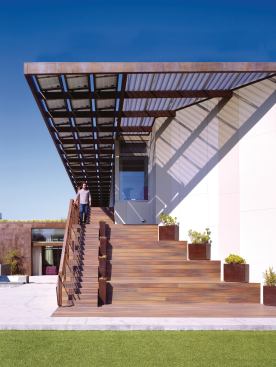
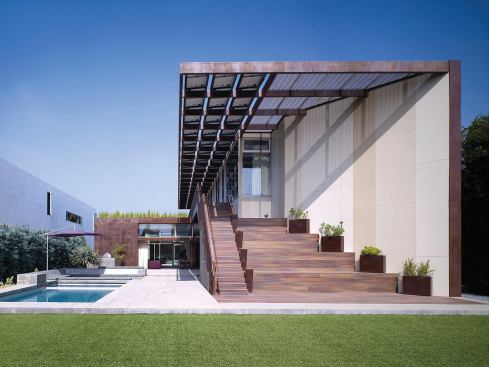
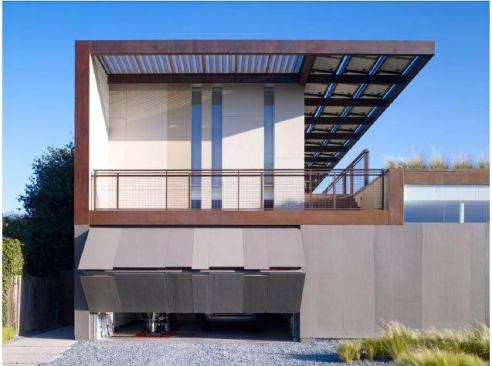
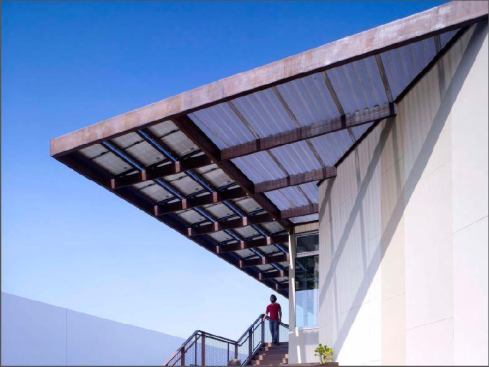
And so it needs to be with solar panels, Scarpa insists. They have to contribute to the architecture. He and his team accomplished exactly that when they positioned the solar collectors on the Yin-Yang House in Venice, Calif. The 175-watt panels are integrated into the roof’s overhang in a louvered pattern that’s entirely intentional, the panels sloped, of course, to improve collection of the sun’s energy. The designers included gaps between the panels, so that sunlight could be filtered in between them. The result is a solar array that doesn’t just grab sun but provides shade, too. Perforated metal on the overhang continues the filtering done by the solar panels. At 12 kW, this home’s solar array is a beefy one—the biggest system of its kind currently allowed for residential use. But for all their collective heft, the panels make sense as a part of the whole.
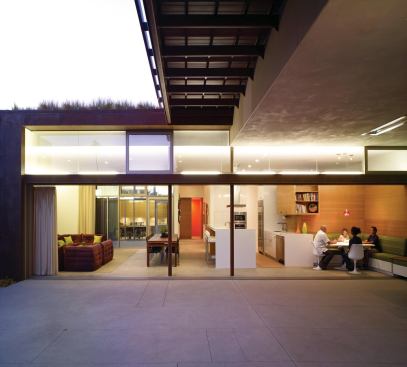
The house is designed for passive efficiency, too. It’s mostly one-room deep, so both floor plan and site orientation take maximum advantage of the elements: sun for warmth and light and breezes for natural ventilation. Blown-in cellulose insulation and a geothermal system bump up efficiency, too. The owners moved into the house over a year ago, and they haven’t yet received a power bill, says Scarpa.
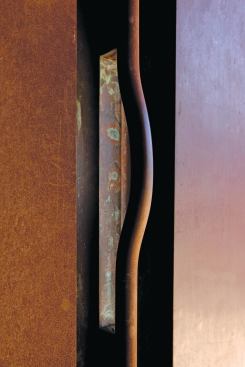
Scarpa’s choosing to set the solar array front and center, plus the use of industrial materials such as steel and concrete make for a look that’s modern, to be sure. But those cool elements are balanced by the warmth of wood. They are also offset by thoughtful, handmade touches. The front door is metal and measures 6 feet by 10 feet, with a forged steel bar stretching from top to bottom. To relieve the door’s massive feel, Scarpa (trained as a sculptor) wanted to add a tactile, simple element. At door-handle height, the floor-to-ceiling bar is bent, forming a bump-out, inside of which nestles a piece of naturally oxidized metal. The speckled metal serves as a grip, its green patina adding texture and visual interest, a small, functional bit of sculpture interrupting the vast flat plane of steel. This quiet flourish sets up a balance of industrial with handmade—a balance that helps the Yin-Yang House to wear its name well.
Learn more about markets featured in this article: Los Angeles, CA.