FERNDALE, MICH., IS A NEIGHBORHOOD of 100-year-old houses, mostly bungalows with coved ceilings, plaster walls, and gabled roofs. It offers a small downtown with vintage-clothing shops, ethnic restaurants, and alternative music and is one of Detroit's most welcoming 'burbs for gays.
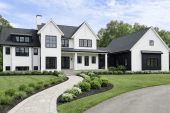
Now, Ferndale is also home to an innovative new residential project. The recently completed structures are boxy, geometric houses with the open spaces, industrial materials, and tall ceilings characteristic of urban lofts.
SOMETHING DIFFERENTArchitect Robert Miller and builders Scott Wright and Steve Ruszkowski didn't set out to create loftlike houses; they just wanted to create something different, something that would blend in with the neighborhood but also offer dash and flair not yet seen in these parts.
Apparently, they've hit on a winning idea: All three of the 1,700-square-foot, two-story homes sold before they were finished, at prices higher than those of comparable homes. (The highest comparable price tag in this part of Ferndale last year was $220,000; these three sold for $250,000 to $267,000 in a severely depressed real estate market.) They're so popular, says Wright, that as many as 20 people stop by on weekends to snap pictures of the unique abodes.
“This town was founded on being different,” says Miller. “This was all about doing something different. I get calls about it all the time. Builders want to buy the plans. I won't sell because it's not about plunking them down all over Ferndale.”
When the city put five lots up for sale in a location bordering an industrial part of town, Miller decided to bid on the project. (The city used two of the lots for a live/work project at the end of the street.) Living next door to the properties, he didn't want to see cookie-cutter white vinyl boxes thrown up with glaring garages out front.
So Miller and Wright, who is also a Ferndale resident and builds loftlike homes in other neighborhoods with Ruszkowski, put together a proposal. Both Miller and Wright are members of the design committee for Ferndale's Downtown Development Authority, and their original concept grabbed city planners' attention, even though their bid was the highest.
The three homes are a buffer between an industrial strip to the east and the traditional bungalow neighborhood to the west, and their style includes details from both worlds. While Wright and Ruszkowski were attracted to the hard-edged materials of industrial buildings, Miller called on his childhood in rural Indiana. They used barn-metal siding on portions of the exteriors, created porches of poured concrete with steel I-beams for posts, and left the foundations raw, exposed above grade. Part of each roof is corrugated steel, with the rest comprising typical residential asphalt shingles.
Because they wanted the houses to fit in with the neighborhood, the construction team used traditional gables to temper the steep roofs. Also, the houses aren't set far back from the street. Inside, the layouts are as open as possible, with as few defined spaces as the team could manage.
Each house has 53 windows and ventilates like a wind tunnel, providing plenty of fresh air and natural light. Many of the windows are high, so the very-close neighbors can't look directly in, but those who live here enjoy views of treetops, night stars, and blue skies.
Inside, the houses' trim is marine-grade plywood with the ply showing. (“The material is the detail, not what we do to it,” says Miller.) The kitchen and bathroom birch cabinets are from Ikea and are complemented by exposed ductwork, stainless steel shelving, and subway tile. In one home, the stairway railing was made from aircraft cable and turnbuckles, and sliding barn doors with galvanized water pipe for handles hide a second-floor laundry alcove.
LOFTY ASPIRATIONSThe current loft craze began 30 years ago in New York, when industrial buildings were converted into residential units and were claimed by artists and others who preferred a “bohemian” lifestyle. Those first lofts were known for their undefined spaces, high ceilings, and exposed pipes, ducts, and concrete.
It took 10 years for the concept to catch on in other cities, says Christopher B. Leinberger, a fellow at The Brookings Institution, in Washington, and partner in Arcadia Land Co. in Wayne, Pa. In the past decade, builders have started creating lofts from scratch, new buildings intended to look like industrial buildings of old but designed to be residential, he says.
“Part of it is fad, but part of it is a reflection of the more informal nature of parts of society,” says Leinberger. “It's taking to its logical conclusion what single-family builders have been seeing for years when they built great rooms and all of a sudden the entire house becomes a great room.”
While there aren't many builders creating new single-family homes with the look, feel, and materials of urban lofts, the trend toward more-open spaces is sweeping the nation, according to Gopal Ahluwalia, staff vice president for research in the NAHB's Economics Department.
And the loft concept itself has become a brand, according to Robert M. Beckley, professor and dean emeritus at the University of Michigan's Taubman College of Architecture and Urban Planning. “There is a certain romantic notion tied [to] lofts and the creative class,” he says.
There's also something attractive about an aged look, Beckley adds. “It's not easy to replicate a sense of age in new construction,” he notes. “Older lofts developed character over time. The bricks used in buildings in the late 1800s and early 1900s were soft, the floors were soft wood, and both show the nicks and scratches that time produces.”
“It's a challenging concept” to build a different style of home that still blends in, says David Strosberg, president of Morningside Group, a Chicago-based firm that builds residential lofts in the Midwest. “If you believe in traditional principles of design, you want form to follow function, and if this building is a residential building, it'll have a lot of the same attributes of a residential building,” he says. “You may use different materials, you may use the materials in unique ways, it may have spaces that are different from [those in] a traditional home, but it's going to have the scale of a residential building. There shouldn't be any reason that it wouldn't blend [in]. It doesn't have to be a box of glass.”
The three houses on Academy Street in Ferndale definitely are not boxes of glass.
“We were afraid of being too cutting-edge,” says Wright. Based on the market's enthusiastic response, however, “we ended up not being cutting-edge enough,” he observes.
But, as Miller explains, blending in doesn't have to mean relying on construction clichés: “We wanted to show people that you don't have to keep doing the same thing over and over again.”
Lynne Meredith Schreiber is a freelance writer based in Southfield, Mich.