FLORIDA BUILDERS HAVE A MESS ON their hands. After four hurricanes, many areas need massive rebuilding and retrofitting but lack the labor and materials to get the job done quickly. In the worst-hit areas of the northwest panhandle and the southwest Gulf Coast, construction crews have had to contend with gasoline shortages, power outages, 10-foot-high piles of moldy couches and carpets, soaking-wet fiberglass insulation, and crumbled gypsum since hurricanes Charley, Frances, Ivan, and Jeanne bombarded the state within weeks of each other last August and September. On hard-hit Captiva Island, construction workers have begun to wear bio-hazard masks to protect themselves from airborne mold. Even inland areas such as Orlando suffered from the storms—especially from water infiltration. The Florida HBA has received more than 1,000 complaints from new-home owners citing water leakage. The most common complaint: water penetrating through concrete block walls.

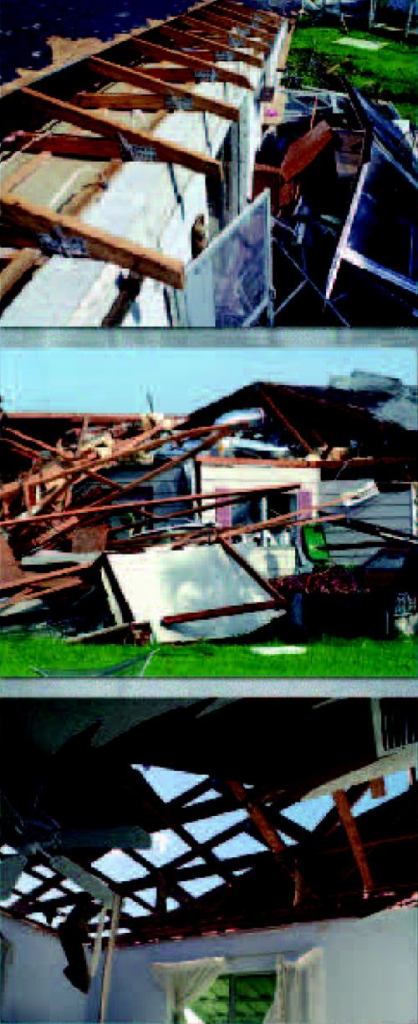
INFIRMITIES OF AGE?: Nearly all the severe structural damage from Florida's four storms struck homes built prior to new codes and building techniques. In a typical tear-down scenario, homes lost shingles, then sheathing, and then walls to high winds.
The FHBA has hired an engineer to look into the problem, says Edie Ousley, spokesperson for the association's Orlando headquarters. One complication, she says, is that “insurers are not covering the damage. They're calling it a construction defect.” She notes that the problem could be related to the use of certain types of stucco finishes or paint.
Ousley says the situation is tough to assess because a scenario like this—four consecutive storms—was never supposed to happen. After the first storm hit, people lost power, so they couldn't dry their homes out before the second storm arrived. “We're not building waterproof homes,” she says. “They're water-resistant so they can breathe. But we may wind up seeing more of a definition in the code about what you can use for covering. In the meantime, we're keeping our builders informed and in the loop.”
When the social and financial fallout from these storms is finally tallied, it's not home builders who will bear the brunt of the suffering. The worst hardships of reconstruction will fall on low- and middle-income Floridians, who may be forced to meet much tougher (read “more expensive”) code requirements. For those who have lost their modest manufactured homes, the future is even more uncertain.
“I think you'll see the state looking at changing the code again, making it more widespread,” says Debi Peterson, executive officer of the Flagler County-Palm Coast HBA. “But we've already just been hit in this county with three impact fees in one day. And land prices are already sky-high.”
Peterson also fears that the storms will result in a clampdown on manufactured housing (see “Manufacturing Change”), leaving many buyers unable to afford to own anything in Florida. “When you're talking about $60,000 for an inland lot that's 80 by 125 feet, that pushes a lot of people out of the market,” Peterson says. “I think you'll see demographics changing in the state. You will find builders and consumers going other places.”
That hasn't happened yet. Maybe it doesn't have to. Based on what Builder's editors saw when they visited Southwest Florida following Hurricane Charley, costly, exacting codes may not be what's needed to save lives and structures in the future. Most of the major storm damage can be traced to a half dozen or so specific causes, outlined below. Address these, and the next storm should have a lot fewer weak points to exploit.

AFTERMATH: Downward pressure from wind entering soffits collapsed ceilings in otherwise undamaged homes (left). Flat roofing tiles, clay and cementitious, proved vulnerable to hurricane winds—in part because many were fastened with mortar only. Experts suggest using screws to anchor tiles.
PRESSURE POINTSBefore we review some of the frequently damaged areas we saw in new construction, one caveat: Nearly all of the severe damage we encountered that affected site-built homes was in neighborhoods 10 or more years old. To narrow the field even more, the least-maintained homes showed the most noticeable damage. Ten-year-old asphalt shingles flew away; new ones didn't. Homes without shutters or impact-resistant glass lost windows; those with these features repelled debris.
What's more surprising, however, is that despite winds up to 130 mph from Charley, very little structural damage was visible on homes less than 10 years old—which includes numerous homes built prior to Florida's 2002 wind codes. That doesn't mean those homes escaped unscathed. Thousands are still unlivable. That's because wind and rain penetrated the structures, soaking them down and tearing them apart. So for our analysis of construction weak points, we've focused on penetration points—kinks in the peripheral armor of the home.
Blown Away: Soffits. Leslie Chapman-Henderson, president and CEO of the Federal Alliance for Safe Homes, in Tallahassee, Fla., identifies soffits as a major weak point highlighted by the Florida storms. Our observations corroborate that assessment. “In Charley,” she says, “we saw lots of homes with all the roofs intact, but people got back inside and found that wind had blown off their soffits. Once it does that, it pushes down on the upstairs ceiling and collapses the ceiling. That pressure has got to dissipate somewhere.”
J. Raymond Byron, chief plan examiner in Charlotte County in Southwest Florida, says that in his area he inspected many buildings erected under the latest code and found the soffits lacking. “The single biggest problem areas were aluminum soffits and fasciae,” he says. “With very few exceptions, soffits were missing.” Byron expects a soffit section to be added to the code now that the weakness is known.

GUT WRENCHING: Once installation and other materials are soaked down—even in relatively new homes such as this one in Fort Myers, Fla.—the damage is done. Warm outdoor temperatures combined with no electricity to run dehumidifiers or air conditioners result in a near perfect interior climate for growing mold.
Torn Off: Roofing. Driving from Punta Gorda to Orlando along the path of Charley, you can gauge the visible signs of damage by the number of blue tarps. The older the neighborhood, the more tarps. The failure or loss of asphalt shingles, in particular, appears to correlate directly with age. Newer homes rarely lost a single tab, with the exception of roll-type ridge vents, which were frequent casualties. With tile roofs, the difference was in installation, not age, although flat tiles almost always fared worse than barrel-type clay tiles. Barrel tiles hung on better than their flat cementitious or clay counterparts.
Chapman-Henderson attributes the high failure rate of many tile roofs to improper fastening. “Mortar setting of tiles alone doesn't do it,” she says. “Residents we spoke to said that when their barrel tiles were screwed down as well as mortar set, they stayed on.” The manner in which the screws are installed also matters, she adds. “The tiles need to be screwed at top and bottom, not just on one end. One of the worst cases of tile stripping on Sanibel Island took place on a custom home with a beautiful royal blue clay tile roof. The multiple-pitch roof lost about 60 percent of its tiles, in large part because they weren't screwed down.”
Shattered: Windows. Losing a window in a hurricane may not sound like major damage, but keep in mind that rain—often many inches of it—blasts sideways in those furious winds. The result: the equivalent of blasting every surface inside your house with a fire hose. Airborne debris of any sort can do a job on unprotected glass. In a high-wind zone, there's simply no excuse for not including some form of window protection (see “Glass Action,” page 382).
Byron notes that flying roof tiles greatly increased overall damage to windows and other features of nearby homes during last year's storms. In truth, he favors banning them and requiring standing-seam metal roofing instead.
“On Punta Gorda Isles, all the houses have to have barrel tile roofs” as part of a local covenant, Byron observes. “In fact, the local building inspector lives there. All the damage to his house came from his neighbor. Tiles came through his roof, windows, and screen cage and took the windshield out of his boat.
“Those cement tiles are quite heavy,” he continues. “The code reads that you have to have impact-resistant glass or shutters. [But] the impact-resistance test is a 7- or 9-pound missile at 60 miles per hour. Some of these tiles weigh at least that, maybe a little more.”

SHATTERED GLASS: Windows blown out by flying debris allowed torrents of water to enter many homes.
Knocked Down: Trees. Along with the loss of lives and property, Florida's tree cover suffered immensely from the spate of hurricanes. Cypress, magnolia, elm, and many other native trees across thousands of acres were either snapped in two or completely uprooted by the storms. On Sanibel Island, huge bonfires burned for weeks, marking neighborhoods that looked like the war-battered Pacific island jungles of Guadalcanal in 1942, with nearly every palm tree in sight either torn from the ground or broken in half.
Trees also played a major part in the damage done to homes and infrastructure, especially power lines, during the four hurricanes. “Hunter's Creek, a master planned community in Orlando, lost 1,700 trees during Hurricane Charley,” notes Daryl Spradley, a Maitland, Fla.–based housing consultant. “One reason for that is that there's a type of tree called a laurel oak that is being planted widely, but the roots are very shallow. They are very easy to topple.”
The complicating factor, Spradley notes, is that some communities now require that only certain trees be planted—often because planners have taken a liking to the look of a particular species. The result, in this case, is more vulnerability to wind damage.
There's plenty of information available on which trees do and don't hold up well in hurricanes. A 1995 University of Florida study by Mary L. Duryea, for example, looked specifically at Florida tree species after two hurricanes. Duryea concluded: “Some species appear to be better suited for use in hurricane-prone areas than others. Dogwood, sand live oak, live oak, sabal palm, and Southern magnolia are native trees that appear to tolerate hurricane-force winds extremely well. Less wind-resistant are laurel oak, turkey oak, Chinese tallow, and red maple. Southern red cedar, sweet gum, and silver maple all appear to have crowns which are easily damaged by the winds.”

ROOT OF PROBLEMS: Because many transplanted trees lack the root system to withstand high winds, many otherwise unscathed homes were damaged by toppled trees, as were landscapes, power wires, and local ecosystems.
Considering the scope of tree damage from Charley and Ivan last year as well as the resulting damage to nearby buildings and landscaping, proper tree specification in hurricane-prone areas should be taken more seriously by both master planners and builders.
DIVIDED FUTUREBuilders we spoke to and the National Association of Realtors note that despite the vulnerability to hurricanes, the hunger for new housing in Florida hasn't abated. Bob Carr, vice president of Brandon Construction in Palm Harbor, observes that the demand for homes hasn't dropped at all, although “the hurricanes solidified a trend, which was moving toward masonry construction and/or ICF systems on all three floor levels of our typical coastal high-end residences.”
Historically, builders often benefit following a hurricane. For example, Inman News reports, “Despite the wrath of Hurricane Andrew [in the fall of 1992], existing-home sales actually picked up in Florida in 1992 and 1993, rising 6.7 percent from 1991–1992.”
Indeed, even Southeast Florida, the area of the state that had suffered most from hurricanes up until this year's storm-fest, has seen a population increase of 600 percent since 1950. And home prices in the state overall have risen 83.5 percent in the past five years.

SUPER STRUCTURE: Concrete-dome homes have unique advantages in high-wind situations. Incredibly strong, they deflect wind, water, and debris. Mark Sigler, the owner/builder of this dome home in Pensacola Beach, stayed inside it during Hurricane Ivan, along with an NBC news crew, to make a statement about the need for hurricane-proof homes in high-risk areas. Most other homes nearby were severely damaged by waves, debris, and wind, but Sigler reportedly slept through the storm, remaining dry and safe.
Therein lies the economic paradox of the Florida hurricane cycle. With each new devastating storm, the quality and durability of housing is likely to rise. At the same time, the availability of affordable homes is likely to plummet. What remains to be seen is whether the state's current and future political operatives have the smarts, the resources, and the compassion to strike a balance—can they encourage new construction while enabling builders to provide affordable replacement housing that meets all new hurricane-driven construction standards?
EMPTY SHELVESLast year's hurricanes have put pressure on an already stressed market for building materials.
Within a few weeks of the first hurricane hitting Florida, Orlando-based Sunshine Roofing received 4,000 calls for reroofing estimates. In October, the company told local news reporters it had 200 homes waiting for new roofing and that some of those jobs might be delayed by as much as a year due to insufficient labor and materials.
And that's in a region with far less damage than coastal areas hit hard by Charley and Ivan. Even builders who weathered the hurricanes unscathed, such as WCI Communities, of Bonita Springs, Fla., are dealing with the materials backlog.
“We were lucky in that we were somewhat inland and not in the eye of the storm,” notes Kelly Goldsmith, marketing director for WCI's Fort Myers office. “Our community was built with the newer codes, so the thing that's impacting us most is the bottleneck with suppliers and trouble getting materials. We're having to put our orders in way in advance to make sure we have materials when we need them.”

DAMAGE CONTROL: Disposing of thousands of downed and damaged trees kept debris fires burning for days on hard-hit Sanibel Island, near Fort Myers.
MANUFACTURING CHANGENew HUD codes work, but a huge inventory of older manufactured homes remains at risk.
According to statistics collected by Florida Trend magazine, Hurricane Charley destroyed 12,000 homes in Southwest Florida and left another 19,000 “uninhabitable.” But what's more telling is that almost every one of those destroyed homes was a manufactured home.
That doesn't mean manufactured homes can't weather a hurricane. In 1994, two years after Hurricane Andrew destroyed 99 percent of all mobile homes in its direct path, HUD raised the building standards for manufactured homes. Those changes included tie-downs and anchor systems in high-wind areas, adding about $4,000 to construction costs. The problem: Only 16 percent of the 900,000 manufactured homes in Florida prior to the 2004 hurricane season were built after 1994.
Another complicating factor, according to Mark Nunn of the Manufactured Housing Institute, in Arlington, Va., is that people often tack on carports and additions.
“A lot of the [2004 hurricane] damage to manufactured homes built prior to 1994 was caused by carports,” says Nunn. “They added additional loads that the house was never designed to withstand. Carports generally took a portion of the roof with them when they failed, resulting in a buildup of internal pressure in the home.”
Conversely, when HUD officials toured Punta Gorda after Charley, they found that most of the newer manufactured homes built using the 1994 HUD code (especially those with hurricane shutters) performed well. Most of their damage was caused by windborne debris—and the homes weren't toppled or lifted from their anchoring systems.

FIRE AWAY: A Texas Tech University study last summer found that vinyl and fiber-cement siding in typical wall assemblies are penetrated more easily than brick. (Of course, like many hurricane-resistant materials, brick costs many times more installed than vinyl and fiber cement.) As part of the study, a 7-foot 2x4 was fired from a cannon (shown) into wood-framed walls clad in the three materials. Videos of the test show the 2x4 penetrating both vinyl and fiber-cement wall assemblies at 34 mph, while the projectile bounces off the brick. Richard M. Bennett of the University of Tennessee Department of Civil and Environmental Engineering carried out the tests, which were sponsored by the Brick Industry Association. Jery Huntley, executive director of the Vinyl Siding Institute, notes that no similar testing has been done of vinyl siding, because some of their products meet current Florida high-wind building codes and there have been no problems. And Denese Bottrrell of James Hardie Siding Products says fiber-cement siding has a proven track record against flying debris, as seen following Hurricane Isabel in 2003.
GLASS ACTIONThe choice between impact-resistant glass and shutters weighs economics against street appeal.
With tougher rules about window openings part of Florida's new building code in some counties, window companies see a potential new profit center. For affordable housing, however, storm shutters may be the only option.
Leslie Chapman-Henderson, president and CEO of the Federal Alliance for Safe Homes, says window protection is perhaps the most urgent requirement for new homes in hurricane zones. Even when new homes suffer little structural damage in a storm, blown-out windows can cause interiors to be completely ruined. One new affordable window-protection product, Fabric Shield, a fiber-reinforced synthetic material made by Wayne-Dalton Corp., costs about the same as aluminum panels, Chapman-Henderson says, but can be added to and removed from windows much more quickly and easily (see chart, below).

VARIETY PACK: With window protection such an important factor in minimizing hurricane damage, builders have a number of options at several price points from which to choose.
Credit: Source: Federal Alliance For Safe Homes