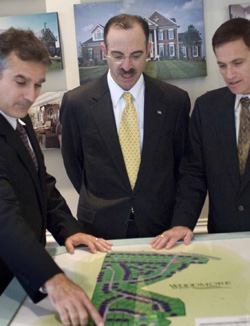
A tuxedoed stephen paul capped off a busy Thursday in October by accepting four design awards from two local HBAs in front of 1,200 of his similarly clad peers. It was an honor the executive vice president of Mid-Atlantic Builders has experienced many times before, as two trophy-stuffed glass cases in the firm’s Rockville, Md., headquarters attest.
Paul later lamented that his pet property, the airy, best-selling Somerset—the first model he designed by himself and one that has won the associations’ coveted local Monument Award four times already—didn’t reap another of the pyramid-shaped prizes. He concedes: “Four … is not too bad for our small company.”
Indeed, this 52-employee firm is doing better than “not too bad” along a stretch that Paul calls the “Mid-Atlantic corridor” in Prince George’s County, Md., the onetime struggling “ugly sister” of Montgomery County, the state’s most affluent, right next door.
Along that corridor, the 26-year-old company is building $1 million mansions as fast as the now-prosperous county’s growing population of affluent blacks, drawn to the bedroom community of Bowie, just a few miles from the nation’s capital, can buy them.
“Not only is it amazing that they can do homes like that in Prince George’s County, but they’ve been doing them for some time,” notes marketing consultant Brenda Desjardins, owner of New Home Marketing Services in Annapolis, Md. “Mid-Atlantic saw a substantial niche in the market and really built into it.”
7:02 A.M.: THE DAY BEGINS
The morning of the awards ceremony, the business of building those homes begins shortly after 7 a.m., when Paul, a onetime land planner who took some college architecture courses and went on to earn an MBA, arrives at work and starts tweaking plans on a drafting table.
On the wall behind the table hang three colorful crayon drawings of homes for sale, a long-ago gift from his now college-age son.
Seeing them conjures a scene from Paul’s own childhood: When his parents would not acquiesce to the 8-year-old’s demands to populate his train-board village with buildings, he built some Erector Set properties and scribbled “future building” on empty plots.
Yet even as a college student, Paul did not foresee his foray into home building. It wasn’t until 1990, five years after he partnered with Mid-Atlantic Cos. president Roger Lebbin, that the two expanded their land development firm into home building. That year, the builders they had developed a subdivision for went out of business, leaving the pair with an unsold, unbuilt community.
“We turned that lemon around after being stuck with that piece of property,” says Paul, who, with Lebbin, built 139 homes on the land. “It was almost a no-brainer.”
But Lebbin’s passion was for developing the land, not building the houses. So he made Paul the head of Mid-Atlantic Builders and remained at the helm of Mid-Atlantic Cos. Since then, Paul has overseen the building of 1,056 homes in more than 20 communities, mostly in Prince George’s County, where he is exercising his own passion for design.
9 A.M.: MANAGERS MEET
At a meeting of Mid-Atlantic Builders’ managers, a report by John Dorsey, who heads field production, tells the story of how Paul’s designs—and the company’s homes and operations—have changed.
In 2003, he tells 10 managers in a map-filled conference room, the firm closed on 136 homes, measuring an average of 3,700 square feet. This year, it will finish about 110 units averaging 5,400 square feet. And as the homes have gotten bigger, the number of options—from sunrooms and home theaters to art niches and grandiose, glass-block–enclosed “shower spas”—has increased into the thousands.
“We indexed every customer request and made them available,” Paul explains.
He adds, “We’re still a production builder. … I’m a mass producer of custom ideas.”
Those ideas, inspired largely by Paul’s trips to Europe—notably, Italy—include lots of curves: on drywall, glass blocks, exterior walls, balconies, kitchen islands, staircases, and even tiled whirlpool bathtub surrounds.
“Lumber is straight, but it doesn’t always have to appear that way,” says Lebbin, who readily boasts about his partner’s creativity. “We all work with boxes. Our box is a little bit different because it’s full of angles and curves.”
Lebbin admits the collection of curvaceous options slows cycle times and ruffles some subs. “It’s hard and expensive,” he says. “They say it’s too much trouble. But we say nothing is too much trouble.”
He adds, “We know we’re doing this the best of anybody in the market.”
Indeed, notes Desjardins, other upscale home builders have entered Prince George’s County because of Mid-Atlantic’s success. For years, she recalls, Bowie housing was geared toward middle-class buyers. “Mid-Atlantic tried to reach a market that was higher than that with what they put into the homes,” she says. “Other builders came in based on what they saw with Mid-Atlantic.”
Paul says those competitors give him incentive to add architectural details that other builders haven’t considered in a market that favors traditional, two-story colonials, such as front and back staircases that are not visible from the entry door, round foyers, tray ceilings, two-story kitchens, oversized kids’ rooms, and first-floor master suites.
Paul and Lebbin’s shared vision for their company revolves around “recognizing that details matter,” as well as integrity, reliability, respect for others, and commitment to excellence.
11 A.M.: PARTNERS MEET
After the morning managers’ meeting, the pair goes to Paul’s office, and talk turns to those shared values.
“That’s our religion,” says Paul of the company’s value statement. “The mission is about how you conduct yourself. We would have the same mission if we were in the paper cup business.”
Indeed, agrees Susan Matlick, executive vice president of the Maryland National Capital Building Industry Association, one of the associations that bestows the Monument Awards, “They are very detail-oriented, very driven. But if people meet their high standards, they treat them with great respect.”
The company’s trade partners are a testament to its loyalty. Dorsey, the field production manager, notes during the morning meeting that the company will need to find a new plumber—because the one whose company they worked with for years has died. Ninety percent of the subcontractors who worked with the firm in 2003 are still on Mid-Atlantic jobs today.
Likewise, most Mid-Atlantic managers have been with the builders long enough to work their way into top positions. And their jobs don’t stop at 5 p.m. An “unwritten policy” at the firm compels managers to get involved in their local communities as mentors, coaches, and fundraisers. Lebbin, a past president of the local building industry association, helped the association raise $100,000 for the 2005 Fannie Mae Foundation Help the Homeless walkathon.
The builders are similarly involved with their customers, splitting the chore of home walk-throughs between the managers—including Paul, who does two a month —rather than leaving them all to customer service reps. The effort, says Nicole Matthyssen, customer service manager, has paid off. On average, the managers discover 12 flaws per walk-through. A year ago, as the manager walk-throughs began, they were finding 40.
“The house sizes are getting bigger, but the problems are declining,” she points out.
12:30 P.M.: QUICK BITE
In
fact, after a lunch of deli sandwiches on this sunny Thursday, Paul and
Lebbin head to Bowie for an afternoon of what Paul calls “management by
walking around” in communities of models with names such as Venezia,
whose standard floor plan is 5,098 square feet, and Tara, named by an
employee who compared the 4,642-square-foot unit to Scarlett O’Hara’s
plantation home in Gone with the Wind. Once there, they shake
hands with a locksmith working in a model home, chat with some sales
reps, and note that a square bathtub had been specified for an oval
surround, which has created a problem with the ceramic tile
installation.
Lebbin says the company builds the kind of homes that he would like to live in, with touches that allow buyers to “feel, see, and touch the difference, even if they don’t always know why,” such as tiny step lights in the optional home theater, arched columns between the living and dining rooms, and a cascading view of the whole first floor from almost any room on it. Sales reps have even been taught where to stand in each room during a tour of the model so they give the potential buyer the best view.
“Whether they’re spending $200,000 or $500,000, we want them to feel like a million bucks,” says Paul. In fact, Mid-Atlantic, which broke a price barrier in 1994 when it sold Prince George’s County’s first $400,000 production home, starts today’s models in the $575,000 range.
Behind the scenes, adds Paul, he and his staff pay just as much attention to detail as they convert their traditionally paper-laden business to one they can keep track of via the Internet.
The builder’s model homes are devoid of colorful brochures and stacks of floor plans. Instead, a Design Your Own Home Online program lets potential buyers call up standard floor plans on a Web site and add optional rooms with a mouse click. Brand-new, custom-made business management software has replaced the spreadsheets and sample books sales reps once used to show and keep track of options and estimate prices for buyers. The Web-based program keeps prices up-to-date, eliminates duplication, and generates prices for the home with and without options.
“This is our sheet of music,” Paul says. “We’re all on the same page.”
The next movement in what Paul refers to as the “Mid-Atlantic symphony” will involve semi-detached, villa-style homes along a Prince George’s County golf course. And the company, which builds only pre-sold homes for prequalified buyers who plunk down a 10 percent deposit, is considering diversifying into West Virginia and Delaware as plots become increasingly sparse in Prince George’s County and regulations tighten.
Beyond that, says Lebbin, “If you have to get in a plane [to get there from Maryland], we’re not going there.”
Though a faraway community isn’t in the plans, Paul says the owners of a private company like Mid-Atlantic have a lot of leeway in bringing their ideas to market. “We don’t report to a board of directors,” he notes. “At the end of the day, Roger and I have to report to ourselves. … At the end of the day, if we haven’t operated with integrity, if we so much as disrespected one of our trade partners, that’s my personal reputation.”
Sharon O’Malley is a freelance writer based in College Park, Md.
MID-ATLANTIC COS.
President: Roger M. Lebbin
Executive vice president: Stephen H. Paul
Company focus: Second and third move-up single-family homes in Prince George’s County, Md.
Employees: 52
Year founded: 1979 (Mid-Atlantic Builders founded 1990)
Web site:www.midatlanticbuilders.com
Notable: European-inspired architectural details; curved interior and exterior walls; thousands of options for each model; first production builder to sell $400,000 homes in Prince George’s County.
Learn more about markets featured in this article: Atlantic City, NJ.