While the bathroom is still very much considered a spa-like destination within the home, the features that homeowners rely on for relaxation are becoming more practical, redefining what escape-driven design looks and feels like.
The ability to elevate everyday moments through practical comforts is becoming the ultimate luxury.
According to the 2026 U.S. Houzz Bathroom Trends Study, how people actually use their bathrooms is shaping design decisions, from larger showers and good lighting to organized storage and easy-to-clean spaces.
Homeowners are continuing to invest in bathrooms, with spending increasing on projects of various sizes and budgets.
Unsurprisingly, homeowners report spending more time in their bathrooms after implementing lifestyle-enhancing upgrades, most often for self-care routines and for relaxation.
What is surprising, though, is what homeowners see as tools for relaxation in the bathroom.
The vast majority say cleanliness is the bathroom’s most Zen feature, suggesting that a space that feels clean, orderly and easy to maintain can itself contribute to comfort.
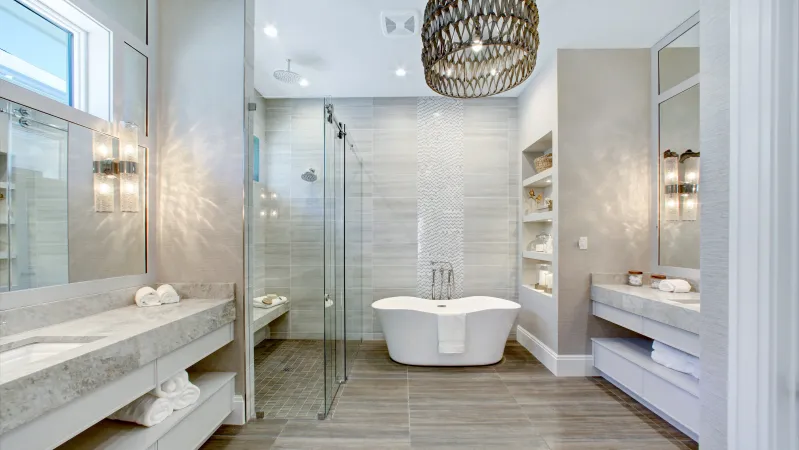
According to the report, homeowners say that spacious showers, organized storage, layered lighting, and comfortable bathtubs contribute to a sense of relaxation.
Showers Size Up
Shower enlargements were the fastest-growing major change this year, according to the report.
Just under half of renovating homeowners reported increasing their shower size, which marks a 10% increase over last year. Meanwhile, there was a marked increase in shower and faucet upgrades.
The move towards larger showers demonstrates the focus on creating daily moments for relaxation, with an emphasis on space and comfort.
Patterns Nudge Color in Bathroom Decor
Bathrooms are becoming more expressive, with homeowners making more considered design choices to personalize and create a warm aesthetic.
Transitional style is the most popular, followed closely by contemporary, modern, traditional, and mid-century modern.
Wood-toned vanities are the most popular, along with white, and blue, while most homeowners are choosing white or off-white countertops.
The report found that just over a third of homeowners incorporated an accent wall in their bathrooms, which is an impactful way to establish a focal point, especially as a backdrop for the bathtub.
What’s notable is that pattern, not color, is leading the aesthetic for accent walls, with applications such as herringbone, checkerboard, and geometric layouts offering another way to create visual interest beyond a traditional accent color. Texture is trending too, with ribbed and fluted tiles.
Wet Rooms Gain Ground
Wet rooms are now incorporated in 18% of bathroom renovations, up from 13% a couple of years ago.
A wet room’s open-concept design makes good use of compact or awkwardly shaped bathrooms, letting homeowners maximize every square foot to create a luxurious retreat, even in a smaller home.
Also adding to a wet room’s appeal is its role in universal design and accessibility, which the report indicated was the main motivator for this design choice. Homeowners also like that they are easy to clean, according to the report.
Bigger Vanities, More Built-Ins
Storage is playing an increasingly important role in the home, and the bathroom is no exception.
As a result, vanities are increasing in size, and built-in features such as electrical outlets, hair-tool organizers, and drawer organizers are popular. Soft-close hardware is in demand for both drawers and doors.
Meanwhile, in addition to vanities getting larger, double sinks are gaining in popularity, up 17% over last year.
Here are some additional highlights:
- Wellness continues to be a driver in bathroom design, with lighting playing a significant role, followed by soaker tubs, water features, and radiant flooring. Only a small portion of homeowners incorporated steam showers, aromatherapy, and self-sterilizing surfaces.
- Almost half of renovating homeowners are incorporating specialty features with their toilets, with bidet seats, adjustable water pressure, and air dryers all gaining in popularity.
- For aging-in-place bathroom design, the most popular features are grab bars and non-slip flooring, with most homeowners choosing either a low-curb or curbless shower.