
First come the kids. Then, sometimes, come the parents. This is a migration pattern we’ve watched play out across the country for years: younger adults move for jobs, affordability, or a better place to put down roots and raise a family, and their parents follow to be closer to their children and grandchildren.
For much of the past decade, millennials and baby boomers have been at the center of this story. Millennials moved through their prime home buying and family-forming years, while many of their baby boomer parents reached a stage of life when retirement and proximity to family became increasingly important considerations. In fact, Zonda surveys have shown that a quarter of boomers plan to retire near their children or grandchildren. For housing, that creates an important ripple effect: markets that attract younger households may ultimately benefit from demand from their parents, too.
This relationship is the foundation of Zonda’s proprietary Baby Chaser Index, our annual ranking of markets seeing the strongest overlapping growth among younger and older adults over both the short and long term. By capturing growth at both ends of the demographic spectrum, the index highlights markets where housing demand may be reinforced across generations.
As the Baby Chaser Index enters its eighth year, however, the generations behind those age groups are beginning to shift. We’ve kept the age cohorts consistent over time to preserve an apples-to-apples comparison and because they continue to capture the life stages central to the Baby Chaser story:
- The younger group represents the years when many adults are putting down roots and starting families (the most recent CDC data puts the average age of a first-time mother at 27.5).
- The older group captures a stage when proximity to children and grandchildren may increasingly factor into where people choose to live.
That means Gen Z is gradually joining millennials on the younger end, while Gen X is beginning to join baby boomers on the older end. This generational handoff will only become more pronounced in the years ahead, but the life stages captured by the index remain largely the same.
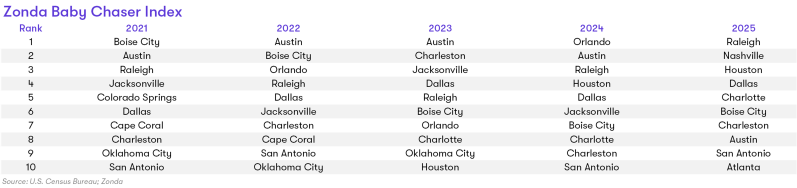
While the life stages driving the Baby Chaser phenomenon remain intact, the geographic preferences of these households continue to evolve. This year’s rankings reveal several notable shifts across the top markets:
- Raleigh claimed the top spot. After climbing from No. 5 to No. 3 last year, Raleigh continued its ascent to claim the top spot this year. Its ranking was supported by strong long-term growth across both age cohorts, even as growth among younger adults cooled from the standout pace seen in last year’s data.
In terms of the rest of the Carolinas, Charlotte, and Charleston also gained ground this year, with Charlotte rising three positions to No. 5 and Charleston climbing two spots to No. 7. The result? Three of this year’s top 10 Baby Chaser markets were in the Carolinas. - Nashville and Atlanta joined the top 10. Both Southeastern markets broke into this year’s rankings, with Nashville landing all the way at No. 2 and Atlanta rounding out the list at No. 10.
- Texas remained dominant, but Austin is no longer leading the pack. Consistent with last year, the Lone Star State represented 40% of the top Baby Chaser markets. However, this year Houston and Dallas both surpassed Austin, coming in at No. 3 and No. 4, respectively. Austin slipped to No. 8, driven primarily by a slowdown in short-term growth among the older cohort, while San Antonio moved up one position to No. 9.
- Florida goes MIA. After taking the No. 1 spot last year, Orlando slipped out of the top 10 entirely. Jacksonville, which made the cut for the past six years, also missed the rankings this year.
Carolinas: Raleigh Takes the Throne as the Region Thrives
The Carolinas have been a growing Baby Chaser favorite, and this year the region’s strength was on full display. Raleigh moved to the front of the pack, while Charlotte and Charleston also landed in the top 10, giving the Carolinas an outsized presence among this year’s leaders.
That strength starts with the fundamentals. Raleigh and Charlotte each added more than 15,000 jobs in 2025, helping support the formation of roughly 24,000 and 28,000 new households, respectively. Charleston, despite its smaller size, added another 8,500 households and maintained a low 3.7% unemployment rate.
“Jobs fuel household growth for the younger generations, which leads to household growth among multiple generations,” said Shaun McCutcheon, vice president at Zonda Advisory and Carolinas expert. “If the fundamentals exist with solid household growth, additional housing is a necessity and demand for new housing will continue.”
Raleigh, in particular, stands out for its combination of employment opportunities and relatively high incomes. McCutcheon pointed out that the market’s median household income approached $100,000 in 2025 and is expected to cross that threshold this year, giving households more purchasing power even as home prices remain elevated. He also noted the region’s university system and concentration of higher-paying industries spanning business, technology, and medicine as important draws for younger professionals and mature families.
And attracting those younger households can have a ripple effect. “Our consumer research reveals that the number one reason retirees choose to relocate is not for single-story living or amenities, though those features help. It’s to be close to family,” McCutcheon said. The Carolinas’ ability to attract young professionals and working families, while offering housing options for older buyers who follow, helps explain why the region continues to excel in the index.
Southeast: Other Rising Stars
The Carolinas weren’t the only Southeastern markets gaining ground this year: Nashville surged to No. 2, while Atlanta broke into the top 10, adding two new markets to a region that’s already well represented among this year’s leaders.
Nashville’s rise reflects its broad appeal across generations. The metro continues to add both people and jobs, with nonfarm and high-income employment up 1.2% and 1.6%, respectively, year-over-year as of June. At the same time, a combination of lifestyle, affordability, and quality-of-life factors is helping draw households at different stages of life.
“Nashville checks a lot of boxes across different life stages,” said Susan Heffron, vice president at Zonda Advisory. “You have a good employment base, good schools, and higher education, access to medical facilities, and lots to do, from sports and music to arts and outdoor recreation.” Tennessee’s lack of a state individual income tax on wages and salaries, as well as interest and dividends, adds to that appeal, particularly for older households.
Heffron also sees Nashville benefiting from the “half-back” phenomenon, as some households looking to move south ultimately find Nashville a better fit. “It can be attractive for the half-backs who have been priced out of Florida or found it too hot,” Heffron said. Continued investment in utilities, schools, and public facilities is helping Nashville accommodate that demand, though capacity constraints remain in some of the region’s most desirable areas.
Atlanta’s top 10 debut comes as the metro continues to stand out as a major population magnet. Atlanta added nearly 62,000 residents from 2024 to 2025, the third-largest population gain in the country behind only Houston and Dallas. This year’s Baby Chaser data points to particularly strong momentum among older households: growth in the older cohort accelerated year-over-year, even as growth among the younger cohort moderated slightly.
Heffron points to Atlanta’s combination of employment opportunities, established suburbs, diversity, and international connectivity as draws for younger households, while access to medical facilities, entertainment, and a wide range of housing options can appeal to older households as well. That older buyer demand has become increasingly visible on the ground, with large national builders targeting Atlanta for more active-adult communities in recent years, particularly following major hurricane seasons in Florida.
“There are retirees who don’t necessarily want a beach lifestyle but still want a moderate climate and the conveniences they’re used to in Florida’s major markets,” Heffron said. Affordability can further shape where those buyers ultimately land. “We’ve seen buyers follow that path, moving northward for what they can afford while still getting the features they want,” she added.
Texas: Shifting Powerhouse
Texas once again cemented its place as a Baby Chaser powerhouse, but this year brought a reshuffling among its leaders. Houston and Dallas both moved ahead of Austin, which had long been the state’s highest-ranked market and held the No. 1 spot nationally as recently as 2023.
The shift comes as some of the forces that fueled Texas’ outsized growth in recent years have cooled. Job growth has been weak across the state, particularly in the tech sector, while international migration has also dropped significantly. Austin may be particularly sensitive to those shifts given its smaller employment and population base and greater exposure to tech, according to Bryan Glasshagel, a principal at Zonda Advisory. Even so, Austin remains a strong draw for younger households, ranking first among this year’s Baby Chaser markets for short-term growth in the younger cohort.
For Glasshagel, that slowdown doesn’t change the longer-term Texas story. Relative affordability, migration, and job growth have historically helped attract working-age households to the state and, in turn, the older households that follow.
Employment likely plays a large role in determining where those households land, but each of the state’s major metros offers something different. Houston has the appeal of a diverse, global city; Dallas stands out for big business and career opportunities; and Austin differentiates itself through its arts, outdoor recreation, and Hill Country lifestyle.
For all their differences, the three markets also have something in common. “The one thing they all have is great developers, builders, and lifestyle-oriented master-planned communities,” Glasshagel said. Zooming out, he sees the diversity of Texas’ buyer base as a positive for long-term housing demand. “It’s not boom or bust because of any one buyer demographic. That is the beauty of the diversity of Texas.”
The Path Forward
The markets leading this year’s Baby Chaser Index may have shifted, but the broader takeaway remains consistent: demographic connections across generations can have meaningful implications for where housing demand takes shape.
As Gen Z moves further into its family-forming years and Gen X increasingly enters the older cohort, the generations shaping that relationship will continue to evolve. Zonda’s proprietary Baby Chaser Index will continue to track those changes, offering a window into where cross-generational demand is emerging and what it could mean for housing markets moving forward.
Sarah Bonnarens contributed to this article.