
Health care is more than a service for residents. It is also an important piece of the employment landscape. Preliminary August data from the Bureau of Labor Statistics shows significant differences in both the number of health care and social assistance jobs across states and the industry’s share of total employment.
In absolute terms, the country’s largest states naturally account for some of the biggest health care workforces. Unsurprisingly, California leads with over 3.18 million health care and social assistance jobs, followed by New York at 1.91 million and Texas at 1.76 million.
However, the health care industry’s share of a state’s total employment base may tell a different and potentially more useful story.
Where Health Care Plays an Outsized Role
West Virginia stands at the top of the list, with health care and social assistance representing approximately 19.6% of total employment. New York follows at 19.1%, with Pennsylvania at 18.9%. Connecticut, Minnesota, and Massachusetts are also among the states where the industry accounts for a comparatively large share of employment, at roughly 18.1%, 17.9%, and 17.8%, respectively.
At the other end of the spectrum, health care represents just 8.8% of employment in Wyoming, 10.6% in the District of Columbia and Nevada, 10.8% in Alabama, and 11% in South Carolina.
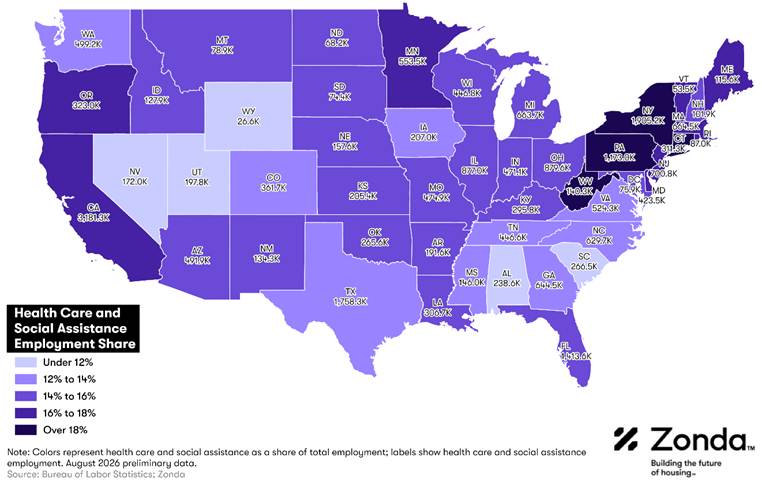
That variation matters because a sizable health care sector can serve as an important economic anchor, providing a meaningful source of jobs that support the broader housing market.
Aging Adds Another Dimension
Access to health care might become an increasingly relevant consideration in retirement location decisions. Affordability matters, but so do physician availability, provider access, and the distance residents need to travel for care.
Demographic trends reinforce that dynamic. Per the U.S. Census Bureau, the old-age dependency ratio, which measures the number of adults age 65+ relative to the working-age population, rose from 20.8 in 2010 to 29.7 in 2024, pointing to future pressure on health care systems, retirement programs, and elder care resources.
As the population ages, health care will matter to housing markets from both an economic and demographic perspective. The sector supports local employment, while access to care can influence where older households choose to live.
The insights in this article were taken from more in-depth research reports published in Zonda’s National Outlook subscription.