
Population growth has long been the foundation of housing demand analysis. But in a period defined by remote work, flexible migration patterns, and shifting economic centers, population alone is no longer enough to explain where growth is headed. One increasingly useful lens is air travel.
Airports are transportation assets, but more importantly, they are economic infrastructure that shape how easily people, capital, and jobs move through a market. In some markets, airport activity far exceeds what population rankings alone would suggest. In others, major markets appear underrepresented when viewed through a single facility. These mismatches are not random; they signal where connectivity is supporting growth and what that means for housing demand.
Measuring the Mismatch
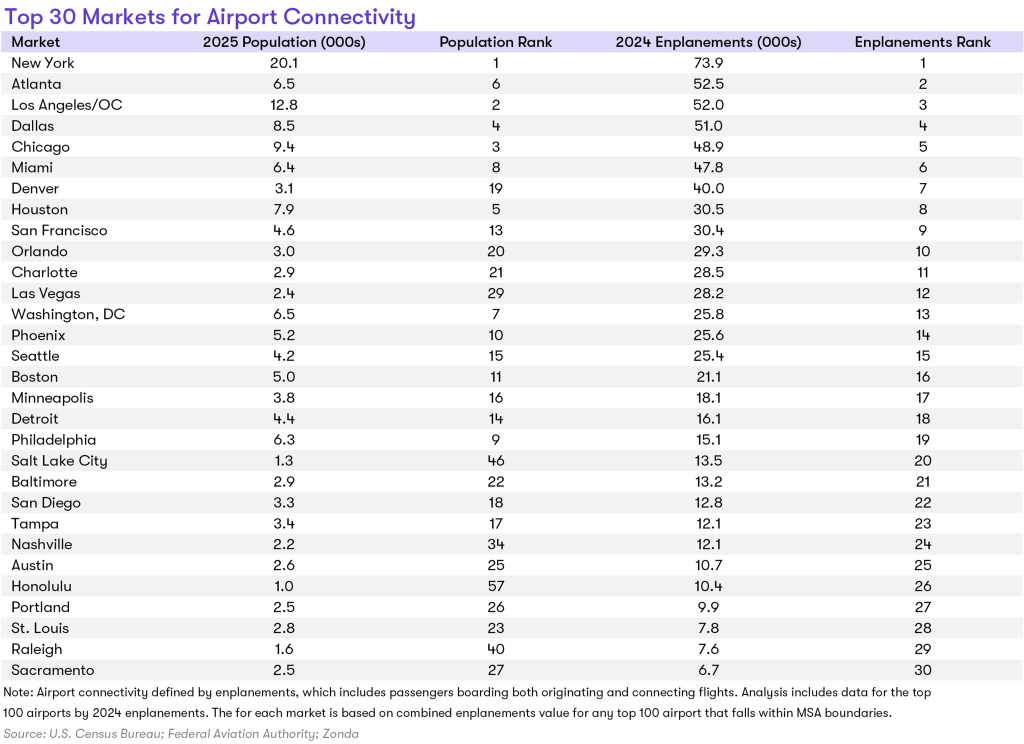
To explore this relationship, Zonda compared metro population rank with airport enplanement rank using the most recent FAA passenger boarding data from 2024. Note here that enplanements capture an airport’s total passenger boardings, including both local travelers and connecting traffic.
This comparison creates a simple signal:
- When airport rank materially exceeds population rank, the market is operating as a regional or national air traffic node and may have more room for economic growth.
- When population rank exceeds airport rank, connectivity is either fragmented across multiple airports or more limited overall; the latter can be a serious headwind to growth.
The insights in this article were taken from more in‑depth research reports published in Zonda’s National Outlook.