Spartanburg, South Carolina, finds itself at an important inflection point. After several years of rapid expansion, the market is transitioning into a more balanced phase where builders are working through higher inventory levels while positioning for future growth. Despite near-term demand challenges, the metro remains one of the Southeast’s more compelling long-term housing stories.
The Local Economy Provides a Solid Foundation
Manufacturing remains a standout sector in the Spartanburg metro, generating the largest annual employment gains among major industries, alongside growth in education and health services, government, and construction-related employment. Those job gains have helped support household formation and housing demand, even as national economic uncertainty weighs on consumer confidence.
Like many markets across the country, however, Spartanburg builders are navigating a cautious consumer. Industry surveys show affordability concerns and broader economic uncertainty remain key obstacles for prospective buyers. Many consumers are waiting for lower mortgage rates before making a purchase decision.
Sales Activity Shows Buyer’s Hesitancy
The average monthly sales rate per new home project has moderated compared with the highs reached during the pandemic-era boom, settling near two sales per community per month. While demand remains positive, builders are seeing a slower pace than what characterized the market several years ago.
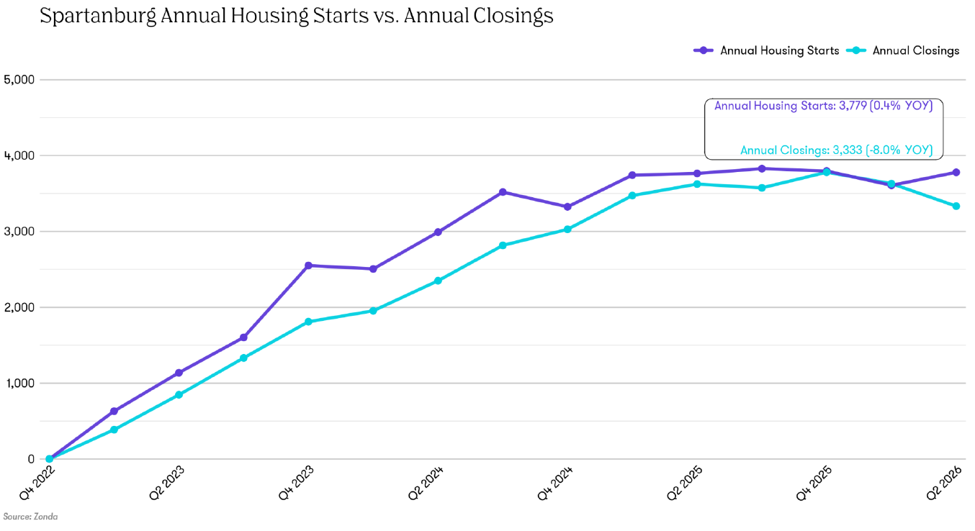
Yet the market is hardly retreating. As of 2Q26 data, observed housing starts over the past year totaled 3,779 homes, essentially flat from a year earlier, while annual closings reached 3,333 homes. The stability in starts suggests builders continue to see long-term opportunity despite softer absorption rates.
One factor supporting the new home market is relative affordability. New home affordability in Spartanburg has improved in recent quarters, while the price gap between new and existing homes has narrowed significantly. The current new home premium sits well below its historical average, helping builders compete more effectively against resale inventory.
Spartanburg offers a familiar 2026 story: demand has normalized, affordability remains a challenge, and inventory is building. But beneath those headwinds sits a market supported by employment growth, competitive new-home pricing, and a development pipeline that suggests the region’s growth story is far from over.
Similar insights can be found through a subscription to Zonda Enterprise.