Raw sales totals can tell builders where homes are selling, but they don’t always reveal whether a market is truly outperforming or simply benefiting from its size. Zonda’s new approach to measuring master-planned community (MPC) performance takes a different view, comparing current sales activity against each market’s own historical norms rather than against competing metros.
Nationally, MPC activity has cooled from the extraordinary pace seen during the pandemic housing boom. After several years of elevated demand, rising affordability pressures and softer consumer confidence have pushed many markets back toward more normalized conditions.
Most recently, as of July data, the national MPC market ranked as slightly underperforming compared to its own history.
Market Momentum is Highly Localized
Despite the softer national backdrop, local performance varies significantly.
Some metros continue to generate stronger-than-expected MPC sales relative to their historical baseline, while others are struggling to maintain typical absorption levels. Among Zonda’s top 25 major MPC markets, 28% were overperforming, 20% were average, and 52% were underperforming.
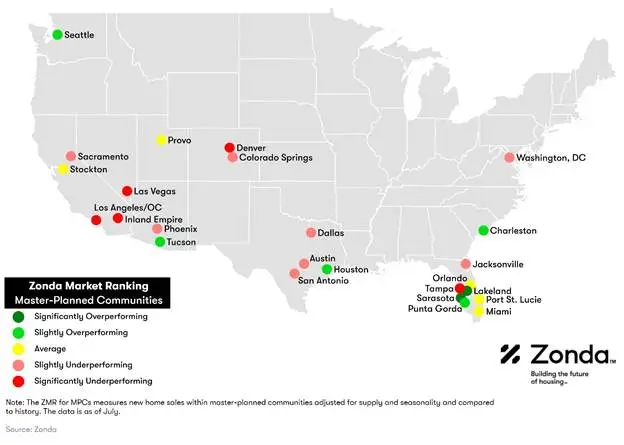
Two Florida markets, Sarasota and Lakeland, were the only tracked metros that ranked as significantly overperforming relative to their historical norms. Outside Florida, Charleston also ranked among the strongest-performing MPC markets, reinforcing the continued appeal of lifestyle-oriented and migration-driven destinations.
At the opposite end of the spectrum, several historically important housing markets are experiencing softer conditions. Los Angeles/Orange County, Tampa, and Denver ranked among the weakest performers relative to their long-term norms, indicating that current sales activity has not kept pace with what those markets have historically produced.
It is important to note that Zonda’s rankings do not account for what it takes to sell a home. For example, securing a sale might still feel difficult in a significantly overperforming market, but if incentives and/or price cuts offered result in a sale, we count the sale.
Looking Beyond Raw Sales Totals
For developers, lenders, and builders evaluating expansion opportunities, understanding how a market is performing relative to its own history can provide an additional layer of insight beyond traditional sales rankings.
Sales volume will always matter, but relative performance can offer an early glimpse into shifting market momentum. As housing demand remains uneven across the country, metrics that compare current activity against historical norms may help identify emerging opportunities and areas of softening before those trends become apparent in headline sales totals.
The insights in this article were taken from the ZMR for MPCs published monthly in Zonda’s Master Plan Outlook subscription.