Brian Coller worked as a licensed security guard for five years. With a new family to support, he needed a career with growth, stability, and purpose.
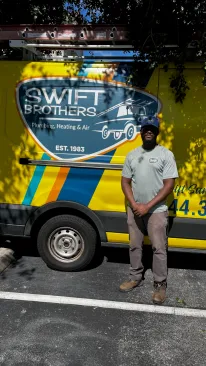
Courtesy Building Talent Foundation
Brian Coller, an HVAC service technician in Central Florida.
Through family and friends, he was introduced to the Building Talent Foundation (BTF) and landed an apprenticeship with an HVAC contractor in Central Florida. Since then, he has grown from an HVAC apprentice to a service technician and has set a goal of one day owning his own HVAC company.
For Building Talent Foundation CEO Branka Minic, stories like Coller’s illustrate a point that has become central to the organization’s work: solving the labor shortage is not just about getting more people in entry-level positions in the industry. It is about what happens after new hires arrive in the industry.
“I would like to have hundreds and thousands of these stories to tell because we have intentional effort on upskilling people,” Minic tells BUILDER. “I would like to have a large percentage of our placed individuals promoted to the next level and refill those entry-level positions with individuals who really need to work.”
The idea sits at the center of the BTF’s Blueprint for Upskilling the Homebuilding Workforce, a study developed with the guidance of the Leading Builders of America and support from Weyerhaeuser.
“The spirit of the study was to identify what are the high value skills that would help people in this industry advance in their careers and that would help us build homes faster and better,” Minic says. “We saw continuous improvement was a priority for many young people and others in skilled trades positions. It’s not just getting a job, it’s also how can I move up, how can I become better, how can I get the next position.”
For the study, the BTF collected more than 96,000 data points through a survey of the industry and convened focus groups involving builders, contractors, tradespeople, educators, manufacturers, and other industry experts. The result is a blueprint ranking high-value skills across 23 trades and a section with best practices and case studies showing practical application.
High-Value Skills and Upskilling in Practice
The Blueprint divided skills into three categories: technical skills; soft or behavioral skills; and skills associated with emerging technologies.
Essential technical skills, including those related to energy efficiency practices or waterproofing, were ranked as extremely important across the board. The study also underscored the importance of behavioral skills. More than 93% of respondents rated soft skills as important or very important.
“It is very important for anybody who teaches technical skills to align with raising awareness on how important those behavioral skills are,” Minic says.
Beyond collecting and reporting data, the BTF developed an action plan for putting the findings to work. A priority was placed on disseminating results of the study to all the BTF’s trade partners, including 2,500 schools and 3,600 employers. Minic, for example, shared findings, takeaways, and practical recommendations with builders in California at the 2026 Pacific Coast Builders Conference (PCBC).
“The other part is to create projects collaborating between education and industry to promote people and refill those positions that were opened,” Minic says. “We are lucky because we have several of our partner organizations that are supporting this concept and implementing it.”
In Florida, the BTF has developed a program with the Sherwin-Williams Foundation where individuals trained at community colleges across the state are then provided with intensive training to further develop their painting skills. The program has helped create a pipeline of trained painters who can be referred to companies in need across the state.
“The BTF creates bridges between different partners so that the whole project is successful and that as people gain skills, they transition into employment,” Minic says. “Training for training’s sake does not accomplish much. We have to link to the industry, to hiring managers. That is where the study is really practical, it gives us a blueprint on how to create these projects.”
The core work of the BTF is built around three priorities: bringing new people into the industry, connecting people who complete training with jobs or additional trainings, and helping employers improve the human resources practices that can keep people moving through a career.
The first is bringing new people into the industry, whether they are young people, career changers, transitioning military veterans, or individuals returning from incarceration. The second is connecting people who complete training with jobs or additional training. The third is helping employers improve the human resources practice that can keep people moving through a career. The third pillar is where upskilling can be particularly important.
“Upskiling doesn’t need to take two years. It can take a few days and somebody can become much more beneficial to your company,” Minic says. “We are in a constant mode of coaching both the hiring manager, the business owner, and the candidates. We are promoting a spirit of continuous improvement, not only improvement in how we build homes but in how we build people and careers.”
A worker who advances creates a vacancy at the next level down. If that opening can then be filled by someone entering the industry, the industry gains a more productive worker in a higher responsibility role and a new worker gaining a foothold. That progression requires coordination. Manufacturers may have highly specialized training, community colleges have instructors, facilities and basic construction programs, and contractors have jobs that need to be filled.
“BTF works to make sure that people who acquire new skills are actually connected to employers looking for those skills, including through hiring events and candidate referrals,” Minic says.
Scaling the Upskilling Model
For the BTF, the next steps include using the findings of the Blueprint as a framework for replicating training-to-employment and upskilling projects it has already developed. The organization is in 27 markets and Minic says the BTF wants to scale projects that bring educators, employers, manufacturers, trade associations, and workforce organizations together.
“We [want to] not just be the source of qualified candidates to our employer partners, but also a source of upskilling project knowledge so that we can leverage the blueprint further,” Minic says. “I think that will benefit employers, builders, schools, individuals, and overall communities.”
The organization is also focused on continuing to build connections between workers and employers through its free-to-use workforce platform, JobsToBuild and making the transition from training to employment more deliberate.
For Minic, the stakes of workforce development efforts extend beyond individual careers. Labor is a significant component of the cost in home building. A workforce with the right skills can improve both productivity and efficiency.
“The more skilled our workforce is and the better they are equipped with the right skills, the more efficient the whole production will be,” she says. “As a result, it will impact the overall affordability and attainability of homes for American families.”
The Changing Nature of the Labor Shortage
Despite progress in changing the perceptions of construction careers, the fundamental labor challenge remains. The industry still does not have enough people entering the trades, retention remains a challenge, and more workers are retiring than are joining the industry. Residential construction is also now competing with talent for infrastructure projects, data centers, and other areas of construction.
Despite these challenges, Minic says the shifting narrative around skilled trades is a major tailwind for future workforce development efforts.
“Seven years ago, these jobs in skilled trades were considered dirty, difficult, dangerous, and dead end,” Minic says. “I don’t think that’s the story that is out now.”
The rise in artificial intelligence is creating further uncertainty about office jobs, giving renewed attention to skilled trades as an alternative career path. Minic says the BTF is seeing greater interest in construction training programs and more young people are considering careers in the trades.
The BTF says it has placed more than 10,000 people into jobs and engaged more than 300,000 people in conversations around construction. For Minic, the next phase is about turning that growing interest into a workforce pipeline that continues to move people upward.
“We are pushing that progression up and that will also retain those in our industry longer,” she says. “Focusing on replication and scaling of these upskilling efforts while we also continue to increase our footprint.”
For the BTF, that acceleration will depend on collaboration. Builders, manufacturers, trade associations, schools, and workforce organizations each control pieces of the training and employment system.
“We are stronger, we are better, we can move faster because we are collaborating,” Minic says. “That collaboration, not competition, will take us forward.”