Two years after Dandelion Energy CEO Dan Yates outlined plans to grow the business fivefold over a four-year span, the geothermal company is progressing faster than anticipated and consistently resetting the bar.
The company is projected to grow approximately 300% in 2026, according to Yates, even as home builder customers contend with a challenging housing environment.
“I would say our growth has been, frankly, faster than I thought it would be at the beginning,” Yates tells BUILDER.
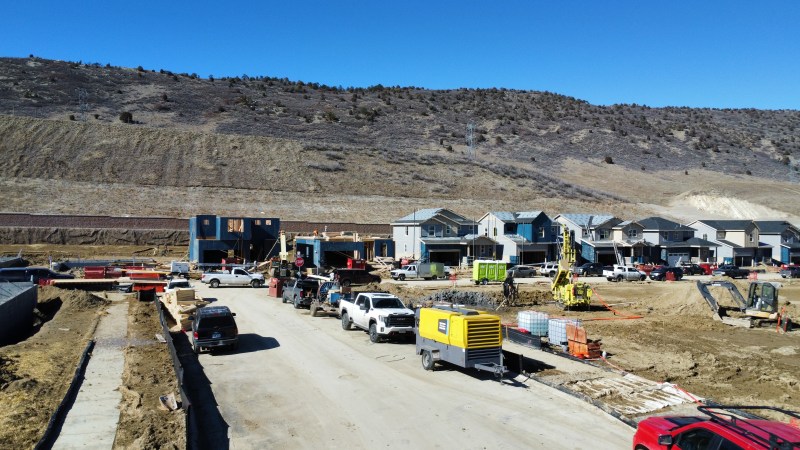
Founded in 2017 as a spinout of Google X’s Moonshot factory, Dandelion Energy has been on a supersized growth trajectory in the past two years. The company closed a $40 million Series C funding round in 2024 before securing a major partnership with Lennar in Colorado to bring geothermal systems to more than 1,500 new homes across 14 Colorado communities.
Yates points to the Lennar partnership, and successful execution in the past year, as one of the largest factors accelerating Dandelion Energy’s trajectory.
“The deal with Lennar in Colorado leaped us forward a full year from where we had thought we would be able to get,” Yates says. “The success of that project, which is to to say that we’ve done right by Lennar, we stayed on their schedule, we’ve stayed in the cost profile, we’ve delivered them working systems, has been a real accelerant to us growing beyond that.”
The partnership represented an important proof point for Dandelion Energy. Rather than installing residential systems ad-hoc, the company is deploying geothermal in Lennar’s production environment across single-family and townhome communities. Working at the scale of the partnership also helps reduce costs and allows geothermal installation to fit within a builder’s production schedule.
Building a Scalable Model
Geothermal heating and cooling replaces the furnace and air conditioner with a single, efficient system that draws on the ground beneath it. The ground-sourced heat pump circulates water through a buried loop to move heat between the home and the earth’s constant underground temperature to deliver heating and cooling from a single all-electric system.
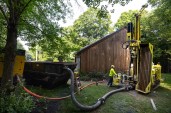
Dandelion Energy is working on thousands of homes each year, with services that span drilling and project management, heat pump distribution, support of trades, technical support, and marketing materials to help builders communicate value to buyers.
“Even as builders are slowing down, they are putting us in a larger and larger percentage of their communities,” Yates explains. “There’s increasing momentum to build all-electric homes and builders have struggled with air-source heat pumps, whether it’s high bills for homeowners or humidification issues or aesthetic limitations because they have townhome communities dotted with condensers. Geothermal solves all those problems for them.”
As awareness is increasing, Dandelion Energy’s ambition with builder customers is also expanding. The goal is increasingly not to win a single community, but to become the preferred energy partner across an entire division for a builder. Yates says two customers have standardized geothermal across their townhome operations.
“Townhomes really see the best economics because they are the cheapest for us to install. They are a smaller home and they require the least amount of drilling,” Yates says. “And they get the most benefit of not having the outside condensers. If you picture a condenser unit, it’s big, it gets very hot in the summer, and it’s loud. With townhomes, it becomes a real issue.”
Yates says the company also has a 100% renewal rate with builder customers. Each company that has installed geothermal in a community has elected to work with Dandelion Energy on additional communities.
Yates says companies Dandelion Energy are speaking with fall into two categories: existing customers discussing additional communities or builders who have never worked with Dandelion Energy or installed geothermal. Happy customers have presented another tool for Dandelion Energy as it combats the learning curve for geothermal.
“The biggest difference for us is a new builder who is interested has the opportunity to call reference customers in their area,” Yates says. “That’s become a big accelerant. Everywhere we are, we have good reference customers for builders to call on and that is helping.”
Different Route to Scale
Earlier this month, Dandelion Energy and Vermont Gas announced a partnership that will bring geothermal to an affordable townhome development in Hinesburg, Vermont.
As part of the partnership, Vermont Gas will invest in the upfront cost of the geothermal ground loops while Dandelion Energy will provide services including design and drilling. Yates says this structure can potentially unlock a new path forward for Dandelion Energy and provides another solution to the upfront cost of the infrastructure.
“I think it has a lot of compelling dimensions and characteristics, not the least of which is that it aligns our interests with that of the utilities,” Yates explains. “Gas utilities are feeling at risk in a lot of states [due to geothermal]. This gives them an opportunity to potentially participate in that transaction. If the utility industry gets excited about something, they can move on it faster than we can.
“It works for the home buyer because instead of having to pay natural gas bills all year, they can pay a flat fee to their utility company for renting the ground loop, which gives them a much lower electric bill,” Yates explains. “Everybody wins.”
The Vermont development also adds to the type of housing Dandelion Energy can point to as evidence for geothermal’s affordability. The planned Riggs Meadow community in Hinesburg is for low- and moderate-income renters and owners.
“Every case like this is another proof point that geothermal can be afforded in any number of circumstances,” Yates says. “It’s also a great proof point that utility ownership is a very useful tool to make this affordable to both the builder and the renter or home buyer.”
Drive to 10,000 Homes
The long-term ambition of Dandelion Energy stretches far beyond demonstrating successful use cases and community examples.
“I think that in some parts of the country, every single new home should be a geothermal home,” Yates says. “I think, overall, across the country, double-digit percentages of new homes should be geothermal homes. That’s when we really will have reached the mainstream.”
The immediate milestone Dandelion Energy is chasing is a target set roughly a year and a half ago: reaching 10,000 homes per year. This would represent roughly 1% of all new-homes built annually in the U.S. The rapid recent growth has not changed this focal point for the company and Yates believes Dandelion Energy can reach this target within the next couple of years.
“Once we are at 1% [of new homes annually], I think there’s still room to go 10 to 30x to where it will be in the long run,” Yates says. “It could be even more, but we have to keep driving the cost down.”