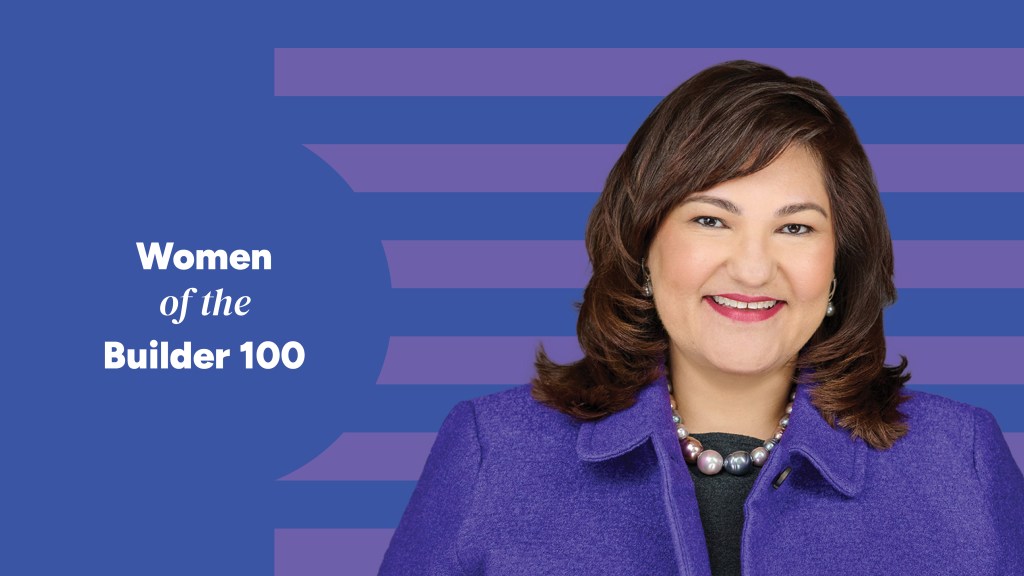
Marietta Rodriguez has spent her career at the intersection of housing, community development, and leadership. And today, as president and CEO of NeighborWorks America, she oversees a national network working to expand housing opportunity across the country. Climbing six spots since last year, NeighborWorks America ranked as No. 72 on the 2026 Builder 100.
In an industry long shaped by complex challenges and traditionally male-dominated leadership, Rodriguez brings a perspective grounded in collaboration, purpose, and community impact. Below, she reflects on what it takes for women to lead in housing, how strong teams are built across sectors, and why partnership-driven solutions are critical to addressing the nation’s affordable housing shortage.
How has your personal experience as a female CEO shaped your perspective on what it takes for women to succeed and lead in a male-dominated industry?
Leadership in housing is ultimately about bringing people together to solve complex challenges. The most effective leaders listen carefully, stay grounded in purpose, and build partnerships that move ideas into action.
Housing development and construction have historically been male-dominated fields. At the same time, women have long played a critical role in advancing housing solutions in communities across the country. Throughout the NeighborWorks America network, I see women leading complex development organizations, financing housing projects, and working alongside builders to expand housing opportunities.
“Housing challenges cannot be solved by any single organization or sector. Progress depends on collaboration among builders, nonprofit developers, lenders, local governments, and community organizations.”
– Marietta Rodriguez
When leadership reflects diverse perspectives and experiences, the entire industry benefits. Better ideas emerge, stronger partnerships form, and housing solutions are better aligned with the needs of the communities they serve.
What is the key to building strong teams?
Strong teams are built around a clear mission and a shared commitment to solving real problems together.
Housing challenges cannot be solved by any single organization or sector. Progress depends on collaboration among builders, nonprofit developers, lenders, local governments, and community organizations.
The strongest teams bring together people with different expertise who are aligned around a common goal: expanding housing opportunity. When trust and accountability are in place, those partnerships can deliver real results for communities.
We’re grounded in our origin story, centered around a woman named Dorothy Mae Richardson, who, together with her neighbors, brought together a diverse team of residents, local bankers, city planners, and government officials to improve their neighborhood. She demonstrated that tackling complex housing challenges requires that same collaboration we value today, and that working together makes practical, lasting solutions possible.
In your role overseeing nearly 250 member organizations and partners, how do you intentionally mentor and develop other women who aspire to leadership in housing, construction, and community development?
One of the most important responsibilities of leadership is developing the leaders who will drive housing solutions forward.
Across the NeighborWorks network, we focus on equipping professionals with both the technical knowledge and leadership skills needed to advance housing solutions. NeighborWorks offers a variety of leadership programs designed to advance skills throughout a career lifecycle, whether you are a community member, a community builder, or executive director. Through programs like the NeighborWorks Training Institute, professionals gain expertise in housing development, finance, construction management, and community engagement while also networking and sharing ideas from other leaders from across the country. This kind of exchange can be very powerful.
Just as important are the everyday leadership moments. Emerging leaders grow when they are invited into decision making, given responsibility for complex work, and supported as they build the confidence to lead.
What advice would you give to women aspiring to leadership in the housing industry?
Stay grounded in purpose and stay engaged in the work. Housing is a complex field that brings together development, finance, policy, and community insight.
Bring your perspective forward and remain curious. Visit communities that are unlike your own, and bring ideas back. The leaders who make the greatest impact are those who stay close to the work, listen to the communities they serve, and build partnerships that turn ideas into real housing solutions.
This work is about more than constructing houses. It is about creating a community where families feel comfortable—and feel that they’ve found a home. It’s more than bricks and sticks; housing is at its best when we are intentional about communities.
What is your current pulse on the housing industry?
One of the defining challenges in housing today is the shortage of affordable homes nationwide.
Closing that gap will require expanding housing supply across the country and strengthening collaboration across sectors. Builders, nonprofit developers, lenders, and policymakers all have a role to play.
What gives me optimism is the level of innovation happening across the industry. Organizations are finding new ways to build, finance, and preserve housing. When those efforts are aligned, we can make meaningful progress in addressing the housing shortage.
What’s often missed in this industry?
Housing is foundational to economic stability and strong communities. When families have access to safe and affordable homes, they have the stability needed to pursue education, employment, and long-term opportunity.
What continues to inspire me is the dedication of people across this industry, from builders and developers to nonprofit leaders and community advocates, who are working every day to expand housing opportunity. That shared commitment is what will ultimately move the industry forward and make communities stronger and more resilient.