
Stay tuned this morning for new home sales data. And this time next month, do it again. In September, one more time.
New home sales–and your own anecdotal reporting on cancelation rates–are a measure to learn more of how housing’s economy is slowly shifting to address, “too many buyers, too few homes.”
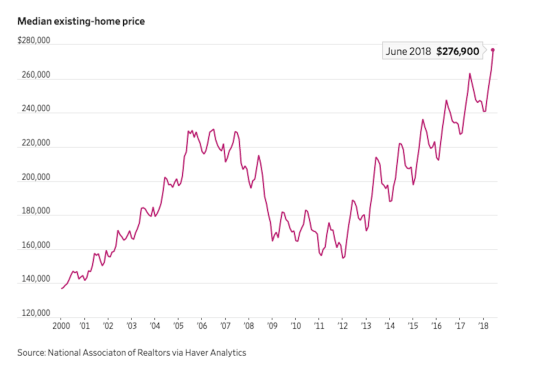
And the corollary statement, “too few new.”
The other relevant corollary inference might be, high prices on resales, and high rents mean a bigger pool of would-be buyers of new single-family for-sale homes and communities, provided they’re priced as “solutions” for people getting beat up in the world of existing homes and rentals.
Trends don’t happen in a one-month report. Fear, however, plays by different rules. Census NHS today should help show how the market is trying to be efficient. The consensus is for 669,000 seasonally-adjusted, a month-on-month pull-back of about 20,000 off May estimates. Actuals anywhere within range of the consensus, or north of it, will spur a raft of media forecasts proclaiming that the housing market is on sturdy ground.
The “mix shift” in new home pricing–from a majority of new homes aimed at the high-margin, higher-end buyer segments where building takes longer, to the low-margin, entry-level market tier where builders pull more overheads through faster inventory turns–can’t come soon enough. However, remember, the economy is heating up, jobs growth has continued, unemployment has bottomed, and household wages have started slowly to inch up, especially among younger workers, and even among less-educated workers. This is all priming the pump for even more demand at the lower end.
Existing home sales have showed weakness now for three months running, as barriers creep up, suppressing sales of homes at the lower price ranges, and creating a bigger gap for would-be buyers to find homes they can finance in a location they want or need.
Media headlines feed fears, and unfortunately, fears inform business decisions that roll up, eventually, into trends.
“Is the housing market on shaky ground?”
“Southern California home sales crash, a warning sign to the nation.”
“Real Time Economics: The U.S. Housing Market is Stuck in a Rut.”
After the Census Bureau release today, we’ll hear color and commentary from a number of public company CEOs in the next couple of weeks as they release quarterly earnings data for calendar year second quarters.
From what we’ve picked up in the field over the past several weeks, demand for new-homes and communities positioned for entry-level buyers is strong. The lion’s share of these new homes and communities–even the ones positioned as entry-level–skew toward area median household income levels at the higher end of the lower range, if you know what I mean.
Developing, value engineering, and building homes at this spec level is a challenge in and of itself amidst labor and materials cost fluctuations.
In its way, however, tapping into this demand pool by stretching move-up model processes and systems toward a higher rate of start-to-completion turns, lower variability, and less square footage, material, and level of effort per home, is the “low hanging fruit” part of the job of activating entry level buyers.
The real work for builders starts with a “user story” that has some financial challenge to it. It’s the refugee from rental who needs more space, or the one who’s been frustrated by what’s out there in existing home territory. These are “borderline buyers,” ones who it’s going to take six- to 12-months to work through credit issues, save some downpayment money, and line-up a personal budget plan in keeping with monthly payments of principle, interest, taxes, insurance, energy costs, and travel.
Will new home sellers develop homes and communities that cross over from the immediately qualified first-time buyers to the apartment rental refugees that want out of a lease re-up, or the ones who’ve got a few years of early-career job experience under their belt and may be ready for their first real jump to a mid-management role with a retention raise from her or his employer in a back pocket.
The debate over when, if, how deep, how long a next economic downturn will be will continue, as those who favor looking at the amplitude–the change in economic growth levels–since the recovery started in early 2011 argue with those who can’t help but fixate on the duration of the current macro rebound, well nigh 100 consecutive months of growth.
Whether it will be an earnings recession, a consumer household spending recession, a jobs recession, or a housing recession is up for debate.
The two things we do know are that there’s a next level–in terms of area median prices that match to a huge unmet market of “borderline” buyers–that builders have barely scratched the surface of activating, and, secondly, an economy that’s putting a lot of people to work at the start of their careers may be the best time ever to solve for that opportunity.