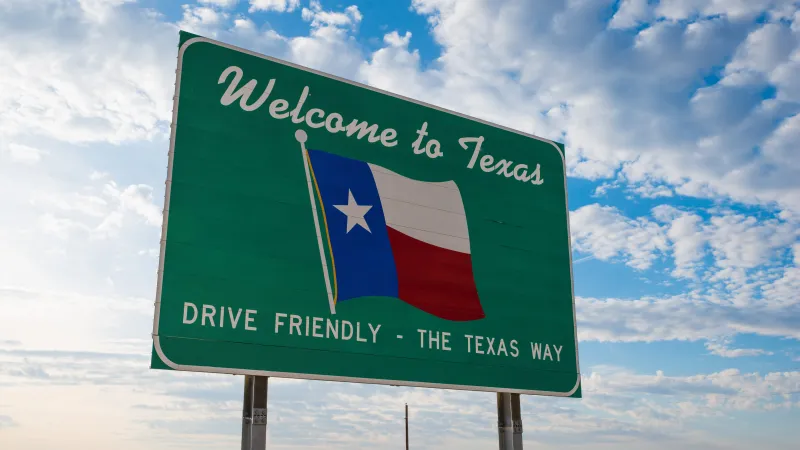
Recently, John and his wife Sarah packed up their house in Boston and moved to North Texas after John accepted a new job in Dallas.
They expected Texas to be cheaper. They did not expect it to be that much cheaper.
With a budget of roughly $700,000, the couple found themselves touring new homes with more square footage, larger lots, and amenities that would have pushed them well beyond their budget back in Massachusetts. What had bought them compromise in Boston suddenly bought them choice in Texas.
The Texas Miracle
John and Sarah’s experience has come to be called the “Texas Miracle” because prospective homebuyers like them find they have access to the same high-quality housing and public infrastructure but at a fraction of the cost relative to other states.
The Boston couple’s experience is one small example of a much larger Texas story. They moved to one of the largest and wealthiest economies in the world and discovered that access to its jobs, communities, and opportunities did not require them to sacrifice affordability. Their housing budget did not shrink when they arrived in Texas. It bought them more.
That combination of extraordinary economic opportunity and relative affordability is part of what makes the Texas growth story so remarkable. Texas offers access to an economy that, standing alone, would rank among the 10 largest in the world, while continuing to offer housing and a cost of living that remain competitive with much of the country.
The scale of that success is difficult to overstate. Texas has led the nation in job creation, population growth, and economic expansion, transforming its major metropolitan areas into some of the country’s most successful centers of business and commerce. Today, Texas has a nearly $3 trillion economy—an economy that, if Texas were its own country, would rank among the 10th largest in the world. And at its current rate of growth, Texas is slated to become the most populous state in the country, overtaking California by 2045 according to one recent estimate. But, the Texas Miracle is about more than jobs and economic output.
Growth brings with it the increased need for high-quality public infrastructure to accommodate such growth and to develop affordable communities. Texas has been remarkably successful at doing just that.
Successful Growth Requires More Than Land
The conventional explanation for Texas’ success is that the Lone Star State has plenty of land. And that is certainly part of the story, but it is not the whole story. Other states have enormous amounts of land as well. California, for example, is the third-largest state in the country by land area, yet housing development there is substantially more expensive and constrained. The difference in housing costs between Texas and other states is usually explained by a familiar trio: cheaper land, lower construction costs, and fewer regulatory barriers. And all three matter.
But underneath the streets of many of Texas’s fastest-growing communities lies another explanation—quite literally underneath them.
Before the first homeowner moves in, someone has to pay for the water lines, sewer systems, drainage facilities, roads, and other public infrastructure that convert a field into a neighborhood. Those costs can run into the tens of millions of dollars. How they are financed can determine whether a development works on paper long before the first foundation is poured.
Texas has developed an innovative collection of financing tools that change the equation. One of the most important is something most developers have never heard of: the Municipal Utility District, or MUD.
MUDs and other special districts allow the public and private sectors to work together to provide the roads, water, wastewater, drainage facilities, parks and recreational spaces necessary to support communities across the state—places where Texans can live, work and raise their families.
These districts rarely receive credit for the part they play in the Texas Miracle. But drive through almost any major growth corridor in Texas, and their impact is everywhere.
Public-Private Partnerships: The Texas Advantage
At a recent Dudes in Development meeting in Dallas, Kelsey Taylor, an attorney at Allen Boone Humphries Robinson, spoke with developers, home builders, and civil engineers and walked through how developers use MUDs and other special districts to solve one of the fundamental problems of urban and suburban growth: how to pay for public infrastructure and achieve more affordable housing?
Under the Texas special district model, private developers advance the capital to build public infrastructure serving new development. As that development succeeds, they are reimbursed for state-specified, eligible public infrastructure costs. This public-private arrangement lowers the cost of bringing homes, industrial and commercial space to market, resulting in lower, competitive pricing which, ultimately, makes communities more affordable for the people and businesses that occupy them.
At its core, the Texas special district model is a public-private partnership built around a remarkably simple principle: growth should be paid for by those who benefit from it, not by those who don’t.
But the model incorporates an equally important safeguard: public financing follows successful development; it does not precede it. The developer generally bears the initial risk of transforming undeveloped land into a functioning community—advancing the capital necessary to construct infrastructure, attracting builders and businesses, and creating municipal-grade development that will ultimately support the public investment. If the development does not materialize, if homes are not built, if businesses do not arrive, and if the anticipated value is never created, the public financing mechanism does not operate as a guarantee of the developer’s success.
Instead, reimbursement is tied to actual development. In practical terms, the model requires the private sector to move beyond a plan on paper. Streets and utilities must be constructed, buildings must go vertical, homes must be purchased or occupied, and commercial activity must take root. Only as the development succeeds does the district acquire the economic capacity to finance and reimburse eligible public infrastructure.
This sequencing fundamentally changes the allocation of risk. The developer and its private capital bear the risk that the project may never achieve its promise; the public-financing structure participates as that promise becomes reality. And because the cost of the infrastructure is ultimately borne by the community that receives its benefits, unsuccessful development cannot simply shift its anticipated infrastructure costs onto established communities elsewhere.
That alignment—between development, demonstrated value, public investment, and the beneficiaries who ultimately support it—is one of the central strengths of the Texas special district model. Public infrastructure financing is not a speculative bet on whether growth might occur. It is a mechanism for financing and reimbursing public infrastructure as successful growth creates the capacity to support it.
Importantly, new communities generate the value that pays for the public infrastructure serving those communities. In this way, growth and development pay for themselves. And the cost of that public infrastructure remains tied to the community receiving its benefits.
The result is one of the quiet strengths of the Texas development model: private investment creates new communities, new communities create new value, and that value pays for the public infrastructure that makes those communities possible, competitive, and affordable.
The Road Ahead: The Future of Texas Development
The role of special districts in sustaining this model of growth was brought into focus at the Dudes in Development meeting in Dallas. Kelsey Taylor’s discussion underscored a central theme of the Texas growth story: MUDs and other special districts are not merely tools that helped build the Texas of today. They remain a critical part of how Texas accommodates the growth of tomorrow. As the state continues to add residents, businesses, and new communities, the need for public infrastructure—and for financing structures capable of delivering it efficiently—will only become more consequential.
For those engaged in land development, infrastructure planning, and public policy, both within Texas and around the country, there is a broader lesson worth considering. The Texas experience demonstrates what can be achieved when public and private interests are structured to work together: private capital and expertise can help deliver public infrastructure, public financing can reduce the cost of growth, and local communities ultimately benefit. Other states need not replicate the Texas model precisely to learn from its central insight: public-private cooperation, properly structured, can turn the challenge of growth into opportunity.
The views expressed in this article are exclusively those of the author. This article has been prepared for informational purposes only and does not constitute legal advice or give rise to a lawyer-client relationship.