Homeowners have never had more design inspiration at their fingertips. Instagram, Pinterest, home tours, and travel can expose them to hundreds of kitchens and baths before they ever sit down with a builder or designer.
That can be both helpful and hazardous.
Here, two industry experts—Katie Kath, partner and creative director of Jkath Design Build + Reinvent in the Twin Cities, and John Altman, owner with Alair Homes in Orlando—share how they help clients separate fleeting trends from design choices built to last.
Trend Spotting
Kath sees firsthand how social media shapes what clients request. “We continue to draw much of our clients through social media,” she says. “People who follow us on Instagram are drawn to an aesthetic—to our ethos of trying to get as deep as we can into quality work and craftsmanship.”
But she doesn’t believe designers need to reject an idea simply because it happens to be popular.
“We’re OK to play with trends,” Kath says. “We don’t get too fussy. You want a black-painted pantry? Great, we’ll do that. But we do try to reinvent things and come up with new ideas; we’re always trying to be better than our last project.”
Likewise, Altman regularly encounters clients armed with ideas pulled from Pinterest and other online sources. The challenge, he says, is helping them distinguish between a bold choice they may still love years from now and one that could quickly date a room.
“Pinterest is kind of our worst enemy and our best enemy sometimes,” he says.
His rule of thumb is to take bigger risks with elements that are easier to update. He encourages homeowners “to be bold into ways that can be changed easily rather than a permanent installation.”
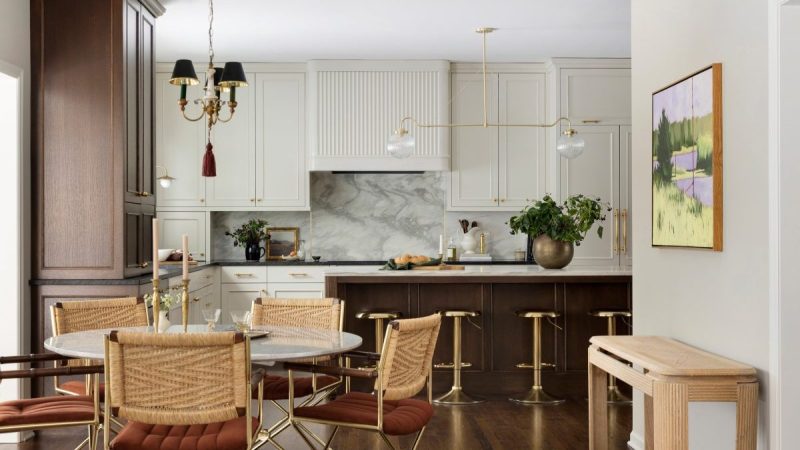
For Kath, longevity begins with architecture and materials. Her firm encourages homeowners to incorporate what they call “warm, honest materials,” including real wood cabinetry with visible grain, natural stone with imperfections, and unlacquered or living metal finishes that develop patina. Kitchens and baths, she says, should feel “architectural, not trendy.”
Oxbow Bend in Chanhassen, Minnesota, by Jkath Design Built + Reinvent. Photo by Spacecrafting.
That approach leaves plenty of room for color and personality while grounding those choices in proportion, craftsmanship, and materials that age gracefully.
Lasting Materials
Natural stone has increasingly displaced engineered quartz as the starting point for kitchen discussions in Kath’s Midwest market. Living finishes are also appearing throughout entire rooms rather than as occasional accents.
“Finally, we’ve arrived to more live finishes here in the Midwest,” Kath says. “I would travel to other markets and it’s everywhere, but we’re doing more and more full kitchens with cabinet and door hardware and certainly all the plumbing and light fixtures have some type of live finish on it that can patina over time.”
That appetite for warmth, texture, and character is showing up in Altman’s Orlando market as well. He says clients are moving away from the stark whites and grays that dominated recent years and toward warmer tones, natural wood finishes, textured stone, handmade tile, and layered materials.
Those qualities were evident in The New American Home at the 2026 International Builders’ Show, where Alair worked with a design team that drew on Scandinavian simplicity and Japanese craftsmanship.
“The homeowners always wanted to gravitate toward the clean lines and just natural material so the spaces seem like they’re more calm than overly decorated,” Altman says.
The kitchen and bathrooms follow that same approach, balancing function with natural light and restrained materials to create spaces that feel calm and luxurious.
Trend Triage
Kath’s team takes a deliberate approach to deciding which trends deserve a place in its projects. Early each year, the designers discuss what they want to use more often and what they may need to sunset.
One example is the full-height solid-surface backsplash. Kath says homeowners still request the look, often because they want to eliminate grout lines.
“I love grout lines,” Kath says. “They add so much depth and shadow, and your kitchen takes on a totally different feel as the sun moves throughout the day in your space.”
Rather than reject the idea outright, she looks for ways to meet homeowners halfway by giving the treatment more character.
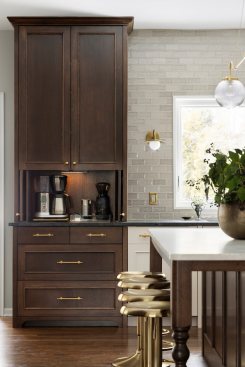
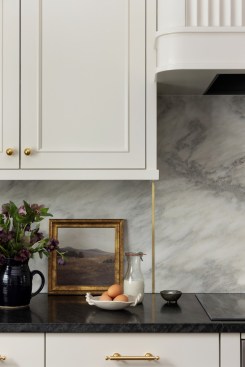
Oxbow Bend in Chanhassen, Minnesota, by Jkath Design Built + Reinvent. Photo by Spacecrafting.
In one project, Kath’s firm embraced the slab backsplash and made it more distinctive. “We used a solid surface backsplash, but we put in brass inlays in the seams,” she says. “I thought, if we’re going to do it [use a solid surface backsplash], let’s make this stand out with a design moment.”
The room also combines two-tone cabinetry, a fluted hood, marble, black granite, dark-stained oak, applied molding, and living finishes—current elements that work together without letting any single trend define the space.
Smart Risks
Altman takes a similarly pragmatic approach when clients arrive with bold ideas. Some choices, he says, simply carry more risk because they are expensive and difficult to change.
Highly specific tile patterns, fashionable cabinet colors, and unusual fixtures can quickly reveal the era in which a room was designed.
“Trendy cabinet colors and things like that, I think are going to be very fast to age,” Altman says.
Rather than eliminate bold choices, he recommends putting them where they can be updated more easily. For more permanent elements, he favors a versatile foundation.
Altman points to white cabinetry as one example because countertops, backsplashes, fixtures, and hardware can dramatically change its character over time.
The idea isn’t to design a home untouched by its era. Color, pattern, and current ideas can all endure when they are supported by durable materials, thoughtful proportions, craftsmanship, and function.
As Kath puts it: “The goal isn’t ‘wow’ at first glance. It’s depth—materials that age well, feel grounded, and tell a unique story to each client.”