
For the first time since 2016, the national land market is considered appropriately supplied, according to the latest quarterly release of Zonda’s proprietary Lot Supply Index (LSI). The shift ends 40 consecutive quarters of undersupply, including the especially tight conditions that followed the pandemic-era housing boom.
However, that does not mean lot constraints are gone. The latest LSI captures where supply stands today, but the picture can change quickly as starts move higher or lower. To help gauge that risk, Zonda is introducing a forecast for vacant developed lots (VDLs), along with scenario testing that shows how future lot supply could respond under different levels of housing starts.
The Q2 2026 national results, pictured below, show just how narrow the current margin is.
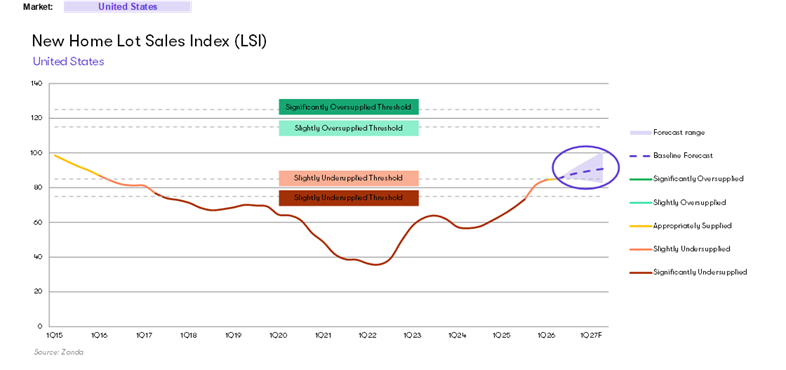
Under a scenario where starts decline 10%, the U.S. would remain appropriately supplied as slower construction activity reduces lot consumption. But if starts increase 10%, available lots would be absorbed more quickly, pushing the national market back into undersupplied territory.
“The realization here is that today’s more balanced land market may offer some breathing room, but is incredibly sensitive,” said Ali Wolf, chief economist for Zonda and NewHomeSource. “If demand strengthens and starts begin to accelerate, lot availability could tighten again relatively quickly.”
Of course, that sensitivity also varies by market. The Q2 2026 forecasts showed the following examples:
- Houston: A 10% decline in starts would slow lot consumption enough to move the market into slightly oversupplied territory.
- Greensboro: A 10% increase in starts would accelerate lot absorption enough to move the market back into slightly undersupplied territory.
The scenarios are not meant to predict exactly where starts will land. Instead, they help identify where changes in housing activity could have the biggest impact on future lot availability.
Zonda’s LSI forecast and scenario analysis will be updated quarterly across more than 50 markets, with the results available in a downloadable Excel file exclusively for Zonda National Outlook subscribers.
The insights in this article were taken from a more in-depth article published in Zonda’s National Outlook.