
Zonda’s third quarter 2026 data shows housing starts over the past four quarters declined 10% from the same period a year ago. More specifically, 22 of the top 25 housing production markets posted year-over-year declines, pointing to a broad-based slowdown. However, the national slowdown can translate into very different competitive conditions depending on geography.
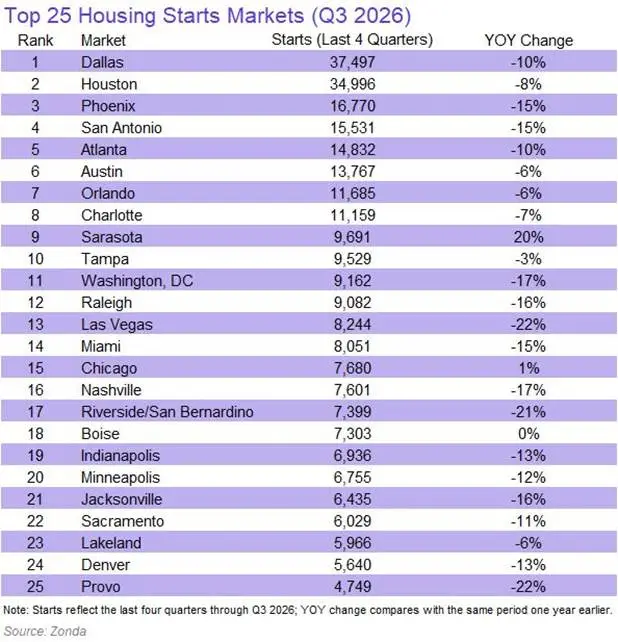
Sarasota was the clear outlier, with starts rising 20% year over year to 9,691 during the four quarters through Q3 2026. Chicago also managed growth, increasing 1% year over year to 7,680 starts, while Boise was effectively flat at 7,303.
At the other end of the spectrum, Las Vegas and Provo posted the largest declines among the top 25 markets, with starts falling 22% year over year in each. Riverside/San Bernardino followed closely with a 21% decline. Washington, D.C., Nashville, Raleigh, and Jacksonville were also among the markets recording double-digit contractions.
Texas Remains the Production Center
Despite declining activity, Dallas and Houston continue to operate on a different scale from the rest of the country.
Dallas ranked first with 37,497 starts over the past four quarters, down 10% year over year. Houston followed with 34,996, down 8% year over year. The two metros operate in a league of their own, each producing more than twice as many starts as any individual market elsewhere in the top 25.
Phoenix and San Antonio were the only other markets to top 15,000 starts, at 16,770 and 15,531, respectively. The rankings also point to relative stability at the top. Every market in the top 10 retained its position from the previous quarter, even as housing production softened nationally.
For industry professionals planning for 2027, the numbers reinforce the importance of looking beyond national trends. The size and direction of the housing adjustment vary substantially by market. Production is still highly concentrated in the Sun Belt metros, but growth in markets like Sarasota and Chicago shows that opportunities remain even against a weaker national backdrop.
The insights in this article were taken from more in-depth research reports published in Zonda’s National Outlook subscription.