Even in a country where cooling is nearly universal, Census data shows meaningful pockets of housing still built or operated without air conditioning and those gaps carry direct implications for builders and product strategy.
The U.S. Census Bureau’s Local Air Conditioning Estimates provide a new lens into cooling access, measuring the share of occupied households without any type of air conditioning across geographies. While more than nine in 10 U.S. households have cooling systems nationally, the regional variation is striking.
It should be noted that statewide averages often obscure local variation, with some neighborhoods reporting significantly higher shares of homes without cooling than others. For builders, this reinforces the importance of understanding demand at a submarket level rather than relying solely on statewide assumptions.
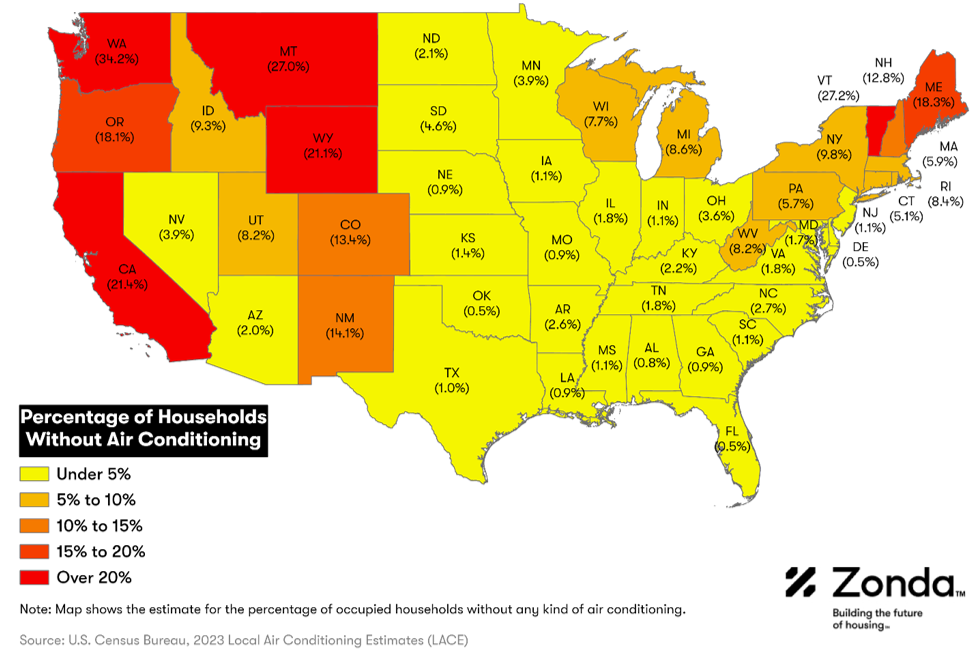
Western and Northeastern States Lead in Homes Without AC
Excluding Alaska and Hawaii, the highest shares of households without cooling systems are concentrated in the West and parts of the Northeast. Washington leads at roughly 34.2% of households without AC, followed by Vermont at 27.2%, Montana at 27%, California at 21.4%, and Wyoming at 21.1%.
This pattern reflects longstanding housing and climate dynamics. Historically mild coastal conditions in the Northeast and Pacific Northwest reduced the need for built-in cooling systems. At the same time, a larger share of older housing stock in these regions was constructed without central air.
Near Universal Adoption in the South
At the opposite end of the spectrum sits the South, where air conditioning is effectively standard. States such as Florida and Oklahoma report just 0.5% of households without AC, while Texas and Georgia come in at or below 1%.
This is largely driven by climate realities. Prolonged periods of heat and humidity make cooling essential, leading to near universal adoption across both new and existing housing stock. In these markets, cooling is not a differentiator but a necessity, shifting builder focus toward system efficiency, durability, and energy performance.
Implications for Builders and Developers
Air conditioning adoption is no longer purely a function of climate. It is increasingly shaped by housing age, migration patterns, and shifting consumer expectations. As people deal with an aging housing stock that lacks some basic comforts, the new-home market looks increasingly attractive.