
Concerns about U.S. housing demand have grown louder as two foundational drivers begin to soften at the same time. The labor market is losing momentum and population growth is slowing, creating near-term pressure on household formation and buyer confidence. Builders are already seeing the impact through slower absorption, heavier use of incentives, and a heightened focus on affordability.
These dynamics have raised broader questions about whether today’s slowdown signals something structural. To answer that, it helps to step back and look beyond the current cycle and place U.S. demographics in a global context.
Population Growth Is Slowing, but Still Positive
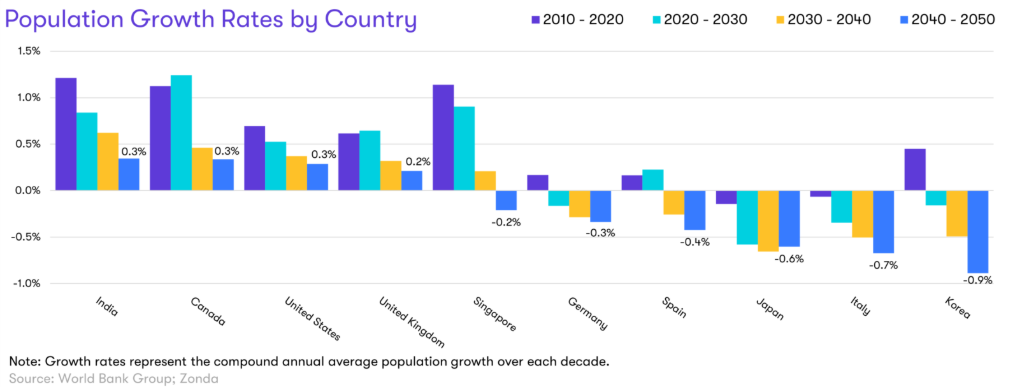
While U.S. population growth is decelerating, it continues to expand at a steady pace. Zonda’s analysis of World Bank estimates shows a gradual step-down in annual growth rates over time:
- 2010-2020: 0.7%
- 2020-2030: 0.5%
- 2030-2040: 0.3%
- 2040-2050: 0.3%
This deceleration matters for housing because slower growth means fewer incremental households each year. Demand does not disappear, but it becomes more sensitive to affordability, employment stability, and mortgage rates. In this environment, builders have less room to rely on population growth alone to drive sales and must compete more aggressively on price, product, and location.
The Global Comparison Tells a Different Story
While U.S. growth is slowing, it remains positive, unlike many other large economies. Countries such as Germany, Japan, Italy, and South Korea are already experiencing population decline, creating structural headwinds for housing demand. Even traditionally high-growth markets like Canada and Singapore are seeing demographic momentum cool.
By contrast, the U.S. is expected to continue adding population through mid-century. “The difference between slowing growth and outright decline is critical for housing,” says Ali Wolf, Zonda’s chief economist. “Positive growth still supports net new household formation, even if the pace is more modest than in prior decades. That provides an underlying demand floor that many other countries simply do not have.”
Navigating the Next Phase of the Cycle
Although the near-term environment warrants caution, the long-term demographic outlook still supports investment. Compared with global peers facing outright population decline, the U.S. remains one of the few large economies with a positive demographic trajectory.
The insights in this article were taken from more in-depth research reports published in Zonda’s National Outlook subscription.