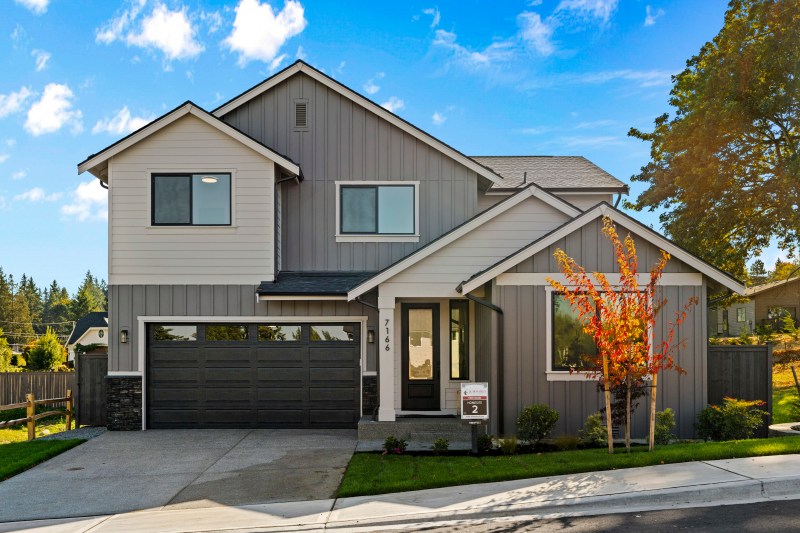
Trumark Homes has taken the next step toward achieving its goal of becoming one of the largest builders in the West with its expansion into the Pacific Northwest through the acquisition of JK Monarch.
This move accelerates the rapid growth trajectory the San Ramon, California-based builder has been on since 2020. Backed by its partnership with Japanese company Daiwa House, Trumark has expanded its footprint into central California through the acquisition of Wathen Castanos Homes and into Colorado via greenfield development.
The builder has averaged a compounded annual growth rate exceeding 60% since 2020. With a new pipeline established in Seattle, Trumark is projecting 1,400 closings in 2026 and forecasting 2,500 closings by 2028 based on its current balance sheet.
“On a macro level, Daiwa House’s objective with the three group companies (Trumark Homes, CastleRock Communities, and Stanley Martin Homes) is to be a top-five builder in the United States,” John Willsie, chief administrative officer for Trumark Homes, tells BUILDER. “Related to that, they want all of the group companies to be top five in each of the markets they are active in.”
The acquisition of JK Monarch provides Trumark entry into the greater Seattle market, a region executives describe as both strategically and fundamentally attractive.
“The greater Seattle market has been a priority for us for several years [and] it has been important for Daiwa House as well. Part of their growth strategy is for Trumark to be the flag of the Western United States,” Willsie says. “Seattle is a high-profile market, but it is also fundamentally a really strong market. There is a diverse job base there and a lot of high-tech, high-profile companies.”
The selection of JK Monarch was the result of a targeted search for both operational capability and cultural alignment. Steve Kalmbach, Trumark’s chief operating officer, says the deep local knowledge of the JK Monarch team was especially important, given entitlement constraints, smaller community sizes, and geographic limitations that make development challenging in the Seattle market.
“All [JK Monarch] operators have been in the greater Seattle market for almost their entire adult lives,” Kalmbach says. “You can’t replace that with an organic growth presence. We see a lot of runway in front of them for growth.”
JK Monarch also brings a pipeline of opportunities that Trumark can now scale with greater financial backing. With access to a stronger balance sheet, projects that were out of reach are now viable, creating immediate growth upside.
“They sold off some lots in the last couple years to bigger public builders, they just didn’t have the balance sheet capabilities to take down 60 to 80 unit communities,” Kalmbach says. “Going forward, that won’t be the case.”
“One and One Equals Three”
As Trumark moves through the post-merger integration phase, its focus is on leveraging its operational platform to accelerate JK Monarch’s growth without overbuilding its organization.
“We’re reviewing plan types, reviewing architectural details, building assemblies, looking at how we can allow them to scale quicker. Providing those resources so they don’t have to bring in 30 more people,” Kalmbach says. “It’s a one and one equals three situation, that’s where we see opportunity.”
JK Monarch’s average price point for their existing portfolio is between $900,000 and $1 million, with Kalmbach suggesting the portfolio can stretch to hit everything between $600,000 and $2 million.
“When you look at those consumer profiles, [we’re] going to try and bring the cost down as much as possible for the entry-level and bring in market intelligence from the corporate level to drill down by consumer type what they look for and what they value,” Kalmbach says.
“We’ve got to be smart on what the higher end consumer is looking for,” he continues. “They have more purchasing power, so we hope to bring a greater basket of optionality to that customer, similar to what we are doing elsewhere in the company to allow them to option up for their finishes.”
While JK Monarch has traditionally offered single-family detached product, Willsie says Trumark hopes to bring its product expertise to allow a broader product lineup in the Seattle region.
“JK Monarch has recognized some of the challenges with doing attached product,” Willsie says. “Fortunately, that is something that we have a lot of experience doing. There is a lot of growth potential up there in the market for townhome, condo, and attached product development.”
Scaling Culture
In its search to find the correct partner for its Seattle market entrance, Kalmbach and Willsie stressed that culture was among the most important elements for the Trumark team.
“I have some threshold topics and knockout issues, and they pertain to culture,” Willsie says.
He evaluates both outward facing values, such as a strong customer focus, and inward facing dynamics, including how leadership treats employees. In JK Monarch, the Trumark team found alignment with a customer-first mindset and a strong people-first internal culture.
Kalmbach adds that culture is often the deciding factor in whether acquisitions succeed or fail after the deal is completed.
“One of the hardest things to change is culture,” he says. “Especially for something that we’re pursuing as a growth platform. To see eye to eye and believe in the same mantra in how we grow as a team, that’s one that excited us going into this transaction.”
For Trumark, the cultural element is taking on a greater importance as the builder continues its rapid growth trajectory. Kalmbach and Willsie emphasize accountability, humility, and collaboration as core principles that Trumark leaders will continue to reinforce as the organization grows in geographic scope and volume terms.
“There’s a tremendous responsibility that goes with maintaining culture. It’s not words on a wall, it’s authenticity,” Willsie says. “You practice what you preach.”
For Kalmbach, growth is ultimately about creating opportunity, for employees as much as for the overall organization.
“One of the beautiful parts about growing is that you give opportunity to up and coming folks on the team,” he says.
Growing With Intention
Trumark’s pace of expansion is atypical in the home building sector and the company is showing no signs of slowing down.
“We’ve gone from 300 units in 2020 to close to 1,500 closings this year. That kind of exponential growth is not normal,” Kalmbach says. “We are going to go to 2,500 units in the next two to three years. Most builders grow anywhere from 2% to 8% a year. It’s going to be something we have to keep an eye on, but we’re confident that we are going to be successful.”
As the company scales, Willsie and Kalmbach say Trumark is in a constant evaluation phase, ensuring systems, processes, and leadership development support not only success today but also success at a larger scale.
“Growing pains are real. What served us well when we are doing 300 homes a year does not work if we are doing 1,400 or 2,500 units a year,” Willsie says. “That’s the challenge for the executive team.”
With Seattle now established as a fifth division, complementing divisions in northern, central, and southern California and Colorado, Trumark sees the Pacific Northwest as both a growth engine and a springboard for further acquisition.
Long term, Willsie says Trumark wants to enter all the large western markets, including Salt Lake City, Boise, Arizona, and Nevada.
“We all know which are the big markets, and that’s where we want to be,” Willsie says. “And we will be.”