A few years ago, it was just about a given that Nextel had the home builder communications market locked up. The company was such a profound force in the industry that every year at the International Builders' Show, attendees would complain that they couldn't get their calls through because so many builders were using Nextel.
Times have changed. Nextel is now Sprint Nextel, following the completion of the carrier's $71 billion merger with Sprint last year. Based on a recent Builder survey and some follow-up interviews, we've learned that although the company enjoys a relatively healthy relationship with big builders, it has some work to do among small builders, many of whom have left Nextel, for reasons described below. Only 36 percent of our 633 small-builder survey respondents (those building fewer than 300 units a year) use Nextel, and even fewer, 9 percent, use Sprint PCS (see “Smaller Market Share,” page 154). The data from our 147 big-builder respondents (those building 300 or more units a year) are much more promising for the merged carrier: Sixty-two percent of our big-builder group uses Nextel, while about 13 percent are signed up with Sprint PCS, giving Sprint Nextel 75 percent of the sample (see “Big-Builder Favorites,” page 154).
“If there was any erosion, I would think it's with the very small builder,” says Butch Musselman, vice president of industry business solutions for Sprint Nextel. “In the small-builder space, there's a tendency to go for the [simple plan],” he explains, adding that large builders want a fully integrated solution that lets users run applications such as PermitWorks, which provides live help-desk service for the permitting process, or back-office software such as BuilderMT.
Musselman has a point. Many big builders are committed to rolling out hand-held applications on Nextel phones. Charles Irsch, chief information officer of Centex Corp., views the merger as a positive step and expects to carry the strong relationship his company has had with Nextel into the future with Sprint Nextel. Irsch says Centex is using Nextel BlackBerrys for its customer-care application. As of mid-November, Centex had rolled out the application, which lets warranty service people update schedules and sign off on service calls using a BlackBerry, to about one-third of its markets.
Even on the small-builder front, Sprint Nextel is slowly winning back customers. Dan Kent, president of Kent Homes in Wilmington, N.C., says he switched from SunComm to Nextel mainly because he couldn't get BuilderMT to work with SunComm's wireless service.

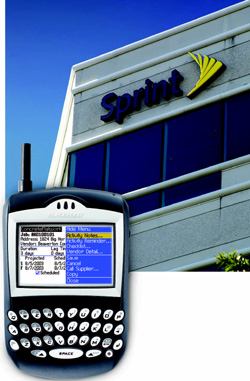
SIGN OF THE TIMES: The new Sprint Nextel logo (right) features Sprint's signature “pin drop” and Nextel's yellow-and-black color scheme. Merging the marketing is one thing; maintaining the companies' networks and identities may be tougher over the long term.ON SCHEDULE: The strength of Sprint's data network will make running applications such as BuilderMT on a Nextel BlackBerry (inset) much easier for builders.
Kent says his company is transitioning from being a custom builder that builds about 12 homes a year to a company that will build about 50 homes in 2006. The home builder has used Timberline accounting software for years and now is adding BuilderMT's purchasing and construction management system. Opting to run BuilderMT on a Nextel BlackBerry just made sense, because the software is optimized to run on the device.
“I never had any problem with Nextel's service. The reason I initially switched to SunComm was more of a price issue,” says Kent, who adds that he was just looking to save money on wireless voice.
Now, Kent is spending roughly $200 more per month than he did with Sun-Comm, but he believes the productivity gains with BuilderMTwill be worth the extra money. His plan is to first run BuilderMT's scheduling application on the BlackBerry, and later this year run the full complement of applications, including estimating, purchasing, bill pay, and punch lists.
SMALLER VOICESDespite the strong relationships with some of the big builders and some recent customer wins, Sprint Nextel needs to listen to some of the smaller builders who have switched carriers. Many of these builders are dissatisfied customers. Here are some examples:
Willie Kendrick is a purchasing manager with Paul Taylor Homes in Dallas. The semi-custom builder closed about 250 homes last year, with sales prices ranging from $150,000 to $500,000. Kendrick says Paul Taylor Homes switched his 13 supers and seven office managers from Nextel to Cingular almost two years ago.
“When Nextel came into the market, its Direct Connect push-to-talk service was a great idea,” Kendrick says. “It also helped that most of the trades were on Nextel,” he adds, “but the coverage was bad.”
Kendrick says his company used the Nextel phones only for voice calls, not even for text messaging. He notes that by opting for Cingular, the builder saves 20 percent on its annual wireless bill. “Cingular gives us better coverage and better plans,” he adds.
Todd Gordon, co-owner of NuWest Custom Homes in Denver, says his company originally signed on with Nextel because of its push-to-talk feature. But he notes that Nextel's coverage has never been great and that the longer NuWest had the phones, the less the company's workers used the push-to-talk feature anyway.
“We don't build in remote areas,” Gordon explains. “A few years ago we were doing a knockdown—it was just a standard city block, and we didn't get the coverage,” he says, adding that his company is in the process of switching to Cingular.
At press time, Gordon had switched three of his eight employees over to Cingular and reported positive results.
“I've had no complaints about bad signals or lost calls,” he says. “People are upgrading to the BlackBerry, using it for e-mail,” Gordon says, adding: “I was just tired of hearing everyone complain about the coverage. I want a phone that's going to work when I need to use it.”
Musselman denies any problems with coverage, saying that Sprint Nextel delivers as much coverage as any other wireless carrier. On the pricing front, he says the addition of Sprint gives Nextel the ability to compete at the low end. He says the company has already rolled out its Fair & Flexible rate structure for a monthly fee of about $30 for an intro plan.
Musselman states that Sprint Nextel is committed to maintaining the network running Nextel's Direct Connect push-to-talk feature for at least another five years. The carrier has also started offering unlimited mobile-to-mobile calling between Nextel and Sprint customers.
Another new feature from Sprint Nextel is DirectSend. This lets a builder take a picture and instantly send it over Direct Connect. Sprint Nextel is offering the service free of charge through March, after which it will cost 25 cents per picture.
The carrier also plans to continue rolling out evolution data optimized (EV-DO) service in about 60 metropolitan areas by this spring. EV-DO will offer wireless-network data speeds of 400 megabits per second to 700 megabits per second. Sprint Nextel first started rolling out EV-DO last summer in select markets.
SENSIBLE MERGERFrom a Nextel perspective, one of the main reasons the company merged with Sprint was to gain access to Sprint's 1,900 MHz data network; the wireless network that runs Nextel's Direct Connect feature runs on the 800 MHz spectrum.
“A big problem for Nextel leading up to the merger was that the company couldn't support its Direct Connect base and deliver the data services it was promising,” says Lisa Pierce, an analyst with Forrester Research, an information technology consulting group based in Cambridge, Mass. “They simply didn't have enough spectrum to do both,” she explains, adding that “the only way Nextel could keep going was to go down the merger road.”
Musselman essentially agrees, noting that Nextel looked into building a next-generation network, but it would have been cost-prohibitive. “The synergies of both companies complement each other,” he says, adding, “The merger gives us a much better spectrum position.”
This is great news for home builders interested in taking advantage of the dozens of data applications Sprint Nextel offers.
Pierce thinks Sprint Nextel will ultimately migrate to a single network, mainly because it's too expensive to maintain two. But the behind-the-scenes technology issues are of little concern to home builders. If Sprint Nextel can deliver enhanced data speeds and extended wireless coverage, builders will finally be able to make BlackBerrys running handheld data applications more ubiquitous in the field—and they'll also be able to set up shop more easily in remote locations.
It may come to pass that the kinds of complaints about Nextel's coverage that builders such as Paul Taylor Homes and NuWest Custom Homes report will fade away as the professed synergies of Sprint Nextel gather steam.