Click here to download the charts for markets 1-28 (22MB PDF)

Click here to download the charts for markets 29-54 (39MB PDF)

Click here to download the charts for markets 55-75 (18MB PDF)

Shea Homes' share of the Phoenix market alone “slipped a bit” in 2006, as its closings declined by 35 percent to 1,040 units. But the Walnut, Calif.–based builder doesn't regret its decision not to sell homes there through outrageous incentives and deep price cuts. “We didn't start a lot of spec homes, either,” says Buddy Satterfield, division president. “We were going to protect our margins.”

Builders around the country were forced last year to ask what, exactly, market share meant if holding onto it required giving away the farm. Saddled with cancelled contracts and unsold homes, many builders saw their only solution as doing whatever it took to lower their inventories through mortgage buydowns, free upgrades, cash and prizes, and finally price reductions that in some markets hit 25 percent. This strategy may have won builders the market-share battle, but it left some bottom lines bleeding in a ditch, as evinced by the astronomical net income declines that public builders have been reporting lately.

Retrenchment took hold last year, as permits issued—a barometer of potential future construction—declined in 18 of the 25 largest housing markets. And the land options that builders walked away from were further indications that expansion at any price was no longer viable. Given these dynamics, this year's Local Leaders listing of the top 10 builders (ranked by closings) in the top 75 metropolitan areas (ranked by permits issued), can be seen as a profile of either survival or folly. The list validates where the housing downturn hit hardest and shows where builders made a stand—or didn't—to retain their share.

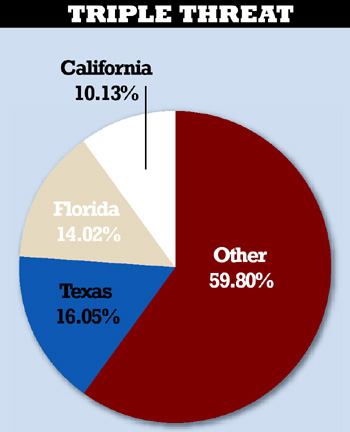
EVERYTHING'S BIGGER IN TEXAS: Led by an increase of almost 9,000 permits in Houston, Texas replaces Florida  as the state with the most permits among the top 75 markets. In 2005, Florida  led all states with over 18% of all permits in the top 75 markets. This  year Florida still boasts the most (12) markets among the top 75, and the  second highest number of permits (159,509), but Texas, with 182,526 permits  in six markets, takes the top spot for 2006. California had eight markets  among the top 75, and 115,205 permits.

EVERYTHING'S BIGGER IN TEXAS: Led by an increase of almost 9,000 permits in Houston, Texas replaces Florida as the state with the most permits among the top 75 markets. In 2005, Florida led all states with over 18% of all permits in the top 75 markets. This year Florida still boasts the most (12) markets among the top 75, and the second highest number of permits (159,509), but Texas, with 182,526 permits in six markets, takes the top spot for 2006. California had eight markets among the top 75, and 115,205 permits.

Indeed, many of the builders interviewed for this article preferred to frame their divisions' performances last year in terms of sales, as opposed to closings that account for cancellations, which are the ranking data our Local Leaders charts use. Several builders also preferred to reference more confined geographic regions than the metropolitan statistical areas (MSAs) that serve as the corrals for our charts.

No matter how one looks at the markets, however, some trends were evident. Houston's leap over Atlanta and Phoenix to lead the nation in permits issued accentuates how Texas builders in general haven't felt the downturn as acutely as builders in Florida, California, and Arizona. Other markets emerged from relative obscurity, such as Salt Lake City, whose ranking jumped to 20th place from 50th in 2005, as permits there rose by nearly 96 percent, and builders and developers looked to cash in while prices were still appreciating. But the image of deck chairs being rearranged on the Titanic comes to mind when one sees how the pecking order changed in several metro markets. Even Chicago, normally one of the most stable areas, became a battle where certain builders—Pulte Homes, Lakewood Homes, and Neumann Homes—relinquished ground. Conversely, Astoria Homes' absence from the top 10 in Las Vegas was by design.

Below, Builder takes a closer look at Vegas, D.C., and another volatile market, Sacramento, Calif. But no matter where builders operated, it's a safe bet they were happier than those selling homes in Fort Myers, Fla., the poster child for the housing industry's turmoil. In February, Fitch Ratings' housing analyst Bob Curran dubbed Fort Myers “one of the worst markets in the country.” Market leader Hovnanian Enterprises took a $90 million charge in the first quarter of 2007 to cover lower sales and higher cancellations there.

Holiday Builders managed to close 15 percent more homes in Fort Myers last year by targeting first-time and move-up buyers with houses priced between $212,000 and $245,000. But Holiday's COO, Bruce Assam, foresees a 70 percent falloff in 2007, after his company “rescrubbed our pipeline and called all of our buyers to see who was still interested. We did not want to build another spec home there.”

If anything, the downturn brought quite a few high-flying Local Leaders back down to earth. Shea, for one, expects to close only 800 homes in Phoenix in 2007, even as it starts three communities and will open three others. “We're encouraged by the quality of traffic we've gotten in the last few months,” says Satterfield, whom Builder interviewed in February. “It's fewer people, but better buyers.”

LAS VEGAS

HIGHER STAKES

Las Vegas builders roll the dice with higher-density projects, as the odds on finding land they can develop get longer.

As of last November, the Las Vegas area had only 6 ½ years of land left for residential development, according to In Business Las Vegas. Local officials are urging Congress to free up more federal real estate through public auction. But builders and developers are preparing for scarcity.

KB Home and Richmond American, for example, got into higher-density attached homes last year, says Dennis L. Smith, president and CEO of Homebuilders Research, which tracks this market. Even Pardee Homes, which remains committed to building mostly single-family detached homes, began designing its first multifamily product, says division president Klif Andrews.

Some of KB Home's production will be available at Inspirada, a 2,000-acre master planned community in Henderson, Nev., where KB will construct 4,000 of that project's 15,000 homes in seven villages. Focus Property Group, Inspirada's developer, altered the concept for this neighborhood to a higher-density, New Urbanist format “that the city of Henderson embraced,” says Focus' chairman and CEO John Ritter. In exchange for open space and parks, Focus got approval for smaller lots and setbacks.

TOP HEAVY: The largest national builders are spread throughout the top 75 markets, but  nowhere are they as concentrated as at the top of the rankings, where each  of the top 25 markets have at least two national builders among their top 10. The  largest 10 markets saw an average of six big builders among their top 10 builders, measured  by closings. At the bottom of the rankings smaller  companies have more breathing room, as seven of the last 10 markets on the  list saw none of the largest builders among their top 10.

TOP HEAVY: The largest national builders are spread throughout the top 75 markets, but nowhere are they as concentrated as at the top of the rankings, where each of the top 25 markets have at least two national builders among their top 10. The largest 10 markets saw an average of six big builders among their top 10 builders, measured by closings. At the bottom of the rankings smaller companies have more breathing room, as seven of the last 10 markets on the list saw none of the largest builders among their top 10.

“A” locations in Las Vegas go for $1 million an acre, and even “C” locations can run $600,000. “So my land is worth more than the house I'm selling,” says Tom McCormick, president of Astoria Homes, which for most of this decade has aggressively built higher-density (up to 15 units to the acre) single-family homes that currently start at $225,000. In 2007, Astoria is introducing an attached version in two master planned communities in northwest Las Vegas, with nine to 12 units to the acre and products that start in the low $200s.

After years of wild price escalation, builders here have “responded splendidly” to the downturn, says Homebuilders Research's Smith, by reducing prices—some by $200,000 per house—and offering incentives. Others got out of projects that no longer made financial sense. Centex pulled the plug on a 2,000-acre project in Henderson, and D.R. Horton walked away from a mid-rise project in the trendy Harmon corridor off of The Strip. Home-builders Research estimates that permits in the Las Vegas region fell by 25 percent last year to 23,219. And it does appear that some companies are easing into a jog. Pardee, which closed 1,523 homes there last year, expects its production to be down 20 percent in 2007, says Andrews. Focus pushed back some projects to 2009 and 2010 because Ritter doesn't expect builders to be “back in force” until next year.

Astoria Homes fell out of the top 10 in closings last year, and McCormick says it will probably never hit 1,000 closings in Vegas again, as it did in 2005, especially now that it's shifting towards the luxury market with $2 million-plus, 6,000-square-foot homes in gated communities. McCormick says he's seeing land opportunities for this product “that we wouldn't see in a normal market.”

WASHINGTON

CAPITOL GAINS

Cutting prices was a last resort for builders in Washington, though bargains were still hard to find.

Last year, K. Hovnanian's Landover Group, which oversees the builder's activities in the Mid-Atlantic and Southeast states, increased sales in the Virginia/Maryland market that encompasses Washington by 6.2 percent, to 1,526 units; and grew its closings by 5.2 percent to 1,453 units, according to Hanley Wood Market Intelligence, a sister division of Builder. When asked how his division accomplished that, group president Tom Pellerito laughs, “We raised prices and cut incentives.”

The opposite occurred, of course, for Hovnanian and other Local Leaders in the greater D.C. area, although price depreciation in greater D.C. was nowhere near as steep as in other markets, according to a Washington Post analysis of government sales records in 13 jurisdictions surrounding D.C. While 2006 sales in the area fell by 21 percent to 83,647 units, median sales prices declined only 0.5 percent to $417,000. Affordability, however, is relative, as The Post reports “it has become almost impossible to find a neighborhood where the median sales price is less than $200,000—a level that was the rule five years ago.”

Affordability caused buyer demand to “hit the wall precipitously” in early 2006, says Bill Slenker, president of Slenker Communities, a Springfield, Va.–based developer. Pulte Homes' “thoroughbred” communities, says Washington-area division president John Reeves, were those with homes priced in the $300,000 to $500,000 range “that appealed to long-time renters who otherwise couldn't touch a house in the market.” Jerry Berman, Lennar's Northern Virginia division president, says his division gained share here in 2006 because “we saw that the downturn wasn't going to be short and faced reality” by lowering prices in some communities by 25 percent.

SEGMENTATION: By breaking the top 75 markets into three segments, divided by rank, we see  the average market share held by the top 10 builders. Markets 26-50 saw the  highest average market share achieved by top 10 builders, a change from 2005 when  top 10 builders had the most market share in markets 51-75. In 2006, markets 1-25 saw  the most national builders, with the 10 largest home builders, measured  by closings, appearing an average of 5.4 times per market. The  biggest builders show up less often in smaller markets, averaging 3.36 appearances  in markets 26-50 and just 1.76 in markets 51-75.

SEGMENTATION: By breaking the top 75 markets into three segments, divided by rank, we see the average market share held by the top 10 builders. Markets 26-50 saw the highest average market share achieved by top 10 builders, a change from 2005 when top 10 builders had the most market share in markets 51-75. In 2006, markets 1-25 saw the most national builders, with the 10 largest home builders, measured by closings, appearing an average of 5.4 times per market. The biggest builders show up less often in smaller markets, averaging 3.36 appearances in markets 26-50 and just 1.76 in markets 51-75.

Lennar also revived an age-old marketing tactic where its salespeople, senior-level managers, and even contractors spend a few hours every Monday night making calls to prospects. Builders here had to be proactive to counter the impact of investors, who accounted for anywhere from 20 percent to 30 percent of sales in late 2005 and early 2006.

Slenker observes that several leading builders in the D.C. area—NVR, Weyerhaeuser's Winchester Homes division, and Richmond American—showed “discipline” in how they've managed their real estate during the downturn. Reeves says that any gains Pulte made last year can be attributed partly to its “land position” and “disciplined land strategy,” which kept his division from purchasing high-priced dirt in certain markets.

Still, Pulte, which closed 700 homes in greater D.C. alone in 2006, expects to open four new communities this year. Its Del Webb subsidiary is adding two new active adult communities in Virginia. Lennar's D.C. division—which closed 360 homes in 2006 and projects 380 closings this year—is scheduled to open three new communities, including Heritage Heights, an active adult community with 80 homes that will sell in the high $200s to low $300s, says Berman.

“Active adult just performs better in a down market,” observes Slenker, who targets seniors. He's now looking for opportunities in “micropolitan” markets where land is more affordable, such as Milford, Del. (30 miles from Rehoboth Beach), where his community's homes sell from the $200s to $499,000.

SACRAMENTO, CALIF.

FREE FOR ALL

Big builders in Sacramento, Calif., tried everything to move inventory last year. The jury's still out on how successful they were.

The Sacramento region (No. 28) was California's most affordable in 2006. The National Association of Realtors estimates that in the fourth quarter of last year, 41 percent of Sacramento households could afford to buy an entry-level home. Maybe that's because Sacramento has been ground zero for incentives marketing by builders scrambling to get rid of unsold inventory in an overbuilt market that had seen an influx of builders—including Lennar, Shea Homes, and MBKHomes—in recent years.

“Builders entered Sacramento thinking they all could build 1,000 homes a year, when the market could absorb only 500,” says Doug Bauer, president and COO of William Lyon Homes, whose annual sales in Sacramento have hovered between 130 and 170 units over the past five years, according to The Gregory Group, which tracks the local housing market.

Outside of Beazer Homes—which dropped to 18th in sales in 2006 from the top three in previous years because of delivery problems it encountered—Sacramento's top builders gained market share in sales, according to The Gregory Group estimates. But as our Local Leaders chart reveals, many of these same companies don't fare nearly as well when their closings are the barometer, to the point where three new builders—Meritage Homes, Pacific West Cos., and Kimball Hill Homes—snuck into Sacramento's top 10 in closings in 2006. (Coincidentally, at least 10 builders brought in new leadership last year, according to the Sacramento Business Journal.) Virtually every builder here played the incentives game, and most finally resorted to lower prices because jaded buyers “were walking out of sales offices without engaging the salesperson,” says Greg Paquin, president of The Gregory Group.

Centex and D.R. Horton, in particular, were “relentless” in their price discounting, says Kevin Carson, John Laing Homes' Sacramento division president. (Neither Centex's nor Horton's divisional offices returned phone calls requesting comment.) “We didn't realize how much the publics could impact our world,” adds Sid Dunmore, CEO of Sacramento-based Dunmore Homes, whose closings last year fell 38 percent to 225 units. “They were willing to lose massive amounts of money just to keep volume up.”

PICKING UP STEAM: A broad swath of the top 75 Local Leaders markets reveals just how fast attached  housing is growing as a percentage of total new-home sales. In Phoenix, the  No. 3 Local Leaders market, attached has grown from 10% of all new-home  sales in 2005 to 23% in 2006. In urban markets such as Washington (No. 10) and  Seattle (No. 12), attached has always made up a sizable chunk of all  new-home sales, and still Seattle saw its attached housing grow to 46% of  all new-home sales from 31% in 2005.

PICKING UP STEAM: A broad swath of the top 75 Local Leaders markets reveals just how fast attached housing is growing as a percentage of total new-home sales. In Phoenix, the No. 3 Local Leaders market, attached has grown from 10% of all new-home sales in 2005 to 23% in 2006. In urban markets such as Washington (No. 10) and Seattle (No. 12), attached has always made up a sizable chunk of all new-home sales, and still Seattle saw its attached housing grow to 46% of all new-home sales from 31% in 2005.

Price cutting and incentives, though, were only fitfully effective, as sales in Sacramento's six counties fell 32 percent to 9,588 units, by The Gregory Group estimates. In a teleconference with analysts in March, KB Home's executive vice president and CFO Dom Cecere said Sacramento “continues to be difficult.” Brendan O'Neill, Beazer's Sacramento division president and general manager, told the Business Journal in February that the market was “bouncing along the bottom.” Aggressive discounting spilled over into early 2007: Carson says JTS Communities in January flew a plane over the market with a banner advertising $100,000 off the price of its homes, and that Morrison Homes was offering $75,000 discounts on its homes.

Curiously, none of the sources contacted for this article expect land to get much cheaper in the foreseeable future. Most agree that big landowners such as Reynen & Bardis Communities and AKT Development Corp. have made so much money over the past several years that they can wait out the downturn. “We're still bullish,” says Mark Enes, AKT's executive vice president. “Sacramento is a beautiful place to live and is relatively cheap by California standards. I receive multiple calls from builders every week; these guys are like factories, and they need lots.”

METHODOLOGY

Hanley Wood Market Intelligence, owned by Hanley Wood, LLC, publisher of BUILDER, is one of the home building industry's largest providers of information on new-home projects, land development, and real estate consulting services. The following methodology was used in compiling the 2006 Local Leaders:

  • The top 75 markets were determined based on 12 months of total permits issued during 2006 using Federal Office of Management and Budget geographic boundaries as a foundation. Metropolitan Statistical Areas (MSAs) are the primary form of organization, with some exceptions. Large MSAs are often split up into separate Metropolitan Divisions, and these Metropolitan Divisions are normally used if it is not inappropriate for that market area. In our top 75 list of markets, 13 are Metropolitan Divisions. Meanwhile, there are three markets in which it was more appropriate to use the entire MSA instead of separate divisions (Seattle/Tacoma/Bellevue, Wash.; Washington/Arlington/Alexandria, Va./Md./W.Va.; and Detroit/Warren/Livonia, Mich.). Further, some market areas are a combination of more than one MSA or Division, but only if it is specifically appropriate for that geographic market area. In our top 75 list of markets, three areas are combinations of more than one MSA or Division (Chicago, Salt Lake City, and Greenville/Spartanburg, S.C.).
  • Builders were asked to provide 2006 closings.
  • If a company was acquired or merged with another during 2006, figures include the results for both companies during the entire year.
  • The country's largest home builders were contacted via fax and phone for their 2006 figures. For more information on Local Leaders, contact Hanley Wood Market Intelligence at 800-639-3777 or e-mail Jodi Bice at jbice@hanleywood.com.