_1_tcm10-91784.jpg)
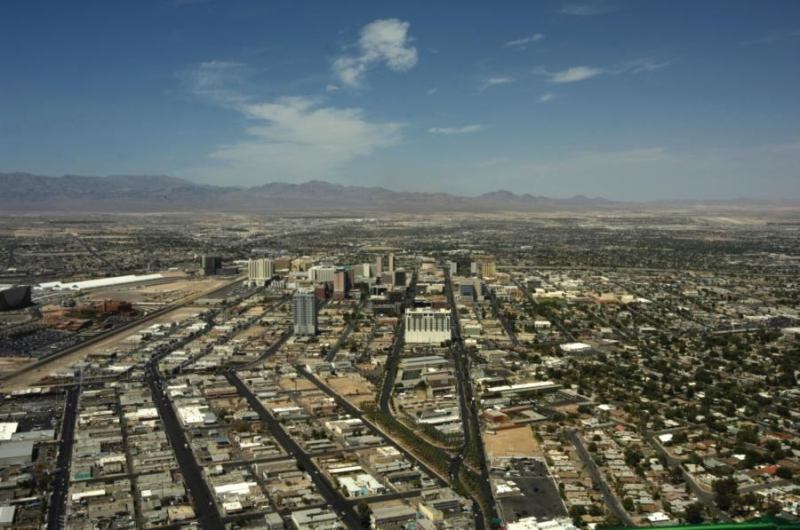
Las Vegas cityscape overview
Despite boasting one of the nation’s highest shares of homes built to the federal Energy Star standard (about 60 percent), only a handful of builders operating in the valley have formally joined the Southern Nevada Green Building Partnership since the local building association chapter launched the certification program in 2005. “A lot of our builders are in what I’d call hibernation,” says Monica Caruso, director of public affairs for the Southern Nevada HBA, citing the market’s current building crisis. “As we recover, though, I think green building will be a stronger trend.”
Some builders aren’t waiting and see green building as the ticket to sustaining or gaining market share during the lull.
Pulte/Del Webb Homes, for instance, is close to selling out two projects that far exceed Energy Star standards and just opened the models to a new project, Villa Trieste, in which every home will not only meet the Partnership standards but also achieve LEED for Homes ratings. “In Las Vegas, there’s nothing special or different about building an Energy Star home,” says Walter Cuculic, the builder’s director of strategic marketing. “Going to this level differentiates us.”
Meanwhile, Signature Homes is building and showcasing a 2,200-square-foot prototype green home within its existing Mission Del Rey community to gauge the initial cost, operating performance, and sales potential of building to a higher level of eco-friendliness. “It’s the nature of how the country and industry are going, and it’s a way to get a leg up on the competition,” says Brian Plaster, vice president of operations for Signature Homes.
Sales Stimulus?
While Pulte/Del Webb has seen success with building green at three of its most recent communities and expects a similar response at Villa Trieste, the four other builders in the Green Building Partnership, as well as their brethren building to Energy Star or other green building standards, have not. “It’s tough to properly or accurately assess the impact of green building in this market at this time,” says Plaster.
One Partnership builder, Pinnacle Homes, successfully sold a zero-energy house within one of its communities in 2004. Though occupied, the 1,610-square-foot unit is still being monitored for performance, specifically its integrated solar roof panels, against a baseline-green home next door by faculty and students at the University of Nevada, Las Vegas. The builder, however, has yet to offer another zero-energy home or move forward with Partnership-level homes since. “We’re waiting for the market to recover,” says company vice president and co-owner Danny Martter.
Meanwhile, Concordia Homes, another Partnership member and the first builder in the market to spec photovoltaic solar panels as standard for an entire community (Sommerset), closed its sales offices in October due to a severe lack of traffic despite prices in the $200s for the all-solar homes. The builder intends to reopen and restart Sommerset as the market recovers.
One sticking point, says Caruso, at Sommerset and among the homes of other green-minded builders, is that local appraisers haven’t caught on to or kept up with the value of eco-features. “They don’t know how to account for solar panels,” she says. Specifically at Sommerset, appraised values came in below the sticker prices, negating any sales advantage or margin—much less any payback for the PV panels—that the builder hoped to gain by going so heavily green. “Until we get rid of all of our inventory [half of which is vacant], it’ll be tough for any new homes to sell.”
Working a Niche
The exception appears to be Pulte/Del Webb, which has forged a local reputation for consistently going beyond Energy Star and generating invaluable word-of-mouth referrals for building higher-performing homes.
The builder also leverages federal tax credits, local utility rebates, and other financial incentives that add up to about $3,000 per house to build green and lower its building costs, helping it compete with foreclosures and empty inventory. “With the programs out there, it costs less for us to build this way than to code minimum,” says Cuculic.
Pulte/Del Webb also makes sure prospects not only know about but also see and feel the difference in its high-performance housing. For instance, model homes feature cut-outs in the walls and ceilings and small television monitors to explain and show eco-specific construction features.
Achieving LEED for Homes ratings at Villa Trieste, says Cuculic, was only a slight upgrade. The company also hopes the community becomes a test bed for the local utility, the university, and the federal DOE projects to monitor the performance of the homes. Cuculic also expects the developer, a real estate investment trust, to offset the slight cost premiums to achieve LEED status. “We’re moving toward a zero-energy community concept,” says Nat Hodgson, vice president of construction, whom Cuculic credits as the driving force behind that goal.
One of the goals for Signature Homes’ green-built prototype is to assess how well the home performs when ideal orientation can’t be achieved—a common complaint among builders trying to do right but dinged by green building certifiers for lot designs and natural topography they can’t control or change. “There’s a lot less flexibility with a production home,” says Plaster.
SALES SUCCESS: Homes at both Azure Canyon and Palm Vistas (pictured), both by Pulte/Del Webb Homes and selling in the mid-$200s to upper-$300s, respectively, feature a standard package of low-E windows, tankless water heaters, 15-SEER cooling systems, upgraded insulation, and dual-flush toilets that enable them to qualify for federal energy tax credits. Driving directions to Azure Canyon: Take the southern 215 Beltway to Durango and exit south; left onto Blue Diamond; right onto Buffalo and turn into Mountain’s Edge; left onto Mountain’s Edge Pkwy.; Azure Canyon is on the right. Driving directions to Palm Vistas: Take 215 East to US-95 South; exit Horizon and turn right; quick left onto Horizon Ridge; right onto Mission; right onto Fortacre; follow the signs. Driving directions to Villa Trieste: From the LVCC, take Sahara Ave. west; right at Hughes Park; right on Summerlin Centre; third exit is Cape Cod Landing; Villa Trieste is on the right.

PROTOTYPE GREEN: Signature Homes hopes to learn some lessons from a 2,200-square-foot prototype in its Mission Del Rey community. The home is a new plan that will feature upgraded products and systems to conserve a variety of resources and adhere to the Southern Nevada Green Building Partnership standards. “It will add about 3 to 5 percent to the cost of our standard Energy Star–rated home, not including the solar panels,” says Brian Plaster, a premium he expects to hone down or pinpoint to remain cost competitive while providing a better-built home. Driving directions: Take US-95 North to Craig Rd. east; left on Donna; left into community.

SAVED BY ZERO: Pinnacle Homes built a zero-energy home—and sold it—in 2004, in partnership with federal, state, and local entities. Builder Danny Martter combined precast walls to more than double the insulating value of the shell compared with conventionally built homes in the valley, and installed a 5.0 kilowatt photovoltaic panel array on the south-facing roof to achieve a net-zero electrical balance. A solar thermal unit takes care of all water heating needs. The home is occupied and the section containing the house is sold out and within a gated community; for more information, go to www.solar.unlv.edu/projects/zeh.php.