Does your house tell a story? A new home may be energy-efficient and pristine, but it may be hard-pressed to compete with the charm and lore of an older home. Then again, vintage homes, for all their charisma, tend to have wrinkles, sags, and leaks that reveal their true age.
So which is better, old or new? Some savvy builders are opting for a little of both in an effort to deliver homes with character. Some are doing so by integrating reclaimed or vintage materials as accents inside or outside the home. Others are faithfully replicating historic architectural styles--down to every last cornice detail, porch column, and gable end--in ways that look authentic, but with products and practices that perform like new construction.
Here are some examples of new or remodeled homes that tell great stories.

Credit: Ryan Lowe
Barn Raising
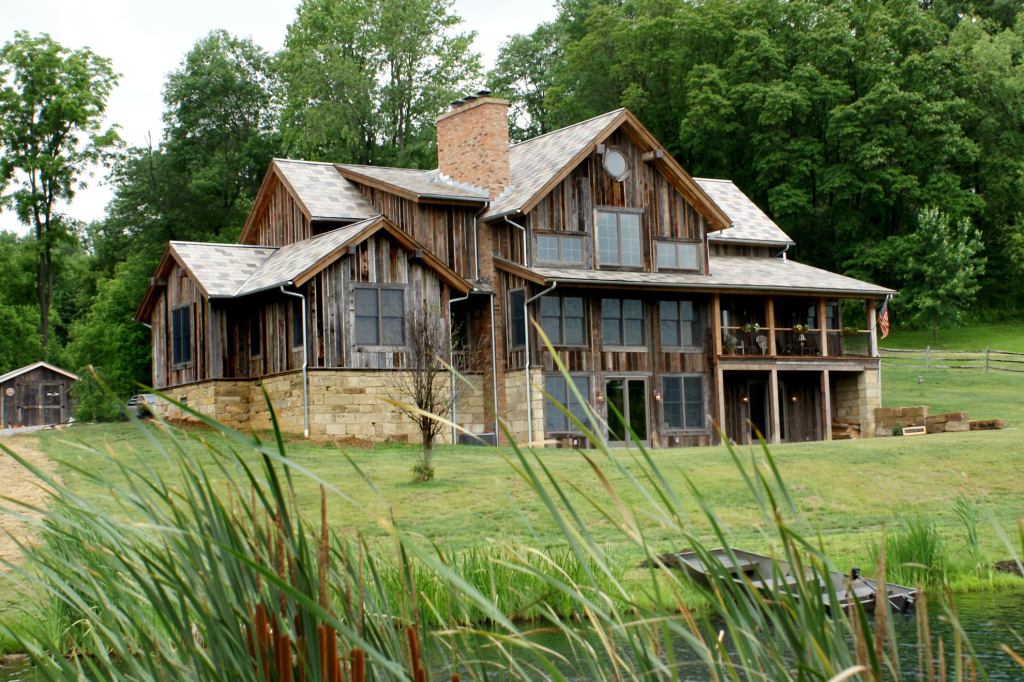
Tommy Sancic’s company, Olde Wood Ltd., recycles vintage wood from old barns and farmhouses that have structurally outlived their use. His personal residence in Malvern, Ohio, which showcases his wares, is arguably packed with more history than some museums.
Clad in random-width pine siding sourced from local farms, the rustic home is topped with an antique slate roof, rusted tin trim, a foundation skirted in reclaimed barnstone, soffits made of old-growth walnut, and exterior support timbers salvaged from an old woodworking shop in Cleveland, circa 1880. (The roof's slate tiles are 9 pounds each, bringing the total weight of the roof to 80,000 pounds.)
The guest suite is paneled in 18- to 22-inch planks rescued from a demolished historic train station formerly located fewer than 8 miles away. Brick pavers in the exterior landscaping were sourced from industrial buildings in Cleveland’s Flats area.
In addition, the home’s kitchen cabinets, flooring, backsplash, fireplace, support beams, floor joists, stairs, bathroom vanity, and shower tiles are all made from reclaimed materials. All wood available through Olde Wood Ltd. is de-nailed, kiln-dried, and milled as dimensional lumber.


Credit: Greg Hursley
Tea Time
The owner of this Austin, Texas, home wanted a renovated kitchen with improved workflow, large prep surfaces, and some display cabinets for a cherished antique china collection. The designers at CG&S Design Build came back with an elegant, functional space that artfully combines old and new elements.
A curved millwork “mantle” conceals an industrial-strength exhaust system while delicately framing custom plate and spice racks. The backsplash is inset with vintage English tiles (discovered in a shop in Leicestershire) that were originally affixed to an old washstand. For a fresh, clean look, they are offset by a crisp white border of contemporary subway tiles.
“I lived in England for several years and continue to visit there as my busy schedule allows,” the homeowner explains. “I asked a dear English friend if she would be on the lookout for some nice antique brown transferware tiles for me. I knew that I wanted the new kitchen to reflect elements of the English country kitchens I have always loved, and the old tiles impart just the updated traditional look I was after.”

Credit: Ed Hall
American Classic
Jacksonville, Fla., has made a comeback in recent years, and SRG Homes has been playing a quiet, but pivotal, role by transforming problematic lots (either vacant or with derelict properties) between many of the city’s well-preserved historic homes into appealing new homes.
SRG's infill residences, which must pass muster with the city’s architectural review board, look every bit as vintage as the 1920s Arts and Crafts or Victorian next door--minus the drafty windows. Inside, many of houses carry the historic theme through the interior with box beams, plate rails, transoms, casement windows, glass cabinets, and built-in bookcases.
That vintage style is complemented by the many resurrected materials that appear in the landscaping. Ripped-up pieces of granite curb become garden benches; bricks salvaged from nearby demolition projects form backyard fire pits; and pine boughs retrieved from Georgia riverbeds become trellises for climbing plants. Although many of SRG's homes are custom jobs, lately the builder has been packing irresistible details into small, historically-inspired homes for echo-boomers that sell for fewer than $200,000.

Credit: Anice Hoachlander
Walk the Planks
Alexandria, Va., is a repository of colonial history, and this renovation of a 2,912-square-foot saltbox is no exception. Antiques provide memory points throughout the house--the original bones of which were stripped down and restored by architect Charles Moore--but the unifying element throughout the home is flooring, courtesy of Mountain Lumber, that’s made from reclaimed oak cider vats. The wood was originally sourced from an old whiskey distillery in Ireland and served as a foundation for other homespun details, including stair handrails fashioned to complement the knotty flooring.
“We reused some interesting materials, but the big story here is that we reused an existing house in order to preserve the home’s original setback allowances,” says Moore. “If you don’t build quite so big, you end up with more budget to put into materials and then you end up with a better house. Bigger isn’t necessarily better. Details that have some history behind them make the spaces feel more personal.”

Credit: Courtesy The Alexander Co.
Brick House
For more than a century, the Fox River Paper Mills were a major economic force in Appleton, Wis. Built between 1883 and 1915, the muscular factory buildings were finally decommissioned in the 1980s, but they weren’t torn down. After all, they still had their rough-hewn good looks, complete with large factory windows and curious brick facades and arches.
These were among the features carefully refurbished by The Alexander Co. as part of a $15.5 million adaptive reuse project made possible with public and private funding. The conversion transformed a dilapidated industrial campus into 175 unique apartments, with units ranging from 1,000 square feet to 3,000 square feet. The Mills quickly became a hot spot for hipsters, and their rebirth triggered a broader revitalization effort in Appleton’s downtown district.

Credit: David Duncan Livingston
Antique Chic
The antique Chinese lattice screens that serve as interior doors in this 1,200-square-foot guest cottage existed long before the house took shape on 65 acres of Napa Valley wine country property. The owner had purchased the screens in his travels and had been waiting for just the right place to install them.
And in fact, they were among the first elements to be installed--at least in the minds of the architects at Dahlin Group when they were conceiving the design palette. With the screens as a starting point, other finishes were specified as a complementary or contrasting response to the Chinese pieces, including smooth plaster walls, sand-blasted Western fir timber beams, mahogany window mullions, and poured concrete floors.
But the antique screens aren’t the only repurposed element in this fresh, peasant-style retreat artfully executed by Grassi Construction. Roughly 80% of the indigenous fieldstone used to build the house (including exterior walls, retaining walls, and fireplace mantels) was mined from the property itself.

Credit: Naomi C.O. Beal
Good Harvest
This mountaintop passive solar house in rural Vermont is chock full of salvaged materials, including reclaimed barn board siding, wooden exterior brackets, vintage sinks, and diamond-pane decorative windows sourced from ADMAC Salvage in Littleton, N.H.
But the most memorable features in this remodel by Kaplan Thompson Architects are arguably the bar stools in the home’s panoramic kitchen. Originally fashioned out of old tractor seats, the stools provide a rustic complement to a massive butcher block island, not to mention a comfy perch with dramatic views of the White Mountains. The stools were locally fabricated for a nearby restaurant before lending their character to this private residence.

Credit: Courtesy Connor Homes
Yankee Swap
Teardowns just don’t get any better than the work of Connor Homes. Specializing in early American architectural styles, Connor Homes has built in meadows, coastal towns, quaint villages, and in spots as historic as the green at Concord, Mass. Whether Georgian, Federal, Greek Revival, or Colonial, the company’s historically-inspired homes are so faithful in their geometry and vernacular detailing that you’d never know they are factory-built.
That is, unless you’re either a neighbor watching the construction process or a homeowner paying the utility bills. All wall and flooring systems are pre-fabricated, meaning Connor’s “mill-built” houses can be built 50% to 60% faster than stick-built homes and do not carry the typical 20% to 30% job site waste overage, according to COO Holly Kelton. The result: Minimal neighborhood disruption during on-site assembly and a building envelope that is super-tight. “Each one looks like an old home, but doesn’t perform like one,” Kelton says.

Credit: Coles Hairston
Fantastically Funky
We just can’t get enough of this rustic ranch compound in Texas Hill Country, designed by architect Rick Burleson. The showstopper in this bunk house--which includes two bedrooms adjoined by a living room and connects to the main house via a dog trot--is its corrugated metal ceiling. But that’s just a small part of a larger flea market aesthetic that carries through in virtually every indoor and outdoor space in the compound.
Other weathered features throughout the ranch include reclaimed barn siding and timber trusses, old screen doors, chicken-wire door transoms, cowhide bar stools, and wide-plank white oak countertops. But all these repurposed materials are part of a larger eco-friendly design sensibility. The whole project is built with large roof overhangs, on-demand hot water, metal exterior roofing, and polyurethane foam insulation. All of the buildings are oriented for passive heating, cooling, and ventilation.
Jenny Sullivan is a senior editor for BUILDER covering architecture, design, and community planning.