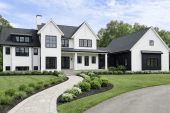
IMAGINE HOW MUCH easier it would be for a parent with a toddler and an infant to get from the garage or driveway into their new house without having to navigate even one step up to the door, or to haul a load of laundry or groceries, with one kid in tow and another one on hip, through slightly wider door openings and hallways. How much more would that family pay for a house with those and similar lifestyle or convenience features, or at least be more likely to purchase it instead of one without them?

Somewhere in the complexity of today's housing market, the concept of universal design (UD) got a little lost in the shuffle, or at least pushed down the priority ladder, as a point of marketable (and profitable) distinction for home builders. Or maybe it is simply masked in a variety of increasingly popular products and design schemes, including refrigerator drawers, walk-in showers, covered porches, and modular garage and closet storage systems.

But make no mistake: UD is a sleeping giant awaiting the alarm of demand from aging baby boomers, up-and-coming echo boomers, and softening market conditions. “Designing a house for an average-size, able-bodied adult male is no longer realistic given our changing culture and demographics,” says John Salmen, president of Universal Designers & Consultants in Takoma Park, Md. “Accommodating disabilities is only the tip of the iceberg of universal design's value.”

Like green building, an equally worthy ideal for better housing, universal design has slowly but surely progressed—albeit stealthily—in its marketability, affordability, and available options to serve the mainstream. Designers and builders who already employ single-lever kitchen and bath faucets, wall ovens, pocket doors, main-level master suites, hard-surface flooring, and thoughtful, task-driven lighting layouts to attract buyers who care about aesthetics find themselves more than a few steps down the universal design path already.

Builders either dedicated to the concepts of UD or some variation of it, or aware of its impending market value enough to consciously implement and sell some of its principles, enjoy a bevy of how-to information about the concept and its execution. UD-specific design idea and house plan books, printed and electronic catalogs of accessible products, illustrated technical manuals for critical rooms and conditions, and online guides and checklists abound in both volume and detail (see “Resources,” page 166), showing how to apply UD to any and all types of market-driven housing.

The stumbling block, of course, is why to do it. Save some scattered municipalities mandating “visitability” (a scaled-down derivative of UD) in new one- and two-dwelling homes, there are no laws governing private-sector single-family builders regarding accessibility, as there are for multifamily and commercial developers.

“Builders tell us that younger buyers don't value it, unless they know for sure that an older parent or relative is going to move in with them,” says Richard Duncan, senior project manager at the Center for Universal Design at North Carolina State University in Raleigh, N.C. But, he suggests, “builders can sell the ease of use and convenience as differentiating points” to all of their buyers.

Devote some thought to it, and it becomes clear how stepless entries, wider doors and hallways, lever handles, D-shaped cabinet pulls, and midheight lighting, electrical, and environmental controls on the walls—among a host of UD features and products—can appeal to a true mainstream of buyers instead of a select few measuring exactly 5 feet 8 inches tall who will go through life without even an occasional injury, much less arthritis, back trouble, or an even more severe chronic disability. “The more people who experience those things, the more receptive they'll become” to UD features, says Dr. Betty Jo White, a professor at Kansas State University in Manhattan, Kan., who leads a departmental focus on UD.

White says the same goes for builders who also may experience or have to manage physical limitations on a personal level, either their own, a spouse's or child's, or an elderly parent's. The experience of not being able to function in their own homes, she says, will likely inspire or motivate builders to consider adding UD features in their future new-home projects.

Some builders' reluctance to incorporate UD stems from a concern about building houses that look institutional, highlighted by grab bars, wheelchair ramps, and lower counter heights. “That's confusing UD with a fully accessible home,” says Duncan, a common mistake made by builders, he says. “Know what you're building and what to call it. The ideal for UD is a mainstream spec house, not a nursing home.”

White is equally intolerant of such excuses from builders. “Sometimes, what makes a wider door look institutional is a wheelchair going through it,” she says.

Builders, of course, also worry about costs. While there is a slight premium for some UD features—primarily with regard to site grading for at least one stepless entry—accommodating UD early in the design process mitigates much of the extra expense. “It could be zero if you're already building a variety of home styles and simply make some adjustments,” says Duncan, who estimates up to a 5 percent direct-cost premium for UD.

Some UD features, in fact, might be cheaper; a 3-0 door requires less wall structure than for a 30-inch opening, says Salmen, saving more money in rough framing materials and labor than the cost of a larger, prehung door.

Consider the universal design principles and guidelines illustrated on the previous two pages—the basics that every UD-programmed house should have, plus, suggestions for features that go beyond the basics, to enhance the marketability and profit potential of new single-family homes suited for a diverse buyer demographic. “Understanding how our society is changing is the key,” says Salmen, such as aging-in-place buyers, multigeneration-al households, and echo boomers. “Not taking that into consideration is a mistake if you want the housing stock to be valuable for a long time.”

RESOURCES

The following list is only a smattering of what's available on the Internet and elsewhere regarding universal design and its application in single-family housing, but all are excellent places from which to start:

  • Center for Universal Design, Raleigh, N.C.; www.design.ncsu.edu:8120/cud/index.htm
  • Universal Design Demonstration and Research Facility, Manhattan, Kan.; www .k-state.edu/humec/atid/UDF/index.htm
  • Universal Designers & Consultants, Takoma Park, Md.; www.universaldesign.com
  • NAHB Research Center LifeWise Home project and Directory of Accessible Building Products (2006 ed.); Bowie, Md., www.nahbrc.org
  • Steven Winter Associates and Accessible Housing by Design: Universal Design Principles in Practice (1997); www.swinter.com
  • EVERYBODY LOVES UD

    Think universal design is ugly? Institutional? Obvious? Tell that to the manufacturers of these products, who consciously or not have given style and popularity to the concept of accessibility:

    BD060801162L1.jpgCLICK HERE FOR IMAGE GALLERY

    BATH BENEFITSA 5-foot, square roll-in shower, complete with a warped threshold entry and a handheld shower fitting on a slide-bar mount, is a luxurious, multi-functional upgrade. If the plan or price point demands a tub/shower combination, leave adequate maneuvering space beside the tub and offset the controls and spout to the outside edge of the wall and deck. Rough-in blocking for grab bars that can support 250 pounds of force in any direction. Beyond the basics: Pocket or outswing door with swing-away hinges and adequate floor clearance on handle side in the hallway; pedestal sink or open vanity and single-control lever faucet; anti-scald valves.

    KITCHEN TRICKSThe minimum clear space for a wheelchair is 5 feet, but some house plans can't accommodate such spaciousness. So enlarge only the toe space of the cabinets (6 inches to 9 inches high) to accommodate the minimum clear space without changing the distance between the cabinet fronts and tops. Also, overlap maneuvering spaces to limit the need for a larger kitchen plan. Finally, consider varying countertop heights. No one standard suits all, and it's a boring look besides. Lower and higher tops, in fact, might benefit certain food prep, eating, and/or serving tasks. Beyond the basics: Full-extension drawers and pull-out shelves; wall oven with one rack even with the countertop; side-by-side refrigerator with door-mounted ice and water dispenser and/or refrigerator drawers; appliances with front-mounted controls; rolling cart set within the base cabinet run; single-control faucet; built-in desk with knee space; glare-free task lighting; D-shaped cabinet pulls and/or touch-latches; modular pantry storage (a good idea for all closets and the garage too; also, it's space-efficient).

    GOOD GRADESMake at least one entrance (not necessarily the front entry) at grade with a garage, carport, driveway, or sidewalk, which not only accommodates people with disabilities but also is more convenient and safer for everyone. On sloping lots, look for opportunities and options to either grade the parcel or place the footprint to allow an at-grade entrance. (Hint: The uphill side of the house will best enable the stepless entry.) Earth-filled approaches or slightly sloping walks to the entry also require no handrails, lowering costs. Beyond the basics: Covered entry for climate shelter and enhanced lighting; full-length sidelites or lowered/twin peepholes for security; at least a 3-0 door; lever-handled hardware; 12-inch to 16-inch kickplate on push side of doors; flush thresholds.

    SINGLE-LEVEL LIVINGPut all key functions, including a bedroom (ideally a suite) and laundry, on the main or accessible level. An alternative might be to design a plan in which the dining room or parlor can be easily and logically converted to a bedroom, if necessary. Then again, main-level master and/or home office suites, complete with private baths or a shared bath, are mainstream already. Beyond the basics: Hallways should be a minimum 42 inches wide, and doorways and passages should be a minimum 2 feet 10 inches wide, with a minimum 18-inch clear floor area on the handle side; swing-away hinges or pocket doors to increase clear space through openings; lever-handled hardware; 12-inch to 16-inch kickplate on push side of doors; flush thresholds; contrast the floor and wall finishes, as well as finishes on the wall (switchplates, etc.); focus on task lighting instead of general ambient lighting schemes.

    BEST OF THE REST: Full-extension cabinet drawers and/or roll-out shelves; kitchen range/cooktops with front-mounted controls; D-shaped cabinet pulls; side-by-side refrigerators; adjustable/modular garage or closet storage systems; and engineered hardwood flooring or wood-look laminate flooring.