MARKET RESEARCHER BARB NAGLE doesn't consider herself a particularly fastidious person, but even she was surprised by what she encountered when she knocked on the doors of people who had recently bought new homes.

“We found messes everywhere,” recalls Nagle, whose company, Marketscape Research and Consulting, was commissioned by BUILDER to conduct ethnographic research with eight multigenerational families for our Reality House, which will be open to visitors during the January 2006 International Builders' Show in Orlando, Fla. “We caught people in the middle of their real lives. We were amazed by what we saw.”

Few builders or architects, of course, can afford to return to homes they've built or designed to see how people really live in them. At BUILDER, where we build one home a year, we had the time. We wanted to find out: How do people use the kitchen island—is it really party central? Do in-laws become part of the daily routine, or do they stick to their casita? Do kids use that special retreat on the landing? Where does stuff get stored?

Marketscape, based in La Jolla, Calif., turned its videotaped research—conducted in San Diego, Las Vegas, and Orlando—into design recommendations that were incorporated into the Reality House, designed by Looney Ricks Kiss of Memphis, Tenn., and built by Issa Homes of Orlando. The program for the home—going up in the fabled community of Celebration, Fla., developed by the Walt Disney Co.—was based on the following findings.

TOO MUCH STUFF

Nagle and her researchers were dumbfounded by the clutter they encountered. It wasn't like they showed up unannounced; families knew Nagle was coming with a video crew. Upon arrival, she would think, “Wow—what a mess! They sure didn't pick up much.”

The problem, it was soon revealed, was that there was no place to put things. Families just didn't have enough storage room for the stuff kids bring home—backpacks, muddy shoes, sports equipment, and memos from school.

This problem paled in comparison with finding a place for bulk storage. If you don't have a pantry, what do you do with the 24 rolls of paper towels or the 50 pounds of pet food that you've so cost consciously purchased from Sam's Club? The answer, in many cases, was to stuff it in the garage or the laundry room.

PURSUIT OF PERSONAL SPACE

Sitting rooms in master suites have become almost de rigueur in new homes today. They afford couples a relaxing place to retreat to read a book, watch their TV shows, or even meditate. But what about everyone else? Where do they go to get away?

This desire to escape is shared equally by all household members. Kids want a quiet place to do homework, but their bedroom often isn't big enough to create a science poster. Older teens desperately want a spot out of their parents' earshot to escape to with friends. And grandparents need to get away from the clamor of family life—after all, they already did their part.

“The TV was always on,” Nagle discovered. “When everyone was home, each generation needed their own discrete space for quiet time away from the family, which is noisy and chaotic. This was true of grandparents, parents, and children alike.”


“There are times of the day when we need to be by ourselves,” said one family member, sounding a common refrain.

Families often felt that secondary bedrooms were too small. Older teenage children didn't really care for their “retreat” at the top of the stairs because everyone could hear what they were up to. (Parents weren't particularly enamored of the space either, because it was always a mess.) And few living rooms were being used as true living rooms. They had become reading rooms, offices, or places to practice the piano or pay bills.

HANGING OUT IN CORE SPACES

If family members stake out personal spaces within the home, they set up core zones for family interaction as well. “A zillion things can be happening in the central gathering space next to the kitchen,” says Nagle. “Some homes didn't have enough space to accommodate all the activity. There needs to be adequate horizontal space to spread out meals, homework, newspapers.”

A small kitchen island or a small nook just doesn't cut it. “We encountered one home where the kitchen island was so big, we wondered how useful it could be,” says Nagle. “But it worked. Kids could eat there. Grandma could sit there. And mom could work on projects there.

“The island has taken on a new identity,” Nagle continues. “People don't sit there to talk—they multitask. Mom and dad may be catching up with each other while they help the kids with homework and grandparents cook. It's the center of the family universe.”

The activity at the kitchen island raised questions in Nagle's mind: Where is a partially completed homework project stored? What happens to the newspapers that stack up? And what do you do with all this stuff when people come to visit? She challenged the Reality House team to provide answers.

A PLACE FOR EVERYTHING

“It's hard to describe what difficulty virtually every family was having with storage,” says Nagle. “We found people living in new homes paying $250 to $340 a month for offsite storage. Translate that into a house payment, and it makes a lot of sense to buy a bigger house.”

The problem is especially acute in the case of blended families that bring two sets of possessions to the house. Kitchen countertops in such households sometimes looked like “appliances on parade.” There was no place for grandma's “treasures.” Closets bulged. Some with attic space complained it was too hot to use.

Most garages don't even house cars, the researchers found. Cars sit on the street or in the driveway. The garage is where stuff accumulates—paint, golf clubs, holiday supplies, extra carpet. It's where you find lawn care equipment and chemicals that people would store outside if they had a shed. Nearly every garage held a second refrigerator and, in many cases, a freezer.

REALLY WORKING FROM HOME

Our researchers encountered many people running full- or part-time businesses from home. They were frustrated. They needed space to store files, supplies, and equipment. They wanted a real business copier, not a toy, but they lacked sufficient room.

Nagle found that these practical concerns were more important than having a door for the occasional private business appointment. The same was true for being able to close off the office to hold a business conversation without background noise.

LAUNDRY, PETS, AND MORE

The laundry room, it turns out, is being used for much more than cleaning clothes. It has become more of a utility room, a place for pets to eat, and a storage space. “This is our laundry room/throw all/everything room,” one family member said. “It's a real multifunctional room.”

Nagle found that people would like additional room in this space, if they could get it. They wouldn't mind having a place to iron, hang dry cleaning, store bulk purchases, and put brooms and vacuum cleaners. A TV in the corner wouldn't be bad either.

Most of the families had pets, but there was no clear place to put the dog when visitors arrived. Some had cut holes in doors or walls to provide pets outdoor access. One was fortunate enough to have a floor drain in the laundry where the dog could be washed.

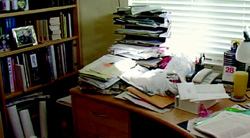
HOUSES OF THE JAMMED: Families are finding that new homes lack sufficient practical storage space: Garages (above) hold anything and everything except cars; kitchen islands (bottom left) become waystations for bags, coats, and mail; and home offices (top left) disappear under paperwork. BUILDER's Reality House, premiering at the 2006 International Builders' Show, addresses this issue.

This much is clear: Life in a new home is nowhere near as calm and organized as builder sales models would have you believe. Moreover, those rascally homeowners aren't living in their homes the way builders and designers thought they would.

Next month: Part 2—How multigenerational families really live.

FOR MORE INFORMATION ABOUT OUR RESEARCH, OUR SPONSORS, AND THE PLANS FOR OUR SHOW HOME, VISIT OUR WEB SITE AT WWW.BUILDERONLINE.COM, CLICK ON “THE MAGAZINE” TAB, AND THEN CLICK ON “BUILDER ARTICLE LINKS.”