Credit: Jack Gardner

 Home builders are diversifying in every which way to ride out the downturn, and that includes rehabs and additions. Some 44 percent of single-family builders in the latest NAHB member census ­reported residential remodeling as a secondary revenue stream. And while a forecast by Harvard University’s Joint Center for Housing Studies indicates that remodeling spending will continue to see 12 percent ­declines in the second and third quarters of 2009, the renovation business is faring better than new construction. A recent survey conducted by the Web site RemodelOrMove.com found more than half (52 percent) of homeowners polled saying they were “excited” about remodeling their houses. Of those, 65 percent said they planned to hire a general contractor.

For builders, remodeling projects typically carry less risk, in that they don’t require construction loans. And for homeowners who qualify for home equity loans, there are paybacks. According to the “2008–09 Cost vs. Value” report, an annual study issued by Builder’s sister publication Remodeling, moderately priced upgrades continue to provide stable returns. While home prices fell 7 percent on average last year, the value of homeowners’ investments in ­remodeling projects declined a lesser 3.86 percent. Many experts now anticipate that retrofits intended to make older homes greener and more energy efficient will keep this sector humming in the new economy. Plus, there are all those foreclosed properties that will need to be fixed up for resale.

Thinking about getting into the spirit of reuse? Builder looks at the challenges presented by three large-scale rehabs.


Give and Take

This spec home in Rosemary Beach, Fla., was built well before the housing bust, and yet it sat on the market for two years with nary a nibble. Its major downfall was that the original builder had neglected to include a bathroom on the second floor—forcing anyone in the kitchen, dining room, or living room to go up or down a flight of stairs when nature called.

The house had other deficits, too, including a drab brown exterior (not so good for curb appeal), cramped porches, and puny windows with high sills that failed to take advantage of the coastal view. And the interior finishes were so dowdy they seemed to predate the house itself.

Architect Darrell Russell and builder John LaPlante saw potential, however, in this misfit, especially considering its scale and massing were already compliant with the town’s stringent TND guidelines. So they bought the place as a private joint venture and set about making it lighter and airier—all within the confines of its existing footprint.

One of the first things to go was a claustrophobic interior staircase, which they opened up (with the addition of structural beams) to become part of the living room. Small windows on the ground floor were replaced with full-length glass doors to maximize views, and the existing antique pine floors were stained a richer, darker brown, allowing the white millwork and window casements to really pop.

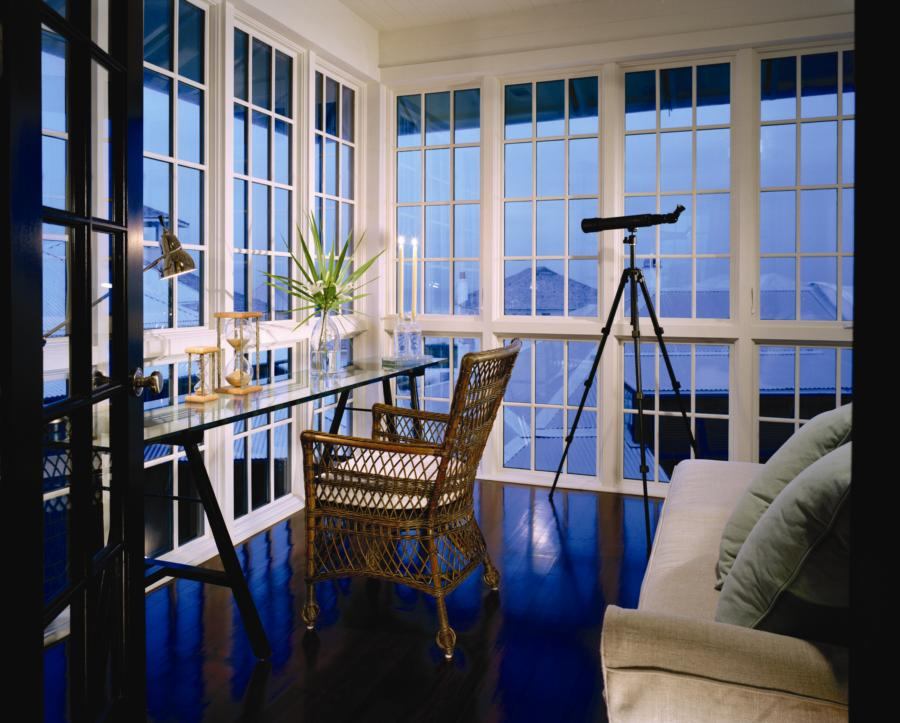
What makes this rehab particularly notable, though, is its deft redistribution of indoor/outdoor relationships. By enclosing a corner screened porch on the second floor, for example, Russell was able to bump the kitchen’s position slightly south and free up just enough space for that ­missing bath. He also enclosed an awkward porch off the third-floor master suite, converting it into a conditioned study and observatory with floor-to-ceiling glass overlooking the rooftops to the beach.

Russell then recouped those lost ­outdoor connections elsewhere. A new screened porch directly off the south wall lends an extra layer of architectural dimension and shading to what was previously a flat façade prone to unwanted solar gain. And the double-decker veranda out front—once so shallow and unfriendly that “a dog wouldn’t even lay on it,” he quips—was reproportioned and allowed to wrap corners, giving the front elevation a more graceful prominence.

Wasting not, Russell even made clever use of odd crannies that were left inside once boilers were replaced with tankless hot water heaters. On the third floor, the switch left a perfect niche for a toilet in the reconfigured master bath. On the first floor, it freed up a space just big enough for a kiddie bunk under the stairs in the guest suite.

“My thinking was that if the owners had visitors, this suite could accommodate a couple with a small child,” Russell says. “I found an old World War II porthole window from an antique dealer and put it in there for fun.”

And in a market where differentiation is everything, there’s something to be said for fun—and fresh. The house sold to a family with kids just 90 days after the final punch list was knocked out, and the partners turned a tidy profit.

Launch Slideshow

ROSEMARY AVENUE COTTAGE
  • ROSEMARY AVENUE COTTAGE

    ROSEMARY AVENUE COTTAGE

    http://www.builderonline.com/Images/41c29e3a-f575-4b05-b01d-2c78c744f744_tcm10-426096.jpg

    ROSEMARY AVENUE COTTAGE

    300

    Photo by Jack Gardner

    The home's original cypress siding and metal roof were durable, but brown just wasn't its color.

  • ROSEMARY AVENUE COTTAGE

    ROSEMARY AVENUE COTTAGE

    http://www.builderonline.com/Images/3d56fb40-b543-4c99-aecb-ce5b5ebadbd9_tcm10-426100.jpg

    ROSEMARY AVENUE COTTAGE

    300

    Photo by Jack Gardner

    After: Freshening up its paint color and reporportioning the windows and porches made this Florida cracker-style house fit to sell.

  • ROSEMARY AVENUE COTTAGE

    ROSEMARY AVENUE COTTAGE

    http://www.builderonline.com/Images/1825a531-28cd-4f29-b953-145f21df78b9_tcm10-426104.jpg

    ROSEMARY AVENUE COTTAGE

    300

    Photo by Jack Gardner

    The original kitchen opened onto a screened porch, but still felt cramped.

  • ROSEMARY AVENUE COTTAGE

    ROSEMARY AVENUE COTTAGE

    http://www.builderonline.com/Images/1686aaf2-74e8-400d-98b0-f01850f9a4f6_tcm10-426108.jpg

    ROSEMARY AVENUE COTTAGE

    300

    Photo by Jack Gardner

    Closing in the screened porch off the kitchen to create an adjoining breakfast area made the whole space feel bigger. It also freed up space for a bathroom on the second floor.

  • ROSEMARY AVENUE COTTAGE

    ROSEMARY AVENUE COTTAGE

    http://www.builderonline.com/Images/a4ed0a04-0229-4cae-acbe-0dcf8170abb9_tcm10-426111.jpg

    ROSEMARY AVENUE COTTAGE

    300

    Photo by Jack Gardner

    The original living room felt claustrophobic and dark.

  • ROSEMARY AVENUE COTTAGE

    ROSEMARY AVENUE COTTAGE

    http://www.builderonline.com/Images/c89f7b0f-1cfd-4153-b765-b305002cb4ae_tcm10-426115.jpg

    ROSEMARY AVENUE COTTAGE

    300

    Photo by Jack Gardner

    Integrating open stairs and French doors into the design made the living room feel more spacious and elegant.

  • ROSEMARY AVENUE COTTAGE

    ROSEMARY AVENUE COTTAGE

    http://www.builderonline.com/Images/f9903680-17cf-4913-b2cd-9e2c814b2f6c_tcm10-426117.jpg

    ROSEMARY AVENUE COTTAGE

    300

    Photo by Jack Gardner

    The original master bedroom...

  • ROSEMARY AVENUE COTTAGE

    ROSEMARY AVENUE COTTAGE

    http://www.builderonline.com/Images/1ce91f3f-f486-4a46-9551-4a37d45c6130_tcm10-426122.jpg

    ROSEMARY AVENUE COTTAGE

    300

    Photo by Jack Gardner

    ...was adjoined by a small sitting room and a screened porch that was seldom used.

  • ROSEMARY AVENUE COTTAGE

    ROSEMARY AVENUE COTTAGE

    http://www.builderonline.com/Images/46ef6767-7a27-4f48-8832-7b2d9c2ea78c_tcm10-426128.jpg

    ROSEMARY AVENUE COTTAGE

    300

    Photo by Jack Gardner

    Architect Darrell Russell kept the sitting room, but freshened it up.

  • ROSEMARY AVENUE COTTAGE

    ROSEMARY AVENUE COTTAGE

    http://www.builderonline.com/Images/eadc9bb6-caf1-4109-a142-7f99e31af67e_tcm10-426131.jpg

    ROSEMARY AVENUE COTTAGE

    300

    Photo by Jack Gardner

    He converted the screened porch off the master into an enclosed observatory with floor to ceiling windows.

  • ROSEMARY AVENUE COTTAGE

    ROSEMARY AVENUE COTTAGE

    http://www.builderonline.com/Images/90c83343-9394-47e8-b3a8-d46386a638d4_tcm10-426135.jpg

    ROSEMARY AVENUE COTTAGE

    300

    Photo by Jack Gardner

    The observatory doubles as a small study off the master bedroom.

  • ROSEMARY AVENUE COTTAGE

    ROSEMARY AVENUE COTTAGE

    http://www.builderonline.com/Images/c5a8633e-25ab-4c8c-80da-ae7a99900de9_tcm10-426140.jpg

    ROSEMARY AVENUE COTTAGE

    300

    Photo by Jack Gardner

    Revamping the master bath presented a small conundrum. The placement of the existing window was awkward, but removing it would have interrupted the architectural rhythm of the outside of the house. Russell's solution? A sliding mirror above the vanity that can be closed when needed, or opened up to allow more natural light inside. The original window remains operable.

  • ROSEMARY AVENUE COTTAGE

    ROSEMARY AVENUE COTTAGE

    http://www.builderonline.com/Images/5f07a4d1-abac-4fc7-9e65-2a252ecd0dd1_tcm10-426143.jpg

    ROSEMARY AVENUE COTTAGE

    300

    Photo by Jack Gardner

    Original bedroom.

  • ROSEMARY AVENUE COTTAGE

    ROSEMARY AVENUE COTTAGE

    http://www.builderonline.com/Images/14f6c846-f2e1-498c-9d06-0d40573082cb_tcm10-426147.jpg

    ROSEMARY AVENUE COTTAGE

    300

    Photo by Jack Gardner

    New guest bedroom.

  • ROSEMARY AVENUE COTTAGE

    ROSEMARY AVENUE COTTAGE

    http://www.builderonline.com/Images/a146a4ed-48d3-4267-b7c0-93f3b3ee184d_tcm10-426149.jpg

    ROSEMARY AVENUE COTTAGE

    300

    Photo by Jack Gardner

    Removing an old boiler from underneath the stairs left a perfect spot for a built-in kids' bunk. The original water heater was replaced with a tankless heater, which, by nature of its smaller size, was able to be located elsewhere.

  • ROSEMARY AVENUE COTTAGE

    ROSEMARY AVENUE COTTAGE

    http://www.builderonline.com/Images/b548546f-1814-4571-bc84-d7d3a213a461_tcm10-426154.jpg

    ROSEMARY AVENUE COTTAGE

    300

    Photo by Jack Gardner

    An existing space above the carport was converted into an outdoor screened kitchen. The backyard pool is just a few steps away.


Project: Rosemary Avenue Cottage

Location: Rosemary Beach, Fla.

Size: 2,600 square feet

Lot size: 5,445 square feet

Architect/developer: Darrell Russell, ­Rosemary Beach

Construction manager/developer: John LaPlante, Rosemary Beach

Interior designer: Kay Douglass, South of Market, Atlanta

Preserve and Protect 

Restoring a historic home inev-itably involves sprucing up its finer vintage details. But sometimes it also involves rectifying crimes that have been committed against the house over the years. This was the case with 229 Douglass, a stately Edwardian residence built around 1907 in San Francisco’s Eureka Valley (now known as The Castro), which, somewhere along the line, had been crudely subdivided into stacked duplex units. When architect Joel Karr was hired to rehab it, his charge was to stitch the pieces back ­together and return the home to its original character—albeit with a few modernist touches thrown in for today’s tastes.

This he did handily, working in tandem with builder Ewen Utting. The exterior ­masonry was sandblasted and repointed; stucco was patched and repaired; and the original cornice detailing—dentils and all—was painstakingly restored. Inside, antique elements such as original leaded glass windows and an arched keystone fireplace now coexist with sleek, frameless cabinets, stainless appliances, and subway tile to create a vibe that is deliciously eclectic.

“The places where we diverged from the vernacular were in kitchens and baths, which is a nod to the marketplace,” Karr says. “The owners wanted something that felt fresh and modern, but also respectful of history.”

The rehab also required some structural work, as reuniting the two units meant eliminating one of two front entries that had been carved into a cross-sloping site. “A portion of the first floor is now lower than it was, so you enter at a diagonal and take a step down,” Karr adds. “We kept the existing foundation but had to restructure the floor.”

And yet, remodeling the house is only half the story. Part two involved resurrecting a decrepit barn out back (also circa 1907), which the owners wanted to convert into a live/work unit with an art studio on the first floor and living ­quarters for an older parent above. This is where things really got tricky; the ­approvals took two years.

Plans to rehab the barn were squelched when an investigation revealed that there was no foundation under part of the structure and it was on the verge of collapse. Nevertheless, preservationists appealed a determination that it held no historic value. “In short, they wanted to restore a building that was not re-storable,” Karr says. A teardown permit ultimately was granted on the condition that the barn be rebuilt to precisely the same specifications as the original structure.

The new-old barn features the same gabled roof forms and window styles as its predecessor and is even clad in reclaimed board-and-batten siding taken from old barns. It clearly exudes a sense of heritage, although the inside is clean lined and contemporary, with features such as a high-efficiency heating system, operable skylights, wide plank floors, custom casework (made locally), and ­sliding panel doors made of eco-resin.

“Virtually nothing is standard because we had to adhere to the same odd depths, heights, and dimensions of the original structure,” Karr says.

Launch Slideshow

229 DOUGLASS STREET
  • 229 DOUGLASS STREET

    229 DOUGLASS STREET

    http://www.builderonline.com/Images/aa6fbc5d-5044-4df6-935d-208127239400_tcm10-426183.jpg

    229 DOUGLASS STREET

    300

    Image courtesy Group 41 Architecture

    Before shot of original house in The Castro.

  • 229 DOUGLASS STREET

    229 DOUGLASS STREET

    http://www.builderonline.com/Images/e34ddee7-d6b1-495a-b2d1-22ff9a4df3f6_tcm10-426186.jpg

    229 DOUGLASS STREET

    300

    Photo by Ken Gutmaker www.kengutmaker.com

    Exterior of main house, post remodel. Paint color is one of the few things that's not regulated in San Francisco. A regal jewel tone offset's the home's crisp trim and Edwardian filigree.

  • 229 DOUGLASS STREET

    229 DOUGLASS STREET

    http://www.builderonline.com/Images/7d7135da-bd65-4014-acd4-e13752c17aa2_tcm10-426189.jpg

    229 DOUGLASS STREET

    300

    Photo by Ken Gutmaker www.kengutmaker.com

    A pretty front hall now reintegrates the upper and lower floors of the main house, which had been separated when the unit was converted into a duplex.

  • 229 DOUGLASS STREET

    229 DOUGLASS STREET

    http://www.builderonline.com/Images/af5a4b65-e2ea-4479-bf5b-4abaca054065_tcm10-426194.jpg

    229 DOUGLASS STREET

    300

    Photo by Ken Gutmaker www.kengutmaker.com

    Stairs lead up to an airy living room.

  • 229 DOUGLASS STREET

    229 DOUGLASS STREET

    http://www.builderonline.com/Images/70930a34-efdc-4346-ba83-c86a9da11eb3_tcm10-426198.jpg

    229 DOUGLASS STREET

    300

    Photo by Ken Gutmaker www.kengutmaker.com

    Although vintage elements were retained in other parts of the house, Group 41 Architecture went full-on contemporary in the kitchen.

  • 229 DOUGLASS STREET

    229 DOUGLASS STREET

    http://www.builderonline.com/Images/50e44e72-3404-4d40-9070-bfc436810996_tcm10-426202.jpg

    229 DOUGLASS STREET

    300

    Photo by Ken Gutmaker www.kengutmaker.com

    An original leaded glass window lends character to a half bath.

  • 229 DOUGLASS STREET

    229 DOUGLASS STREET

    http://www.builderonline.com/Images/b92d328a-6611-48a3-bea7-992b1c9d9305_tcm10-426205.jpg

    229 DOUGLASS STREET

    300

    Photo courtesy of Group 41 Architecture

    The original barn out back proved too decrepit to rehab.

  • 229 DOUGLASS STREET

    229 DOUGLASS STREET

    http://www.builderonline.com/Images/1386d170-f729-4b3c-8c1a-9dcb730354f8_tcm10-426209.jpg

    229 DOUGLASS STREET

    300

    Photo by Ken Gutmaker www.kengutmaker.com

    The replacement barn is clad in reclaimed wood planks sourced from old agricultural buildings. It also features the same roof gables, window patterns, and second story bump-out as the original.

  • 229 DOUGLASS STREET

    229 DOUGLASS STREET

    http://www.builderonline.com/Images/cccba33e-201e-4062-8d1d-3b7c5886bba8_tcm10-426214.jpg

    229 DOUGLASS STREET

    300

    Photo by Ken Gutmaker www.kengutmaker.com

    Inside, the new barn improves on the past with space-saving built-ins and operable skylights for natural ventilation.

  • 229 DOUGLASS STREET

    229 DOUGLASS STREET

    http://www.builderonline.com/Images/1dbc3a02-7be5-4c0e-b6d2-c38d923faee9_tcm10-426217.jpg

    229 DOUGLASS STREET

    300

    Photo by Ken Gutmaker www.kengutmaker.com

    The teardown permit for the new barn was granted on the contingency that the new structure be built to the same specifications as the original -- steep roof pitches and all.


Project: 229 Douglass

Location: San Francisco

Size: 2,067 square feet (main house); 2,036 square feet (barn)

Lot size: 3,125 square feet

Architect: Group 41 Architecture, San Francisco

Builder: Ewen Utting, San Francisco

Character Counts

Some additions clone the existing house in an attempt to appear seamless. Not this one.

When architects Christine Albertsson and Todd Hansen purchased the original gabled salt box (which had been designed and built by Minnesota architect Carl Stravs in 1923), it had no ­garage, no shower, and scant storage space. It also had no discernible front entry—a ­casualty of the lot having been subdivided in the 1950s, which had shifted its front door to the side.

On the plus side, though, it was an extremely well-built little house. And, from its perch 30 feet above Minnehaha Creek, a protected waterway, it had a lovely view.

The owners’ first resolution was to preserve what was good, so they left the shell of the 30-foot-by-25-foot cottage intact, along with a beautiful oak tree on its west side.

What remained was a relatively small building envelope for an addition, concentrated mostly to the south. Fortunately, the incumbent structure already had a sturdy retaining wall on its downhill side that could be exploited. “We used that existing wall as part of the foundation for the addition,” Albertsson explains, “which, in the end, helped save the oak tree. By using what was already there, we were able to get by with a mini-excavator during construction, causing minimal disruption to the soil.”

Changes to the old house were mostly cosmetic. A fresh switch to white paint made its cedar shake siding appear less tired, and, with the addition of a crisp portico, the owners pivoted the front entry to face the street. The entry hall that now hugs the west elevation leads back to a 1,210-square-foot gabled addition—which, in contrast, is clad in barn red fiber cement with vertical cedar battens. From the outside, the residence now looks like a New England farmhouse that grew over time to become conjoined with its barn.

Inside, the old and new sections of the house do a similar dance between continuity and reinterpretation. The existing S4S millwork (a simple, cottage-style molding with no profiling) was easy enough for Hansen to replicate with a table saw and carry over into the new space. But the sand float plaster finish on the original interior walls was tougher to pull off. Not wanting to use plain sheetrock, the architects instead ­opted to line the walls of the addition with beadboard paneling. (For cost savings, Hansen ordered an overrun of boards he had already custom designed for a client.) The result is a texture that is different yet complementary, and no less charming.

Launch Slideshow

229 DOUGLASS STREET
  • 229 DOUGLASS STREET

    229 DOUGLASS STREET

    http://www.builderonline.com/Images/f88ceef8-5ed1-44e4-90b1-8bab676cb432_tcm10-426240.jpg

    229 DOUGLASS STREET

    300

    Image courtesy Albertsson Hansen Architecture

    Before shot of original house

  • 229 DOUGLASS STREET

    229 DOUGLASS STREET

    http://www.builderonline.com/Images/531fd707-66bf-4201-b981-e35ce96ec516_tcm10-426243.jpg

    229 DOUGLASS STREET

    300

    Photo by Peter Bastianelli-Kerze

    After shot of front elevation: An entry portico creates a sense of arrival on the street side.

  • 229 DOUGLASS STREET

    229 DOUGLASS STREET

    http://www.builderonline.com/Images/61ec2bd6-4540-4de1-8ab5-16c1f4e9e998_tcm10-426247.jpg

    229 DOUGLASS STREET

    250

    Photo by Peter Bastianelli-Kerze

    A new front entry hall connects the original house to the addition in back.

  • 229 DOUGLASS STREET

    229 DOUGLASS STREET

    http://www.builderonline.com/Images/823641ee-6be6-406f-b860-70ee1108042e_tcm10-426251.jpg

    229 DOUGLASS STREET

    300

    Photo courtesy Albertsson Hansen Architects

    Before shot of rear elevation.

  • 229 DOUGLASS STREET

    229 DOUGLASS STREET

    http://www.builderonline.com/Images/288c999c-267c-47ac-9320-5d297cbf37d0_tcm10-426255.jpg

    229 DOUGLASS STREET

    300

    Photo by Peter Bastianelli-Kerze

    After shot of rear elevation. With the cantilevered addition in back, the house nearly doubled in size. Windows ganged around the southeast corner make the most of southern exposure and bucolic scenery.

  • 229 DOUGLASS STREET

    229 DOUGLASS STREET

    http://www.builderonline.com/Images/937ee748-3c0c-41f9-bf89-8a0aa819ad1a_tcm10-426258.jpg

    229 DOUGLASS STREET

    250

    Photo courtesy Albertsson Hansen Architecture

    Before shot of dining room and porch.

  • 229 DOUGLASS STREET

    229 DOUGLASS STREET

    http://www.builderonline.com/Images/621eef38-5128-4ffa-b29e-8b75535c6c33_tcm10-426263.jpg

    229 DOUGLASS STREET

    250

    Photo by Peter Bastianelli-Kerze

    After shot of dining room area.

  • 229 DOUGLASS STREET

    229 DOUGLASS STREET

    http://www.builderonline.com/Images/59e74de5-b748-4996-87b0-023d8fd4d5ea_tcm10-426266.jpg

    229 DOUGLASS STREET

    250

    Photo courtesy Albertsson Hansen Architecture

    The original kitchen was later converted into a laundry room.

  • 229 DOUGLASS STREET

    229 DOUGLASS STREET

    http://www.builderonline.com/Images/d55dbbef-232d-4f9d-b526-b1e11c615900_tcm10-426270.jpg

    229 DOUGLASS STREET

    250

    Photo by Peter Bastianelli-Kerze

    The newer, roomier kitchen sports a 9-foot island.

  • 229 DOUGLASS STREET

    229 DOUGLASS STREET

    http://www.builderonline.com/Images/63581c29-fa4a-413e-8757-414d49d597ca_tcm10-426273.jpg

    229 DOUGLASS STREET

    250

    Photo by Peter Bastianelli-Kerze

    Kitchen and dining area in new addition.

  • 229 DOUGLASS STREET

    229 DOUGLASS STREET

    http://www.builderonline.com/Images/f6625c75-2478-4b0a-9046-ae6963eb02e8_tcm10-426277.jpg

    229 DOUGLASS STREET

    250

    Photo by Peter Bastianelli-Kerze

    The original master bath was given a face lift. That included replacing the tub with a space-saving shower.

  • 229 DOUGLASS STREET

    229 DOUGLASS STREET

    http://www.builderonline.com/Images/cc7ed070-ad94-4dc9-bbe0-6fc075c4c22d_tcm10-426282.jpg

    229 DOUGLASS STREET

    250

    Photo by Peter Bastianelli-Kerze

    Living room

  • 229 DOUGLASS STREET

    229 DOUGLASS STREET

    http://www.builderonline.com/Images/63b682a3-b819-405f-80d7-a3c9a7e40040_tcm10-426285.jpg

    229 DOUGLASS STREET

    250

    Photo by Peter Bastianelli-Kerze

    First floor screened porch.

Project: Minnehaha Creek Addition

Location: Minneapolis

Size: 1,240 square feet (before); 2,450 square feet (after)

Lot size: 7,200 square feet

Architect: Albertsson Hansen Architecture, Minneapolis

Builder: Choice Wood Co., St. Louis Park, Minn.