One of the best parts of being BUILDER's design editor is the chance to savor so much great architecture. I get to study and write about ingenious houses all day long, daydreaming about how my next residence (when I’m rich and famous) might be that cute little beach cottage or that bohemian factory loft or the Victorian-style painted lady. I can only imagine the exhilaration a builder feels when touring a neighborhood, pointing out a particularly fine residence, and saying, “I built that.”
But it's also nice to say "I wrote about that" when a house is particularly special. As 2009 draws to a close, here are 10 such houses, all worthy of a builder's pride.

Credit: Mariko Reed
Margarido House
Oakland, Calif.
What’s to love: Amazing glazing and earth-friendly living.
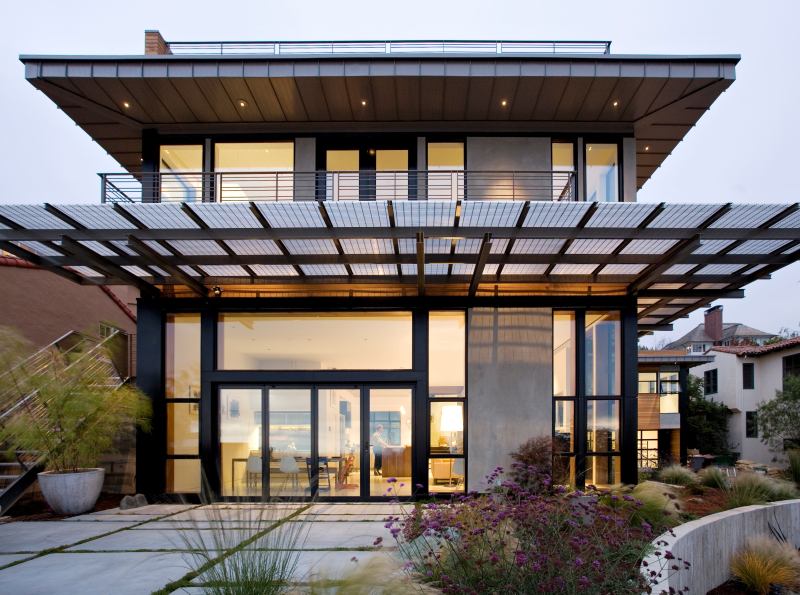
It’s hard to believe a 4,600-square-foot house with 80 windows and doors could be green at all, much less LEED Platinum certified, with efficiencies that beat California’s Title 24 energy standards by 55%. But this Oakland residence is all those things.
And on the matter of performance, windows made a difference. “During the planning phase, we modeled the home using an energy model that took into account the placement of operable versus non-operable windows,” says builder Mike McDonald. “In doing so, we were able to eliminate a lot of superfluous operable features that didn’t contribute to cross-ventilation. This helped from a cost perspective and also helped us achieve a lower U-value overall. It also made an aesthetic difference because a lot of the windows we’d originally planned as operable didn’t look as nice as fixed glazing.”

Credit: Mariko Reed
The strategic window program combines thermally broken aluminum windows by AlumaTherm--a third of which are now operable--with a NanaWall retractable wall system. Deep eaves and a dramatically cantilevered awning--elements McDonald refers to as “eyebrows”--accentuate the window arrays while protecting interior spaces from the hot summer sun. The handsome awning is made of recycled aluminum grating, an off-the-shelf product. “The grating provides nice ambient lighting through the shade all day, but because it’s an inch and a half deep, it has the shielding effect of a solid shade,” explains the builder. “Plus the material has structural integrity, so we were able to integrate it as part of the decking.”
Other green features: Energy Star cool roof; a 600-square-foot “living roof” and deck; LED lighting, in-floor hydronic heating, solar electric power and thermal hot water; smart home automation; energy-efficient appliances; on-site water reclamation tanks; permeable paving; concrete countertops made with fly ash and recycled glass; indoor air quality management system, drought-tolerant landscaping; zero-VOC paints; and locally sourced, sustainable products such as metal tiles made from discarded kiln shelves.
Builder: McDonald Construction and Development, Oakland, Calif.
Architect: Plumbob, Philadelphia
From our 2009 September Windows and Doors supplement, “Green with a View”

Credit: Tommy Crow Photography
Dos Flores
Alys Beach, Fla.
What’s to love: Stunning little outdoor spaces that make you feel like you’re on vacation.
It’s not unusual these days to see a 1,960-square-foot townhouse with a little private outdoor space. But it is unusual to see one in which half of the rooms in the plan (yes, half) are open air.
Resting on a footprint measuring just 36 feet by 80 feet, this townhouse pulls off the seemingly impossible with a zero lot-line configuration that reallocates precious yard space in an introverted way. All of the home’s public rooms open to an oasis in the heart of the plan, but unlike your typical courtyard, this one isn’t just a doughnut hole punched in the middle of the building. It’s a delicately layered sequence of Spanish-style covered loggias, galleries, and patios, intertwined to create keyhole views.

Credit: Tommy Crow Photography
Oriented along two axes, each intimate space has its own distinct flavor and natural light gradation. From the street, 11-foot wooden doors open to a zaguan (open air entry hall) that is intentionally dark in contrast to the sun-drenched courtyard and plunge pool beyond. A covered gallery paralleling the kitchen, living, and dining areas is roofed in cedar purlins with a woven cane awning to filter light for a dappled effect. The gallery culminates in a 13-foot-tall, shaded alcove, which overlooks the pool through an Andalusian archway.
In this alfresco retreat, landscaping takes on a role as important as fixtures and finishes inside the house. The joints between Dominican shellstone pavers are planted with Dichondra to create a mossy carpet, while additional plantings of horsetail, climbing English ivy, and Japanese red maple provide complementary textures to beach pebbles, whitewashed walls, and Moorish tile work.
Architect/Interior designer/Landscape architect: Khoury & Vogt Architects, Alys Beach, Fla.
Builder: Wave Construction, Rosemary Beach, Fla.
Developer: EBSCO Gulf Coast Development, Panama City Beach, Fla.
Land planner: DPZ Architects and Town Planners, Miami
A 2009 Builder’s Choice merit award winner in the townhouse unit, less than 2,000 square feet category.

Credit: Jim Bartsch
Urban Crash Pad
Santa Barbara, Calif.
What’s to love: A tiny footprint loaded with space-saving features and tons of style.
When it comes to luxury, size doesn’t really matter. It’s the little things that count. Case in point: this 894-square-foot “crash pad,” which replaces a 1,400-square-foot dwelling that previously occupied the same .08 acre spot in a neighborhood dating back to the 1880s. It’s an efficient plan predicated on multi-use spaces akin to those seen in small sea-going vessels. And the open, loft-style configuration eliminates unnecessary circulation spaces that eat up precious square footage and result in extra heating and cooling costs.

Credit: Jim Bartsch
The key to making it all work was using height and light as a counterbalance to the small footprint, according to architect Barry Berkus. The tidy interiors feel plenty airy, thanks to ceilings stretching 14 feet in the living area, 12 feet in the bedroom, and 10 feet in the kitchen, combined with skylights and north/south glazed openings. Ceiling-high cabinets in the cooking and sleeping areas maximize storage space and are accessible via a custom-designed (by the architect), sliding ladder chair.
Even the outdoor space is multifunctional. Sometimes used as a “car arbor,” it doubles as an entertainment pavilion with track lighting and a sculptural fence.
This home’s tiny size alone is enough to render it sustainable (it doesn’t require much energy to stay running) but it also features recycled countertops, low-VOC paints, environmentally rated insulation, Energy Star appliances, and a tankless water heater.
Builder: Jack’n Toolbox, Santa Barbara, Calif.
Architect: B3 Architects, a Berkus Design Studio, Santa Barbara
Land planner: Earthform Design, Santa Barbara
A 2009 Gold Nuggets grand award winner in the custom home under 7,500 square feet category.

Credit: Orion Bishop
Cottage at Extown Farm
New Canaan Conn.
What’s to love: This renovation gets an A+ for authenticity, and its history makes for great cocktail conversation.
This 17-acre farm was established in 1778 and took several interesting turns (including a stint as a jail for locals recovering from public drunkenness) before a “deed of conservation” was established in 1998 to protect its historic assets. Fortunately, the modest caretaker’s cottage, which had been added to the property’s south side in the 1930s, wasn’t beholden to the same stringent preservation requirements as the venerable main house. That gave architect David Harlan some latitude to exercise a little revisionist history. One could easily argue that the Georgian classical makeover of the cottage looks even more historic than the original.

Credit: Orion Bishop
Working with EMR Builders, Harlan was able to retain roughly 75% of the existing concrete foundation and some of the original framing. He kept the 1,250-square-foot salt box intact, but then skirted it with a wide front porch, and bumped up the roof lines to create a raised central great room. Clerestory windows were added to channel in natural light, along with a new fireplace and chimney. A porch on the east side was enclosed to create a sunroom, thus increasing the amount of functional conditioned space.
As one of several accessory buildings complementing the main residence (which is currently being restored), the cottage does abide by a controlled vocabulary. “The design language of the property has a hierarchy,” Harlan explains. All of the barns have vertical red siding, while outbuildings are shingle-clad with plain moldings, simple corner boards, and historically accurate window sizes.
“This farm is a living history project, not a museum like Mount Vernon or Monticello,” says the architect. “Preservation was a goal, but that had to be balanced by meeting the functional everyday needs of the family.”
Architect: David D. Harlan Architects, New Haven, Conn.
Builder: EMR Builders, Branford, Conn.
Landscape architect: Diane Devore Associates, Fairfield, Conn.
Interior designer: A. Defne Veral Interiors, New Haven
A 2009 Builder’s Choice grand award winner in the whole-house makeover or significant addition category.

Credit: Christopher Barrett
Yannell House
Chicago
What’s to love: Clean lines, ethereal interiors, and the highest LEED-H platinum score on record.
Goldberg General Contracting (GGC) is known for its ability to translate unorthodox ideas into beautiful, livable houses, having built the personal residences of several noted Chicago architects. What it’s not known for is doing anything halfway. So it’s not surprising that this, the builder’s very first green project, achieved net-zero energy status, as well as LEED Platinum certification.
Sited on an infill lot that previously held a two-unit rental, the house consists of two volumes—a single-story section containing a main living room with a garage below grade; and a two-story form housing private spaces—with an entry foyer connecting the two wings. Architects at Farr Associates oriented the house to capture daylight and used the home’s butterfly roof to provide just the right angle for the 10-kilowatt solar heating and cooling system and for water collection. The roof shape hides the solar panels from the street.

Credit: Christopher Barrett
To achieve LEED Platinum status, the project team had to adhere to strict construction processes. They deconstructed the existing building and recycled as much as possible, reusing oak floors in the new house. In addition to photovoltaics, they integrated resource-conserving systems such as solar hot water, geothermal heating and cooling, and graywater recycling.
Though the house hits high sustainable notes, it still manages to do it in a beautiful way, incorporating sleek, modern design touches and innovative materials, such as Forest Stewardship Council–certified cedar, Italian fiber-cement board, recycled walnut flooring, cement block, and a green roof.
Builder: Goldberg General Contracting, Chicago
Architect: Farr Associates Architects, Chicago
Interior designer: Moka Plus Design, Chicago
Landscape architect: Christy Webber Landscapes, Chicago
A 2009 Builder’s Choice grand award winner in the green/sustainable home category.

Credit: Peter Bastianelli-Kerze
Minnehaha Creek Addition
Minneapolis
What’s to love: An old house and new addition are stitched together using clever cost-saving measures.
Some additions clone the existing house in an attempt to appear seamless. Not this one.
When architects Christine Albertsson and Todd Hansen purchased the original gabled saltbox (which had been designed and built by Minnesota architect Carl Stravs in 1923), it had no discernible front entry—a casualty of the lot having been subdivided in the 1950s, which had shifted its front door to the side.
On the plus side, though, it was an extremely well-built little house. And, from its perch 30 feet above Minnehaha Creek, a protected waterway, it had a lovely view. Preserving what was good, they left the shell of the 30-foot-by-25-foot cottage intact, along with a beautiful oak tree on its west side.

Credit: Peter Bastianelli-Kerze
What remained was a relatively small building envelope for an addition, concentrated mostly to the south. Fortunately, the incumbent structure already had a sturdy retaining wall on its downhill side that could be exploited. “We used that existing wall as part of the foundation for the addition,” Albertsson explains, “which, in the end, helped save the oak tree. By using what was already there, we were able to get by with a mini-excavator during construction, causing minimal disruption to the soil.”
Changes to the old house were mostly cosmetic. A fresh switch to white paint made its cedar shake siding appear less tired, and, with the addition of a crisp portico, the owners pivoted the front entry to face the street. The entry hall that now hugs the west elevation leads back to a 1,210-square-foot gabled addition—which, in contrast, is clad in barn-red fiber cement with vertical cedar battens. From the outside, the residence now looks like a New England farmhouse that grew over time to become conjoined with its barn.
Inside, the old and new sections of the house do a similar dance between continuity and reinterpretation. The existing S4S millwork (a simple, cottage-style molding with no profiling) was easy enough for Hansen to replicate with a table saw and carry over into the new space. But the sand float plaster finish on the original interior walls was tougher to pull off. Not wanting to use plain drywall, the architects instead opted to line the walls of the addition with beadboard paneling. (For cost savings, Hansen ordered an overrun of boards he had already custom designed for a client.) The result is a texture that is different yet complementary, and no less charming.
Architect: Albertsson Hansen Architecture, Minneapolis
Builder: Choice Wood Co., St. Louis Park, Minn.
From the March 2009 feature, “Major Makeovers.”

Credit: Jeff Herbert
Lake House
Carmel, N.Y.
What’s to love: A design that’s quirky, site-specific, and original.
This lakeside cottage has such a casual, homespun air about it, you’d hardly suspect the intense discipline that was necessary to pull it off. The hitch was that several of its aesthetic priorities were at odds with each other.
For starters, it was unclear which side of the house was meant to be the front. The southeast arrival sequence from the main road and driveway had to be striking, explains architect Donald Powers, but then again so did the west elevation facing the water. The compromise? A residence with two faces that are complementary and yet distinct.

Credit: Jeff Herbert
Engineering the perfect plan also required a balancing act between daylight and scenery. To make the most of pristine lake views, Powers strung most of the rooms together in an enfilade pattern facing west, with large picture windows overlooking the water. But the massing and window placement made necessary because of this decision came with a trade-off: a comparatively small south elevation with minimal solar exposure.
Channeling natural light inside thus required some ingenuity to keep the home’s interiors from feeling too dark. One clever remedy is a light box that captures midday sun from a bank of south-facing shed dormer windows and then redirects those rays into the living room through a clerestory valance above the fireplace. Dramatic millwork in the ceiling, painted a gloss white, amplifies the ethereal effect of that diffused light.
Architect: Donald Powers Architects, Providence, R.I.
Builder: Aphrodite Construction, Putnam Valley, N.Y.
Interior designer: Patricia Stadel Design, Lancaster, Pa.
From the February 2009 feature, “Little Gems.”

Credit: Rick Ricozzi
Claremont House
Chapel Hill, NC
What’s to love: Southern charm with European touches.
A former artisan potter, builder Carol Ann Zinn began dabbling in Carolina real estate development in 1976 when her sons were small. It wasn’t long before the creative energy she’d been pouring into ceramics was redirected into single-family homes with a boutique sensibility.
They’re mostly production homes, but they don’t look like it. Although most are based on a portfolio of in-house plans (all designed by Zinn herself), no two are alike. One might offer clapboard siding, clean-lined Scandinavian window treatments, and subway tile, for example, while another might be shingle-clad with hand-turned newel posts and British-inspired cabinetry. Custom fireplace mantels and built-ins are often commissioned from master furniture makers in nearby Durham.

Credit: Rick Ricozzi
“People either like what we do or they don’t,” says Zinn, who builds between 17 and 25 homes per year. “If they do, they certainly can’t find anything else like it in the area.”
Zinn residences often beguile with an eclectic charm you’d be more likely to find in remodeled older houses, but each also provides the best that new construction can offer. All homes are Energy Star and GBI certified, and feature airtight insulation, high-performance appliances, tankless water heaters, green label carpeting, specially filtered air handling systems, reflective roof sheathing, and zoned irrigation landscaping. For buyers, those ingredients can mean energy savings of up to $740 per year, compared to conventionally-built new homes, Zinn says. Roughly 70% of the builder’s business is spec homes, while the other 30% is custom commissions.
Taking note of shifts in consumer preferences and loan qualifications, the builder recently rounded out its plan selection to include smaller single-family detached and townhomes. “We are now offering single-family houses ranging from 2,200 to 2,700 square feet, whereas the last subdivision we finished had 3,700- to 3,800-square-foot homes,” Zinn says. “We built one custom house for a client that was 2,200 square feet, and so many people were stopping by the site and asking the agent about it, we decided to do more of them.”
Builder/Developer/Designer: Zinn Design Build, Chapel Hill, N.C.
From the March 2009 Success Stories column, “Personality Contest.”

Credit: Courtesy Dominick Tringali Architects
Habitat House
Pontiac, Mich.
What’s to love: All-American good looks at a price point even a journalist could afford.
What can you do with $100,000? Dominick Tringali Architects and Brooklynn Homes parlayed that meager budget into a fine residence that’s not only easy to build, but primed for LEED certification.
Intended as a prototype for a new collection of Habitat for Humanity homes, the handsome little house was built for just $54 per square foot. The pro forma relies on stacked framing and prefab walls and ceilings to reduce construction waste, with room dimensions dictated by plywood dimensions and stud spacing. This simple configuration reduces costs and serves up a structure that’s easy for volunteers to build

Credit: Courtesy Dominick Tringali Architects
It’s also energy-efficient. Strategic site orientation, window placement, canopies, and porches maximize daylighting and cross-ventilation, while preventing unwanted solar gain in summer and heat loss in winter.
The tight structure is built with rigid insulation on the exterior walls and crawl spaces walls below grade. Add to that a tankless water heater, dual flush toilets, low-flow faucets and shower heads, a high-efficiency furnace, rainwater collection barrels, and Energy Star windows and appliances. Yes, it can be done.
In Pontiac, Michigan, a depressed low-income area where much of the housing is dilapidated, abandoned, and in need of replacement, these affordable homes could prove critical in rebuilding the fabric of community.
Builder: Brooklynn Homes, Novi, Mich.
Architect: Dominick Tringali Architects, Bloomfield Hills, Mich.
From the June 2009 online exclusive, “10 Cottage Projects You’ll Love”

Credit: Photo by Naomi C.O. Beal
Bright Built Barn
Rockport, Maine
What’s to love: A prefab house that tells you how much energy it’s using.
When Kaplan Thompson Architects received a simple commission for an outbuilding, they had little idea that it would turn into a much more important endeavor. The client had a lofty goal to create a high-performance structure that also could serve as a demonstration project to help educate the industry about net-zero houses.
Collaborating with prefab manufacturer Bensonwood Homes and a variety of green engineers, Kaplan Thompson came up with the BrightBuilt Barn, a 756-square-foot single-level outbuilding on the clients’ property in Rockport, Maine. The 90% prefabricated structure features a continuous R-40 shell and has 2x6 exterior walls, blown-in cellulose insulation, timber-frame structural insulated panels, and triple-glazed windows. Instead of a furnace, the barn has an air-to-air heat pump (which operates at temperatures as low as 0 degrees F), a 5-kilowatt photovoltaic system, solar hot water, and a heat recovery ventilator.
A real-time energy feedback system allows owners to see their current energy usage levels. LED lights installed around the base of and inside the structure are programmed to glow in three colors: green when the building is using less energy than is being produced, yellow when it’s borderline, and red when it exceeds net-zero goals.
Architect: Kaplan Thompson Architects, Portland, Maine
Builder: Bensonwood Homes, Walpole, N.H.
From the May 2009 online exclusive, “6 Prefab Houses That Could Change Home Building”