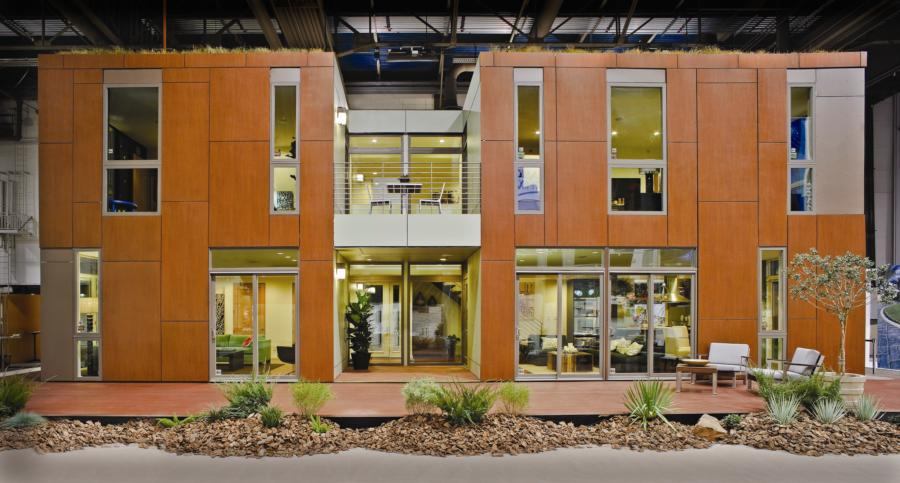
Boxes and Panels: Shipped in parts and assembled on the show floor of the Las Vegas Convention Center in just four days, the Builder LivingHome was an experiment in modular efficiency.
Credit: James F. Wilson
When Charles Darwin developed his theory of evolution, he wasn’t thinking about housing, of course. But in this, the year of his 200th birthday, you can’t help but imagine that the forces of natural selection are taking their toll on home building.
Few would argue that the industry has reached a point of reckoning. With credit in a virtual lockdown and fossil fuel reserves edging closer to extinction, home builders are adapting to new realities. The pressure is on to provide comfort and luxury in a smaller envelope, to engineer integrated, multifunctional plans and systems, and to build faster, smarter, and more economically. For many, this means rethinking how they’ve always done things.

Big Stretch: Spanning 54 feet from end to end, the Builder LivingHome is rather modest but feels plenty spacious thanks to an open floor plan with long sight lines. The designers at Color Design Art used rich accent colors on the end walls to create appealing vistas.
Credit: James F. Wilson
Far be it from BUILDER to preach and not practice, so we upended some of our own timeworn habits in preparation for this year’s International Builders’ Show. Rather than doing stick-built showcase homes on conventional lots—as has been our tradition for nearly a decade—we partnered with modular builder and developer LivingHomes, the groundbreaking architects at KieranTimberlake Associates, and the eco-minded designers at Color Design Art to create an entirely different animal.
The 2,160-square-foot concept house that made its debut on the trade show floor of the Las Vegas Convention Center in January was factory-built to LEED specifications over the course of roughly three months. Shipped as a suite of modules and panels, it arrived on site nearly 95 percent complete and was stitched together in just four days. Simple, flexible, and sustainable, it is a study in how housing may very well evolve in the not so distant future.

Of a Piece: Built to California seismic code as well as HUD requirements for transport, the house traveled to the convention center by truck as a series of boxes, plus siding, roof, wall, and infrastructure panels.
Anatomy Of A Hybrid
There’s much to be said for factory prefabrication. Framing and sheathing are not exposed to the elements before they are closed in; sequences are not waylaid by bad weather; and waste is all but eliminated by designing and pre-cutting materials to exacting specifications. Experts wager that cycle times can be shortened by as much as 30 percent, as site prep can be executed at the same time the house is being built. And modular structures are often sturdier than their stick-built counterparts because they must be engineered to withstand transport.
But prefab does have its drawbacks. “Modular construction is performed in a controlled, synchronized environment, so it can be very efficient,” says LivingHomes founder and CEO Steve Glenn. “The problem is that shipping [a box full of] air is expensive, and you have to ship out these modules and use big cranes to put them in place. Panels have an advantage over modules in that they can be shipped flat or on their sides. The downside is that panels then become substitutes for framing systems or walls. If you use SIPs, you at least have insulation in place ahead of time, but you still have to run infrastructure, ducting, and mechanicals.”

Come In: A recessed entry keeps the program simple, yet still creates a sense of place. The arrival sequence is enhanced with a simple shift in cladding colors inside the box.
Credit: James F. Wilson
So which is better? Modular or panelized? The BUILDER LivingHome combines the best of both. Manufactured by Profile Structures, the bulk of the house is made up of four steel-and-wood–framed modules (“mods”) stacked in a two-over-two configuration, plus an additional panelized wall, floor, and ceiling system that creates a third bedroom and drive-through carport. And here’s where the plan gets really interesting: The biggest energy-consuming areas—the kitchen, bathrooms, laundry, and mechanical room—are organized in a linear sequence along the back wall, and that’s no accident. It’s a move that allowed the building team to consolidate mechanical ducting, electrical, propane, and plumbing systems into flat smart panels that tilt up to form a spine along that rear wall. The result is a tight, integrated power backbone with no wasted mechanical footage and therefore very little energy lost in transmission.
“The hybrid system we’ve introduced begins with prefab core modules for the areas that require a lot of skilled labor, such as kitchens and baths, and then introduces new smart panels that integrate the infrastructure,” Glenn explains. “It’s a flexible system that allows for high-volume fabrication, assembly, and easier transportation.”

Bite Size: The kitchen is small, compact, and good-looking. The open peninsula doubles as a workspace and eating bar and even incorporates a wine fridge.
Credit: James F. Wilson
Geography Of Anywhere
The typical show home strategy goes something like this: Stake out a prime patch of turf, preferably a corner lot in a pretty neighborhood; load it up with goodies; and entice visitors to “picture yourself here.”
The BUILDER LivingHome didn’t quite follow the script. Suffice it to say the convention hall was not its final destination. (The prototype was sold following its show tour and will soon be installed in a permanent location in Newport Beach, Calif.) LivingHomes’ business model is to provide modular components in a state of near completion to eco-minded builders, developers, and home buyers who develop their own lots. The idea is for customers to envision the hip residences just about anywhere.
“We purposely designed a home that could be situated in any number of environments including a small city lot; a thin, deep lot; a long, wide lot; or a more rural setting,” explains design architect Stephen Kieran, whose firm, KieranTimberlake, has developed a suite of kit plans for the LivingHomes portfolio (of which the BUILDER LivingHome is one). “Lots of cities are developing small-lot ordinances. We kept that in mind.”

Need to Vent: Big windows and sliding doors on all sides of the house promote cross-ventilation and natural daylighting, thus reducing the need for air conditioning and artificial illumination. The area rug, by Shaw, is made of recyclable materials.
Credit: James F. Wilson
Although site constraints inevitably vary from one location to the next, the house is designed to be more or less plug-and-play, with a host of attributes that minimize the use of fossil fuels. Most rooms cross-ventilate in multiple directions, with a particular emphasis on lateral air flow, and large-scale operable glazing systems are designed to capture prevailing winds. The exteriors are set up to accommodate cantilevered overhangs and solar panels.
The interiors are no less versatile, with virtually no wasted space. Designed with the efficiency of a ship’s cabin, each zone inside the house lends itself to multiple functions. The first-floor bonus room, which adjoins a bathroom and can be closed off with a sliding pocket door, might be used as a media room, home office, studio, meditation spot, or guest suite.
The open kitchen, dining, and living area, which extends outside onto a spacious patio, is a fluid realm that can easily accommodate small gatherings or large parties. Multiple outdoor connections make the space feel bigger and integrated with its surroundings . “It’s a human perceptual thing,” Kieran says. “You really don’t want to walk into this house, shut the door, and turn on the air conditioning.”
Specifying plants and shrubs for the show presentation was a bit of a challenge, notes Robin Pendergrast, owner of Las Vegas–based Lifelike Botanicals. “I selected plant material that would balance well with the contemporary architecture, blend with the living roof, and survive on a convention show floor without the benefit of natural light,” she says. “The landscape has a casual and inviting feel that can transition into other urban area settings.”

ALL NATURAL: Textiles in earthen colors, such as this bedding by Area, complement warm wood tones in the floors, window casements, and solid interior doors.
Credit: James F. Wilson
Simple Is A Virtue
On matters of style, LivingHomes abides by the modernist mantra of form follows function. But this less-is-more philosophy is about more than the politics of aesthetics, Glenn says, particularly at a time when climate crisis, budgetary prudence, and energy efficiency are top of mind for both builders and home buyers. The fancy bump-outs, tricky roof forms, and volume spaces that epitomized the trophy homes of the housing boom have more recently come to represent longer construction cycles, costlier labor, and energy inefficiency (more dead space to heat and cool).
“We avoid superfluous materials that are there just for show and that use up extra resources unnecessarily,” Glenn says, pointing to the mod home’s clean lines and simplified building forms. “Nothing is there just for window dressing. In that regard, the contemporary approach is very relevant.”
Glenn himself lives in just such a house (his company’s very first prototype) and is betting the streamlined style will prove a winning one with some of today’s more coveted buyer segments. These include Gen Y buyers—who are expected to start hitting their prime home buying years around 2012—and “cultural creatives,” whom he describes as style-, budget-, and carbon-conscious types who are already driving Priuses and shopping for furniture at places such as Ikea and Design Within Reach. “These are people who really value design, health, and sustainability in the products they buy,” he says.

Not Sterile: This softer version of modernism feels warmer and more organic—and, of course, green.
Credit: James F. Wilson
The fact that the BUILDER LivingHome (and several other modular plan variations on the theme) are production versions of KieranTimberlake’s prototype Loblolly House—which one critic went so far as to deem “one of the most innovative and important houses of this century”—holds considerable cachet with design aficionados, he adds. It’s the next step up from buying an Eames chair or Philippe Starck light fixture.
“Loblolly was a custom home with off-site prefab components,” Kieran explains. Although there are distinct differences between the original Loblolly and the production versions (for example, the original waterfront home stands on piles and has an independent aluminum scaffold frame, whereas the Builder LivingHome sits on the ground and has a steel moment frame), the plan layout and design rationale share similar DNA.
“The idea was to productize the concept in a format that could be marketed in a middle-class price range to a populist market,” Kieran says. LivingHomes’ long-term pricing goal for the production plans fall in the $150 to $220 per square foot range, although hitting that mark will be contingent on achieving cost efficiencies through volume.

Room to Move: Color Design Art specified armless sofas, modular case goods, and an area rug by Carousel that could be easily rearranged to accommodate large gatherings. The coffee table cubes, by Livingreen, are made from recycled Napa Valley wine barrel staves.
Credit: James F. Wilson
Material Matters
Every room in this house is designed to be occupied daily. To illustrate the home’s supreme morphing capabilities, the interior designers at Color Design Art (CDA) outfitted common areas with modular furniture pieces, floating seating, and nesting tables that could be configured multiple ways.
“One initial thought we had was to go harder contemporary with the interiors, given the nature of the architecture,” says CDA principal Don Anderson, “but that seemed kind of cliché. We wanted it to feel approachable and friendly, not stark and cold. So we went with a lot of warm woods but also clean lines.”
And, in keeping with its commitment to healthier homeowners and a healthier planet, the house is appointed, head to toe, in furnishings made from salvaged, recycled, or rapidly renewable content, organic fabrics, and nontoxic paints and stains. Among the wares (most of which were provided by small start-up manufacturers with limited lines): modular coffee tables and case goods made of reclaimed wood from century-old buildings; side tables fashioned out of old railroad ties; a dining room table base comprised of scrap furniture remnants glued together with low-VOC resin; a desk chair made of vintage advertising rulers; a handwoven bamboo floor lamp; and a table and chairs made of recyclable polypropylene. Even the art on the walls is printed on cotton canvas with low-VOC inks, incorporating wood stretcher bars made from reforested trees.
Permanent finishes and fixtures were similarly selected for their sustainable virtues, as well as for time, cost, and transport advantages. A stretched fabric ceiling, for example, proved easier to ship than drywall (no cracking) and was installed on site in a matter of hours. “It has noise attenuating qualities, and you can also use it for walls, which makes it a great material for hiding mod lines,” notes Reed Walker, a project manager for LivingHomes. “It can even be screen-printed.”

Nice Play: A CDA custom-designed bunk bed/desk combo in the second-floor kid’s room was fabricated with formaldehyde-free, FSC-certified plywood. The desk chair, by Viva Terra, is made out of vintage advertising rulers.
Credit: James F. Wilson
Equally significant is the home’s exterior cladding—an eco-friendly, UV-protected biocomposite of resin, sawdust, and laminate, which comes in 4-foot-by-8-foot siding panels that can be ripped, length-wise, to accommodate varying window sizes. Shipped flat (in sections) and then easily reassembled on the show floor, this panelized skin serves as the top layer of a RainScreen system that allows the house to breathe. Its staggered application not only makes for an interesting geometric pattern, but it also cleverly hides the horizontal mod seams between floors.
“We are getting to the point now where if you don’t see the mod lines, you can’t necessarily tell that a house is modular,” Walker says. And it’s getting easier and easier to be green without sacrificing quality or aesthetics.
Is this the wave of housing’s future? “I’m not sure,” he says. “But it should be.”
The Stuff that Green is Made Of
Founding Sponsors
Andersen Windows & Doors(windows and doors) www.andersenwindows.com
Whirlpool Corp.(major appliances) www.insideadvantage.com
Premier Sponsors
Kohler(plumbing fixtures and accessories) www.us.kohler.com
KraftMaid(cabinets and millwork) www.kraftmaid.com
Underwriting Sponsors
DuPont(quartz surfacing) www.countertops.dupont.com
Klip BioTechnologies(exterior siding) www.kliptech.com
Propane Education & Research Council(propane energy) www.buildwithpropane.com
Tyco Fire Suppression & Building Products(home fire sprinkler system) www.tyco-rapidresponse.com
Participating Sponsors
Beam Central Vacuums by Electrolux (central vacuum) www.beam.com
Broan Nu-Tone(ventilation products) www.nutone.com
Crossville(tile products) www.crossvilleinc.com
Eaton Corp.(electrical distribution systems) www.eaton.com
Ford Motor Co.(pickup truck) www.ford.com
Generac Power Systems(back-up generator) www.generac.com
Goodman Manufacturing Co.(HVAC equipment) www.goodmanmfg.com
Energy Saving Products(air distribution and indoor air quality management) www.hi-velocity.com
iLevel by Weyerhaeuser(structural framing) www.ilevel.com
Lyptus by Weyerhaeuser(wood flooring) www.lyptus.com
Owens Corning(insulation) www.owenscorning.com
Rinnai Corp.(tankless water heaters) www.rinnai.us
The Sherwin-Williams Co. (coatings) www.sherwin-williams.com
Therma-Tru Doors(entry-door system) www.thermatru.com
Typar Weather Protection System(housewrap) www.typar.com
Uponor(water distribution system) www.uponor-usa.com
Donors
Area (accent pillows and bedding accessories) www.areahome.com
Carousel (area rug) www.carouselcarpet.com
CEMCO Steel (galvanized rainscreen furring) www.cemcosteel.com
Circle City Roofing(green roof installation) www.circlecityroofing.com
Clipso Technical Fabrics (stretched fabric ceiling) www.clipso.com
Dynamic Plumbing(plumbing installation) www.dynamic-plumbing.com
Florasource(green roof) www.florasourceltd.com
Forecast Lighting(recessed lighting) www.forecastltg.com
Hoppe North America(door hardware) www.us.hoppe.com
Humabuilt (interior doors) www.humabuilt.com
The Krux Co. (home automation) www.kruxhomes.com
Lightolier (decorative lighting) www.lightolier.com
Livingreen (accessories and furniture) www.livingreen.com
Masland Carpets (area rug) www.maslandcarpets.com
Merida (area rug) www.meridameridian.com
Milk Design (stairs and railings) www.milkdesign.net
Open Energy Corp. (inverter for solar electric system) www.openenergycorp.com
Pindler (fabric) www.pindlercorp.com
Plexi Gallery (framed photos and accessories) www.theplexigallery.com
Shaw (area rug) www.shawfloors.com
Simpson Strong-Tie (joist hangers and hold-downs) www.strongtie.com
Sliding Door Co. (interior pocket doors) www.slidingdoorco.com
Stone Etc. (tile installation and quartz countertop fabrication) www.stoneetcinc.com
Strini Art Glass (custom light fixture) www.striniartglass.com
Suntech Energy Solutions(photovoltaics) www.suntech-power.com
Thorpe Design (fire sprinkler installation) www.thorpedesign.com
Trex Co. (exterior decking) www.trex.com
Viva Terra (tables, chairs, and bath accessories) www.vivaterra.com
Mod Squad
Builder and construction drawings: LivingHomes, Santa Monica, Calif.
Design architect: KieranTimberlake Associates, Philadelphia
Manufacturer: Profile Structures, Santa Fe Springs, Calif.
Interior designer: Color Design Art, Culver City, Calif.
Landscaping: Lifelike Botanicals, Las Vegas
The team: Steve Glenn, CEO, LivingHomes (above); James Timberlake and Stephen Kieran, partners, KieranTimberlake Associates (left); Don Anderson, principal, Color Design Art (center); Ed Feser, president, Profile Structures (right).