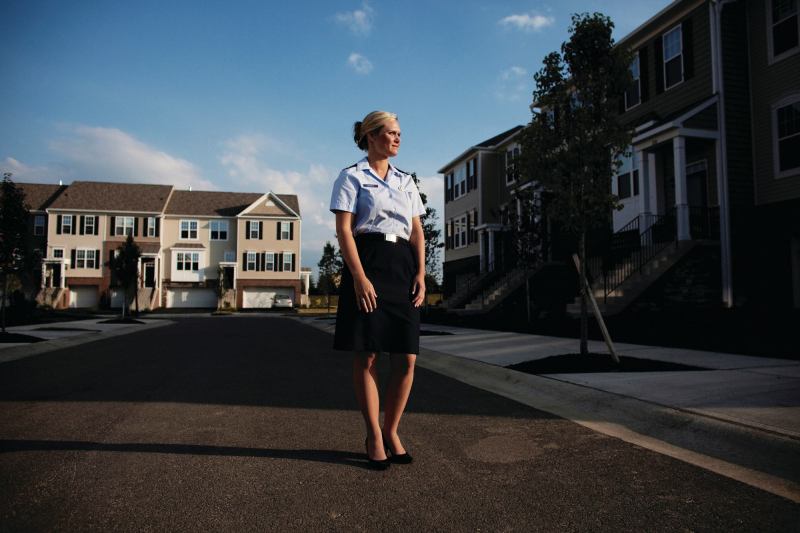
Woman’s Intuition: Part-time Air National Guard reservist Kristen Wenrick, 26, looked for six months and used her VA loan to buy her Columbus, Ohio, townhouse from M/I Homes.
Credit: Matt Eich
Twenty-four-year-old Jonathan Hong is a member of the Millennial generation, and he represents the type of buyer that could make builders very happy in the very near future.
An electrical engineer, Hong bought his first home in 2008 just one year out of college. “I didn’t see the need for a condo or an apartment,” Hong says. “I wanted something not too big and not too small, so I thought a townhouse would be perfect for me. Truth be told, I wasn’t thinking about location. I think cost played a big factor.”
With married couples becoming a smaller share of the home buying population and unmarried-partner, single-parent, and single-person households increasing, the Millennial generation is emerging as a heavyweight in housing. By the sheer force of their numbers—which is reportedly between 80 million and 90 million—Millennials (also referred to by the less popular Generation Y) are poised to change the home buying and building landscape. Builders, developers, and real estate professionals who ignore this group do so at their peril.
“Real estate agents may wonder why they should care about the Generation Y age group, ages 18 to 30,” Jessica Lautz, a senior research analyst at the National Association of Realtors, wrote on the organization’s website in 2008. “These unique home buyers are the youngest of the home buying segment and are the most likely to purchase a home in the next two years in comparison to any other age group.”
“The bulk of this group right now is in college,” says Shyam Kannan, vice president and director of research and development at Bethesda, Md.–based Robert Charles Lesser & Co. (RCLCO), a consulting firm to the home building and development industry. “Let’s assume they begin to graduate from college in 2010, 2011, roughly about when they turn 22, and they rent for two to three years. They’ll start hitting the home buying market in 2013, and by 2015 they’re in the peak time for home buying. Just in terms of numbers, this group is hugely important.”
Boomer Babies
According to NAS Recruitment Communications, a Cleveland-based human resources research firm, Millennials include individuals born between 1977 and 1994 (though some demographers mark the dates from 1982 to as late as 2003). “The largest generation since the Baby Boomers, the Millennials are defined by their numbers,” the group writes in its report “Generation Y: The Millennials—Ready or Not, Here They Come.” “They will have a huge social and economic impact.”
The good news for builders is that Millennials favor homeownership and believe in its importance in wealth creation. Earlier this year in its national “Gen Y Survey,” The Concord Group found that respondents overwhelmingly see real estate as a good financial investment. “Sixty-two percent view wealth creation and 52 percent view retirement investment as ‘very big advantages’ of owning real estate,” the group says.

No Man’s Land: Jonathan Hong, 24, bought his first home almost one hour from Washington, D.C., but now he wants to live in the city.
Credit: Jonathan Hanson
Despite this large pool of future buyers and their positive view of homeownership, the prospects for capturing their sales may not be as easy as it sounds. Millennials, it turns out, don’t behave like their Boomer parents, and it appears they will not seek the same type of housing solutions.
“What [Millennials] are indicating is that they’re making very different decisions than their parents,” Kannan says. “They are choosing lifestyle over work style. They’re the ones that are likely to choose a home based on their ability to canoe on the weekends, if that’s what they do. They’re also choosing transit and close-in locations much more than their parents did.”
Hong, for example, bought his new house from NV Homes in Frederick, Md., which is a 10-minute drive from his job in Germantown, Md. “That’s the one good thing about the house,” he says. “I didn’t want anything more than about a half-hour commute and that’s what I got.”
But Frederick, Md., also is 45 miles from the vibrancy and nightlife of Washington, D.C., and that has been a problem. “I wanted to stay within a [price] range that was comfortable for me, and I didn’t mind the location at first,” says Hong, a graduate of the Georgia Institute of Technology in Atlanta. “Going from a city environment in college, I didn’t want to be in the city when I moved. But as I started living [in Frederick], I realize the city might have been a better choice for me.”
Location, Location
It’s not surprising that Hong now yearns for the city. Demographers say Millennials generally prefer urban locations or at least denser environments to the suburbs. In an RCLCO survey of Millennials, about 33 percent of the respondents indicated that they would be willing to buy small-lot single-family detached homes, and similar percentages indicated that “they’d be willing to trade off and go into a townhouse or condo if it offered the location they wanted,” Kannan says. “The issue is that while product isn’t irrelevant, product is now less important than place.”
Young buyers don’t all think alike, of course, but the urge for members of this group to live in urban locations or close to activities that they enjoy is a strong one. The desire is certainly important for Lina (24) and Stefan (31) Schneider, who rent an apartment in the resurgent downtown of Silver Spring, Md. “Everything is close by,” says Stefan, who is accustomed to density in his native Vienna, Austria. “The metro is one block away, it’s close to downtown and restaurants, and we can walk everywhere.”
But the Schneiders are facing a conundrum. They’re looking to buy a townhouse in their neighborhood, with a basement and enough space for Lina, an artist, to paint and sculpt. But prices are high, and the couple does not want to move too far away. “I don’t want to drive more than a half hour to get to work,” says Stefan, vice president of finance and treasury at Frequentis USA in Columbia, Md. The couple has expanded its search to about four miles out in the suburbs, but they don’t want to go any farther and are prepared to continue living in their apartment until they find what they want. “We are happy to stay where we are because we like [the building and neighborhood] a lot,” Stefan says.
Brave New World
-
Community and energy efficiency top their lists of priorities.
-
But where builders and their products fit into that vision differs for each buyer group.
-
By 2011, half of all homeowners will be over 50. But the current housing landscape doesn't necessarily provide what they want -- or need.
-
Millennials make up almost a third of the U.S. population, and they will fundamentally change how you do business.
Location has always been the key in real estate, but it’s even more of a driver for Millennials. And ideal locations need not be in downtown urban cores. Suburban-based density is just as attractive to some buyers, demographers and builders say.
“There are going to be people who want to live near where their life revolves,” says Bill McDonough, chief marketing officer for M/I Homes in Columbus, Ohio. “And for many, that’s going to bring them back into proximity to urban living.” McDonough says this type of development is promising because many businesses, transportation hubs, and commercial areas already have moved out of cities. “The axiom of location, location remains,” he says, “but as centers of living continue to morph into new places around cities, people are looking for their homes there.”
The data seems to support McDonough’s theory. In The Concord Group’s 2009 “Gen Y Survey,” lifestyle (52 percent) and employment (49 percent) were the top reasons respondents chose their current location, and proximity to employment was the No. 1 factor (24 percent) why respondents will choose their next residence. Transportation also was important. “Eighty-one percent responded that it’s ‘very or somewhat important’ to live near alternative modes of transit.” It also showed that 67 percent would pay a premium to live closer to alternative modes of transit in their next residence.
Ladies’ Choice
A subset of the Millennials that builders also should get to know is its female buyers. Demographic data shows that by 2010 households headed by a woman will be well over 30 million, and many are buying their own homes. About two years ago, M/I Homes noticed the phenomenon.
“[Millennials] are buying homes earlier in their lives than any generation before them, and women are really the driver,” says McDonough.
Female respondents in RCLCO’s survey indicated “a strong preference” for the city and “are much more likely to choose what we call ‘safe urbanism,’” says Kannan. “Safety is very important to them, but they want to be able to walk to shopping and dining.”
This squares with what Rebecca Safford was looking for when she was shopping for a home. “Location was probably the No. 1 thing anytime I looked for a place to rent or buy,” says the 31-year-old graduate student and academic advisor at the University of Arizona in Tucson. “I’ve always lived downtown or close to the university. That’s important to me.”
Ultimately, Safford moved in with her then-boyfriend Scott into his studio in the Ice House Lofts, an adaptive reuse project by architect/developer Rob Paulus who is known for edgy urban infill projects in the Tucson area. When the now-married couple needed more space, they sold the studio and bought a 1,300-square-foot, one-bedroom in the same development. “The Ice House is wonderful because it’s an old historic building that was gutted and redone on the inside so it’s perfect,” Safford says.
There are many reasons Rebecca likes her home, but because she lives a hectic life she especially likes the fact that it has surfaces and finishes that are easy to clean—important features for many female buyers. She also likes the modern interiors and the focus on energy efficiency.
“We specifically did not look at demographics as much as we looked at psychographics [when we were developing Ice House],” says Randi Dorman, a partner in R&R 17th St. LLC, which developed the project. “What was interesting is that different parts of the building dictated the size of the units, but because they range from 621 square feet to 2,344 square feet it opened us up to a wide range of demographics.”
“Everything we did was based on light and space and proportion,” Paulus explains. “We had the opportunity to create more bedrooms, but we opted not to do that, which was a huge design decision to create this more open lofty feel.”
The Ice House developers may not have been targeting women or Millennials consciously, but they inadvertently did so with edgy design, open loft-like interiors, and other features that are attractive to these groups. KRDB in Austin, Texas, attracts a large share of young buyers for the same reasons, says architect/developer Chris Krager. “It’s more of an intuitive thing,” he explains. “We focus on affordability, modern design, and energy efficiency.” He continues, “We’ve had people from across the spectrum, but when we look at the kinds of inquiries and interest we get, it’s definitely younger buyers.”
Architectural features and design are important to young buyers, especially for WINKS (women with income and no kids) who “need places for hobbies, activities, and working from home,” the RCLCO research concludes. “Architectural details within indoor living areas can provide subtle articulations suitable for suggesting reading nooks, yoga corners, and laptop crevices.” The RCLCO report continues, “Meticulous attention to design will be necessary [to capture the attention of these buyers]. For example, a focus on height and light can help smaller urban homes live larger.”
Sensing a shift in the gender and age of its buyers, M/I Homes is responding with new house designs to meet this audience. “When we design homes today we are looking at who the buyer is, and we are looking at affordability,” says Dan O’Malley, vice president of product development. “We want to make sure that the houses we create are attainable with the way the [economic] situation is today.”
Earlier this year, M/I announced the “eco series” line of smaller-footprint, efficiently designed, economically priced, and ecologically smart homes that will appeal to Millennials and women. “My first goal with these houses was to unclutter the plan,” O’Malley explains. “I start taking out the redundant spaces, and the net result is a floor plan that leaves in the high- value spaces.”
The Novare Group, an Atlanta-based developer of urban mixed-use high-rise condos, attracts young buyers because of its built-in hook (location), but development manager Marc Bramburt says the company still works hard to attract this demographic. “One of the things we do is invest a lot of money in the common areas and in amenities, which include elaborate club rooms and fitness centers,” he says. “Technology is another area where we differentiate ourselves.”
Novare uses an intranet system called HALO that allows residents to, among other things, access HOA information, request assistance from the concierge, or submit maintenance requests. “We also have [Internet-enabled] thermostats, which allow residents to configure their system from the Internet or from a Blackberry,” Bramburt adds.
So what should other builders and developers be doing to attract the coming wave of educated, young buyers? “We’ve been telling builders to go back to the drawing board,” Kannan explains. “The real estate industry is notoriously slow to adapt to change, and we’ve been advising our builder and developer clients that the old models that worked very well for them through the 1980s and 1990s ... are not models that represent the growth in the industry.
“If they haven’t done so already,” Kannan continues, “builders and developers need to get over the pain and suffering of learning to build infill mixed-use.”